ByMax Lee
Hawaii’s $16 Late Vehicle Registration Fee Explained
Hawaii’s $16 annual flat rate penalty for late vehicle registration renewal catches many drivers off guard. It’s a fixed fee that kicks in the day after your registration expires, and it doesn’t matter if you’re one day late or 364, the first year still costs $16. This penalty is unique to Hawaii and applies uniformly across all counties.
The rule is tied to your birthday, not the calendar year, which confuses even long-time residents. As of 2026, the fee remains $16 per year overdue, with no grace period.
Bing (Web (fair-use with source credit))
Quick Answer
Hawaii charges a $16 annual flat rate penalty for late vehicle registration renewal. It applies per full year overdue. The fee is the same in Honolulu, Maui, Kauai, and Hawaii County.
You pay it when you finally renew, not when you’re pulled over.
How the Penalty Works in Real Terms
The penalty is simple: $16 for each full year your registration is late. If your tags expired on your birthday in March 2024 and you renew in June 2025, that’s one full year late. You’ll owe $16 on top of your standard renewal fees.
It doesn’t compound monthly or daily. Whether you’re 1 day late or 364, the first year is still $16. After that, each additional full year adds another $16.
There’s no cap, so leaving it for 5 years means $80 in penalties alone.
This is separate from your county’s vehicle property tax, which is based on weight and value.
Who Gets Hit with the $16 Fee and When
Every Hawaii-registered vehicle owner faces this penalty if they miss their renewal deadline. The deadline is tied to your birthday, not the vehicle’s model year or purchase date. If your birthday is July 15, your registration expires on July 15 every year.
Military personnel stationed in Hawaii with locally registered vehicles follow the same rule. Out-of-state residents with Hawaii-registered cars aren’t exempt either. The penalty applies the day after expiration, with no warnings or grace periods.
New residents often get tripped up. Hawaii doesn’t prorate registrations from other states, so you’ll need to register immediately and may still owe penalties if you drive on expired out-of-state tags.
The Birthday Rule: Why Your Renewal Date Isn’t What You Think
Hawaii uses a birthday-based system for registration renewals. Your vehicle’s registration expires on your birthday every year, regardless of when you first registered it. This is different from many states where registrations expire annually on the same date.
If you bought a car in December but your birthday is in May, your first renewal is still due the following May. The system is designed to spread renewals evenly throughout the year, but it can be confusing if you’re used to other states’ methods.
Bing (Web (fair-use with source credit))
This rule means you can’t time your renewal to avoid the penalty. Whether you renew early or late, the deadline is always your birthday. The Hawaii Department of Transportation confirms this structure on their official site.
How the Penalty Stacks (and How to Calculate What You Owe)
Calculating your penalty is straightforward. Count the full years between your expiration date and renewal date, then multiply by $16.
For example:
- Expired March 1, 2024, renewed March 15, 2025 = 1 year late = $16
- Expired March 1, 2024, renewed April 1, 2026 = 2 years late = $32
- Expired March 1, 2024, renewed February 28, 2025 = 0 years late = $0
Partial years don’t count. Even if you’re 364 days late, it’s still just one full year. The penalty only increases after you cross into the next full year.
What Happens If You Drive on Expired Tags
Driving with expired registration in Hawaii is illegal. You risk a traffic citation on top of the $16 annual penalty. Police can pull you over solely for expired tags, and the fine for that infraction is separate from the late renewal fee.
The penalty itself doesn’t trigger a citation. It’s only assessed when you finally renew. But driving unregistered means you’re breaking the law every mile until you fix it.
Wikimedia Commons / Riley from Christchurch, New Zealand (CC BY)
If you’re stopped, you’ll likely get a ticket for operating an unregistered vehicle. That’s in addition to the $16 per year you’ll still owe when you renew.
Step-by-Step: How to Renew Late and Pay the Penalty
First, check your renewal notice or look up your registration online. Each county has its own portal: Honolulu, Maui, Kauai, and Hawaii County all handle renewals separately.
Gather your documents. You’ll need your current registration, proof of insurance, and a valid emissions certificate if your vehicle requires one. Most gasoline vehicles need a biennial emissions test.
Bing (Web (fair-use with source credit))
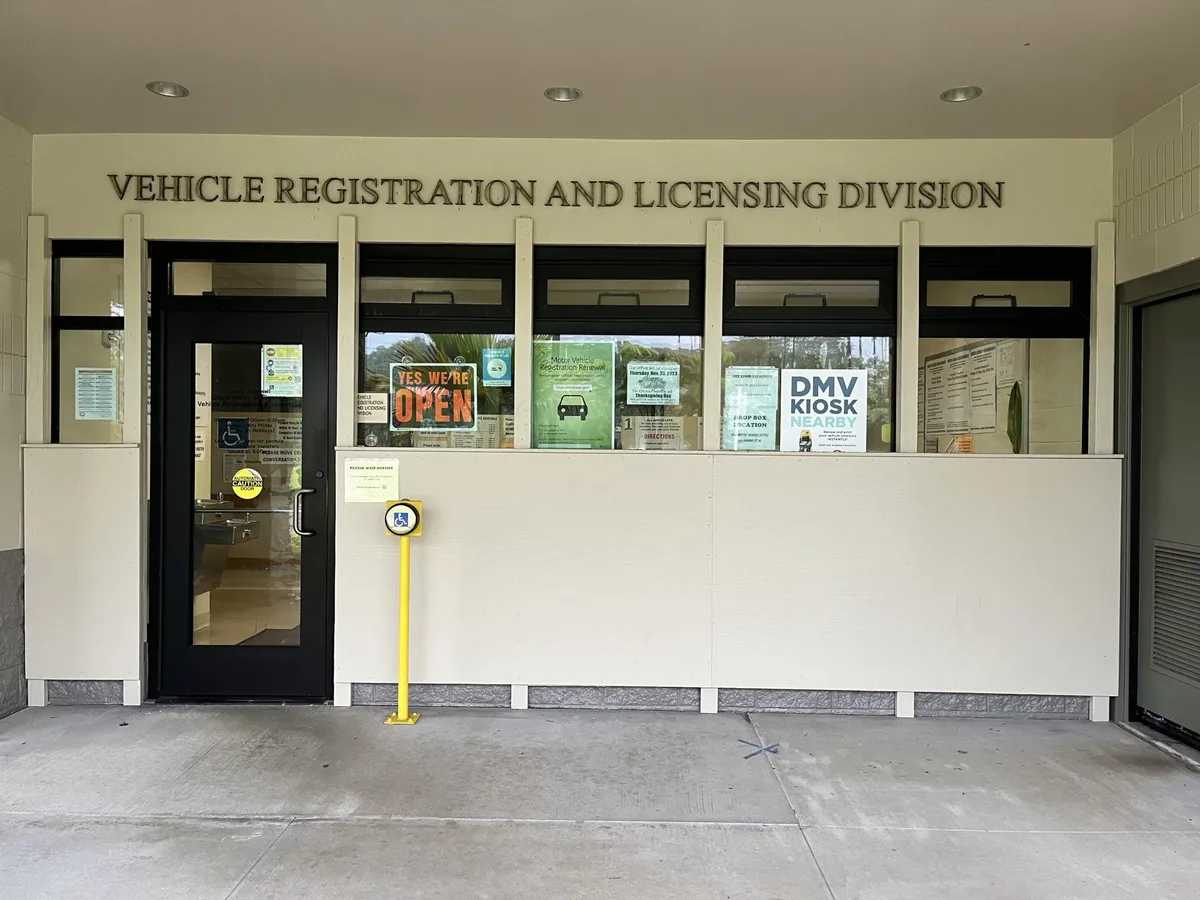
Pay your fees. The system will automatically calculate the $16 per year penalty. You can pay online, by mail, or in person at a county DMV office.
County-by-County Differences You Need to Know
All counties charge the same $16 annual penalty. But their base registration fees and property taxes differ. Honolulu, for example, has higher weight-based taxes than Kauai.
Processing times vary too. Some counties issue new stickers immediately online. Others may mail them within a week.
Check your county’s specific rules before you start.
The renewal portals look different. Honolulu’s is the most user-friendly, while rural counties may require in-person visits for certain cases.
Common Mistakes That Cost Hawaii Drivers Extra
Many drivers assume there’s a grace period. There isn’t. The penalty starts the day after expiration.
Others forget the birthday rule. If your birthday is in December but you registered in June, your renewal is still due in December. Missing it triggers the fee.
Some try to renew without a current emissions certificate. The system will block you until you upload a valid one. That delay can push you into another penalty year.
How to Avoid the Penalty Next Time
Set a calendar reminder for your birthday. That’s your renewal deadline every year.
Sign up for email or text alerts if your county offers them. Most do, and it’s the easiest way to remember.
Renew early. You can typically renew up to 90 days before your birthday without penalty. There’s no downside to getting it done ahead of time.
The Penalty vs. Other Fees: What’s Separate and What’s Bundled
The $16 annual penalty is just for late renewal. It’s separate from your county’s vehicle property tax, which is based on your car’s weight and value. Both fees appear on your renewal bill, but they serve different purposes.
You’ll also pay the standard registration fee, which varies by vehicle type. Motorcycles, passenger cars, and commercial vehicles have different base rates. The penalty doesn’t replace these, it just gets added on top.
Some drivers confuse this with emissions testing fees. Those are separate too. You pay for the test at the inspection station, then the renewal portal verifies compliance before letting you proceed.
When to Double-Check Before You Pay
Always verify your expiration date. The birthday rule means it’s easy to miscalculate. Log into your county’s portal to confirm the exact due date.
Check your emissions status. If your test is expired, the system won’t let you renew. You’ll need to get a new certificate first, which could push you into another penalty year.
Review your address. If you’ve moved, update it with the county first. Renewal notices go to the address on file, and missing one could mean missing your deadline.
Official Sources to Verify Your Penalty
The Hawaii Department of Transportation oversees the state’s vehicle registration laws. Their site explains the birthday rule and penalty structure.
Each county’s finance or DMV department handles the actual renewals. Honolulu’s site is the most detailed, with a clear fee calculator. Maui, Kauai, and Hawaii County have similar tools.
For legal specifics, refer to Hawaii Revised Statutes Chapter 286. Section 42 outlines the late penalty provisions.
The Penalty vs. Other States’ Late Fees
Hawaii’s flat $16 annual penalty is simpler than many states’ systems. California, for example, charges a percentage of your registration fee plus a fixed amount. That can add up quickly for expensive vehicles.
Texas has a more complex structure. Their late fee is 5% of the registration fee for the first 30 days, then increases. After 90 days, it jumps to 20%.
Hawaii’s approach is more predictable. You know exactly what you’ll owe: $16 per year late. There’s no percentage-based surprise when you finally renew.
Frequently Asked Questions
Does the penalty apply to motorcycles?
Yes. Motorcycles follow the same $16 annual flat rate penalty for late registration renewal. The only difference is their base registration fee, which is lower than for passenger cars.
Can I get the penalty waived?
No. Hawaii doesn’t offer waivers for the late renewal penalty. The only way to avoid it is to renew on time.
What if I never received a renewal notice?
You’re still responsible. Hawaii law requires you to renew on time regardless of whether you received a notice. The birthday rule makes it easy to track your deadline.
Does the penalty reset if I move counties?
No. The penalty is tied to your registration expiration date, not your county. If you move from Honolulu to Maui, your deadline stays the same.
Can I renew without paying the penalty?
Only if you’re not late. Once your registration expires, the $16 per year penalty applies. There’s no way around it.