ByMax Lee
Car Wash Fundraiser: Tips for Maximum Success
YouTube / City of Columbia (YouTube thumbnail (fair-use with source credit))
A car wash fundraiser can raise serious money for your cause, but most groups leave hundreds of dollars on the table. The difference between a $500 day and a $2,000 day comes down to three decisions you make before the first car pulls in.
Per industry benchmarks, a well-run event with 15 volunteers in a high-traffic spot can wash 200 cars at $15 each, clearing $2,000 after supplies. Get any of those variables wrong and profits shrink fast.
Quick Answer
A car wash fundraiser is a volunteer-run event where drivers pay for a wash to support a cause. Groups typically charge $10, $25 per car. A team of 10, 15 can net $1,000, $3,000 in a single day.
Success hinges on location, workflow, and pricing.
Why Most Car Wash Fundraisers Fail to Reach Their Goals
The biggest mistake is picking a spot with no foot traffic. A quiet side street might feel easy to set up, but it won’t bring in cars. You need a location where drivers already stop, like a grocery store or gas station.
Another failure point is poor workflow. If cars stack up because drying takes too long, customers leave. The best setups move vehicles through in under 10 minutes.
Without a system, you lose momentum and money.
The Three Critical Decision Points: Location, Model, and Pricing
Location: Traffic vs. Permits vs. Water Access
Traffic is king. A spot with 500 cars passing hourly can out-earn a low-traffic area with perfect permits. Look for grocery stores, big-box retailers, or busy intersections.
Avoid residential streets where neighbors might complain.
Permits are non-negotiable in many cities. Some require a temporary business license, others a water runoff permit. Check with your local city hall or chamber of commerce.
Water access decides your model. If you have a hose hookup, you can do full washes. No water?
You’re limited to waterless products or a bucket brigade. Either way, confirm drainage rules. As of 2026, most municipalities ban soap runoff into storm drains.
YouTube / askHRgreen (YouTube thumbnail (fair-use with source credit))
Model: Self-Service vs. Full-Service vs. Mobile
Self-service means drivers wash their own cars with your supplies. It’s low labor but lower profit, since customers do the work. Best for small teams or tight budgets.
Full-service is the classic fundraiser. Volunteers handle everything from soaping to drying. It commands higher prices but needs more hands.
Aim for at least one volunteer per two cars per hour.
Mobile flips the script. You bring the wash to customers at their homes or offices. It’s great for upscale neighborhoods but harder to scale.
You’ll need a truck, water tanks, and a generator.
Pricing: Flat Rate, Suggested Donation, or Tiered Add-Ons
Flat rate is simplest. Charge one price, say $15, and wash every car the same. Easy for customers, easy for cashiers.
Works best when speed is the priority.
Suggested donations let supporters pay what they want. This can boost goodwill but may leave money on the table. Use it only if your cause has strong community backing.
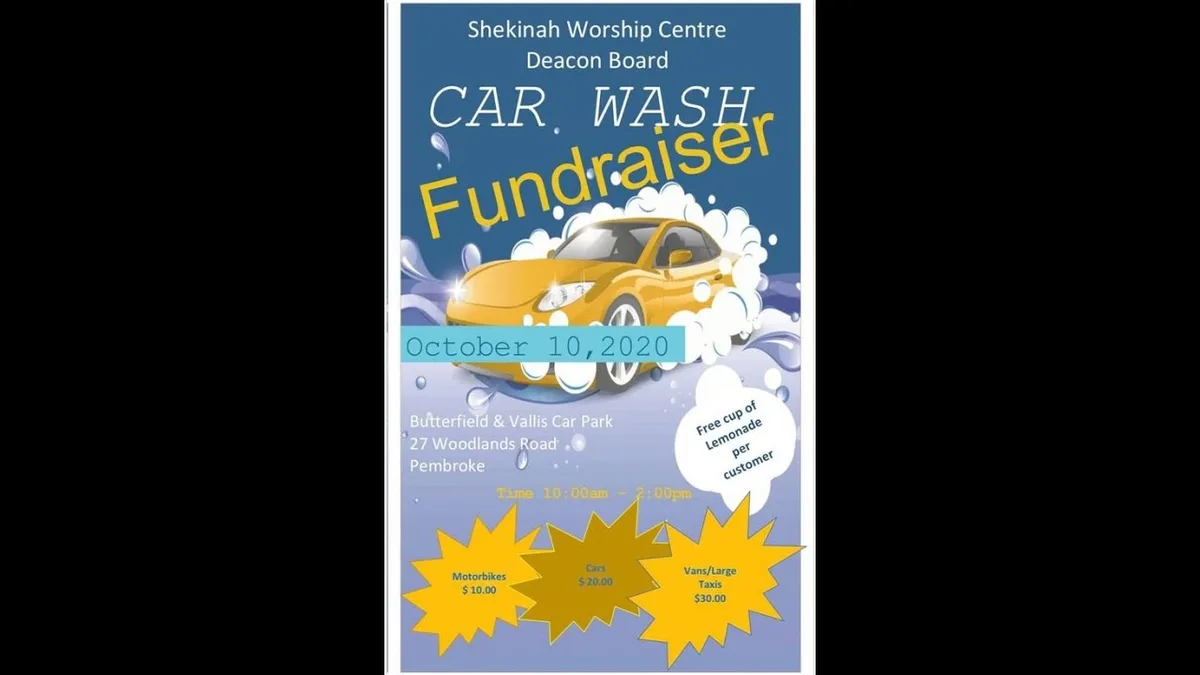
Tiered add-ons maximize revenue. Base wash at $10, then offer $5 for tire shine, $5 for interior vacuum. This can lift average revenue per car by 30, 50 percent.
YouTube / Dr. Maria Seaman (YouTube thumbnail (fair-use with source credit))
Step-by-Step Workflow: From Planning to Cleanup
Start with a date. Weekends in spring or summer draw the most cars. Avoid holidays or local events that pull traffic elsewhere.
Secure your location next. Get written permission from the property owner. Confirm water access and electrical outlets if needed.
Mark the area with cones and signs the day before.
Recruit volunteers early. Assign roles: greeters, washers, dryers, cashiers. A good ratio is two washers, one dryer, and one cashier per lane.
Rotate shifts to keep energy high.
Set up stations in order: pre-soak, wash, rinse, dry. Place a trash can and recycling bin at each. Keep a first-aid kit and phone handy for emergencies.
During the event, direct traffic smoothly. Have one person guide cars into the wash area and another manage the exit. Use hand signals and clear signage to avoid confusion.
For cleanup, dispose of wastewater properly. Sweep up debris and return the area to its original condition. Thank volunteers with a quick debrief and share the total raised.
Volunteer Setup: How Many People You Need and Where to Put Them
A team of 10 can handle 100, 150 cars in a 6-hour day. Add more volunteers if you expect higher volume. Assign roles based on skill and stamina.
Washers need the most people. They do the heavy lifting. Two to three per lane keeps the line moving.
Dryers should be quick and thorough. One per lane is usually enough.
Cashiers must be organized. They handle money, receipts, and change. Place them at the exit so drivers pay after the wash.
Greeters at the entrance keep the flow steady.
Have a float person to cover breaks and help where needed. This keeps the operation running smoothly even when someone steps away.
Supply and Equipment Checklist (Don’t Overlook These)
You need more than soap and water. A basic kit includes buckets, sponges, microfiber towels, and a pressure washer if available. Skip the cheap sponges that can scratch paint.
YouTube / askHRgreen (YouTube thumbnail (fair-use with source credit))
Stock up on car-safe soap. Dish soap strips wax and damages finishes. Biodegradable options meet most local environmental rules.
Don’t forget the small stuff. Trash bags, a first-aid kit, and a cash box with change are easy to overlook. A megaphone helps direct traffic in noisy areas.
You need more than soap and water. A basic kit includes buckets, sponges, microfiber towels, and a pressure washer if available. Skip the cheap sponges that can scratch paint.
YouTube / askHRgreen (YouTube thumbnail (fair-use with source credit))
Stock up on car-safe soap. Dish soap strips wax and damages finishes. Biodegradable options meet most local environmental rules.
Don’t forget the small stuff. Trash bags, a first-aid kit, and a cash box with change are easy to overlook. A megaphone helps direct traffic in noisy areas.
Common Mistakes That Cut Profits in Half
Underpricing is the most common error. Charging $5 might attract cars but won’t cover costs. Aim for at least $10 to $15 per wash in most markets.
Poor signage loses customers. If drivers can’t see your prices or entrance from the road, they’ll keep going. Use large, bold signs with clear arrows.
Ignoring safety risks invites trouble. Wet floors cause slips. Electrical cords near water are a hazard.
Assign one person to monitor for dangers.
Legal Must-Knows: Permits, Insurance, and Water Runoff Rules
Most cities require a permit for fundraising car washes. Fees range from $25 to $100. Some waive them for nonprofits but still need an application.
Insurance protects you from liability. A general liability policy covers accidents or damage. Check if your organization’s existing coverage applies.
Water runoff is a big concern. Soapy water can’t go into storm drains in most areas. Use a containment system or wash on grass where the ground can absorb it.
Realistic Profit Benchmarks: What You Can Expect
A small event with 5 volunteers might wash 50 cars at $10 each. After $100 in supplies, that’s $400 profit. Not bad for a few hours of work.
A medium event with 15 volunteers can handle 200 cars at $15. Supplies cost around $300. Profit lands near $2,700.
Large events with 25 volunteers and premium services can hit 300 cars. At $20 per wash with $500 in costs, you’re looking at $5,500 profit.
Decision Guide: Pick the Right Combination for Your Group
If you have a small team, stick with self-service. It’s lower effort and still profitable. Focus on a high-traffic spot to make up for the simpler model.
For medium groups, full-service is the sweet spot. You can charge more and move cars quickly. Just ensure you have enough volunteers for each station.
Large groups should consider mobile or tiered pricing. These models scale well with more hands. They also justify higher prices for premium services.