ByMax Lee
Guide to Arizona Aggressive Driving Statute Definitions
If you've been pulled over and handed a citation for aggressive driving in Arizona, you're probably trying to figure out what that actually means. The Arizona aggressive driving statute definitions are more specific than most people guess. This isn't just a moving violation you can pay by mail.
It's a criminal misdemeanor.
Under Arizona Revised Statutes Section 28-695, aggressive driving requires two separate traffic violations committed at the same time with an intent to create an immediate hazard. As of 2026, that remains the legal standard law enforcement uses. Let's walk through exactly what qualifies and what happens if you're cited.
Bing (Web (fair-use with source credit))
Quick Answer
Arizona's aggressive driving statute (ARS § 28-695) defines aggressive driving as intentionally committing two or more moving violations simultaneously that create an immediate hazard to others. It is a criminal misdemeanor. A first offense carries up to six months in jail and a $2,500 fine.
A second offense within 24 months triggers a mandatory license suspension. Aggressive driving is different from reckless driving under ARS § 28-693.
What Exactly Is Arizona's Aggressive Driving Law? (ARS § 28-695)
Arizona lawmakers created ARS § 28-695 to target drivers who intentionally endanger others. The law doesn't cover a single mistake or a moment of distraction. It requires a pattern of deliberate behavior that puts people at risk.
The statute breaks down into three key elements:
| Element | What It Means |
|---|---|
| Intentional act | You acted on purpose, not by accident |
| Two or more violations | You committed at least two traffic violations at the same time |
| Immediate hazard | Your actions created a real, direct danger to someone else |
If any one of these elements is missing, you likely don't qualify for an aggressive driving charge. A single act of speeding or one quick lane change, even if unsafe, is usually a civil traffic violation, not a criminal aggressive driving charge.
The statute also requires criminal intent. That doesn't mean you planned to hurt anyone. It means you consciously chose to drive in a way that violated traffic laws and put others at risk.
The prosecutor has to prove you acted intentionally, not just negligently.
The Two-Violation Requirement — Why Most People Don't Qualify
This is the part of the law that surprises most Arizona drivers. You cannot be charged with aggressive driving for one violation alone. Even extreme speeding by itself doesn't meet the threshold.
You need two separate violations happening at the same time.
Here's what that looks like in practice:
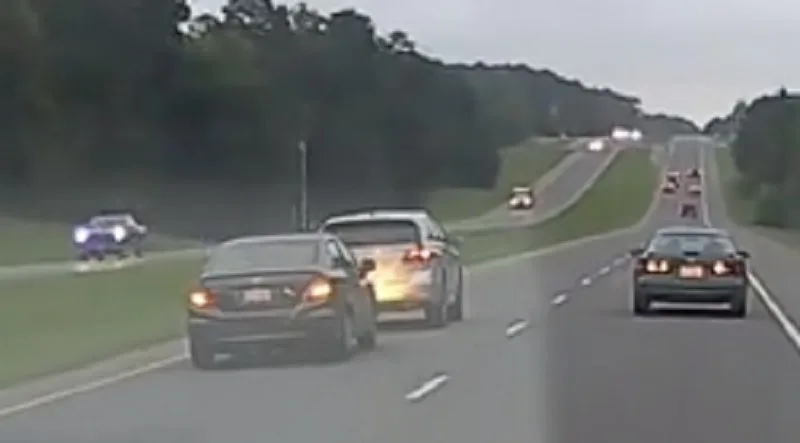
- Speeding while tailgating the car in front of you
- Weaving through traffic while failing to signal lane changes
- Running a red light while passing another vehicle
- Driving on the shoulder while exceeding the speed limit
Each of those examples pairs two distinct violations into one act. If you're only speeding, even at 30 mph over the limit, that's a criminal speeding charge under a different statute, not aggressive driving.
This two-violation requirement is unique to Arizona. Many other states charge aggressive driving for any single reckless action. Arizona's legislature wrote the law specifically to target the most dangerous driving behaviors.
Law enforcement officers know this distinction well. If they write you a citation for aggressive driving, they have to articulate two clear violations in their report.
Bing (Web (fair-use with source credit))
Aggressive Driving vs. Reckless Driving: The Critical Difference
People often use these terms interchangeably. Arizona law treats them very differently. Understanding the distinction can change how you handle a citation.
Reckless driving (ARS § 28-693) covers any act that shows a wanton disregard for safety. It requires just one violation. You can be charged with reckless driving for a single high-speed chase, running a stop sign at high speed, or driving aggressively in a construction zone.
The standard is about the nature of the act itself.
Aggressive driving (ARS § 28-695) requires the two-violation structure we just covered. It also demands intent. The prosecutor must show you meant to create a hazard, not just that you drove carelessly.
| Factor | Aggressive Driving (28-695) | Reckless Driving (28-693) |
|---|---|---|
| Number of violations required | Two or more | One |
| Intent requirement | Yes | No (wanton disregard suffices) |
| Maximum jail | 6 months | 6 months |
| Maximum fine | $2,500 | $2,500 |
| License suspension | Second offense within 24 months | Possible on first offense |
In some cases, a driver might qualify for both charges. Police and prosecutors then decide which one fits the behavior better. If you're charged with both, you could face penalties from either or both statutes.
What Behaviors Trigger the Statute? (The Complete List)
Arizona's aggressive driving statute lists specific violations that count toward the two-violation requirement. These aren't random. They're the behaviors most often linked to road rage and serious collisions.
The eight triggering behaviors are:
- Excessive speed, Driving significantly faster than the posted limit or faster than conditions allow
- Tailgating, Following another vehicle too closely to stop safely
- Weaving, Moving between lanes in a way that disrupts traffic flow
- Unsafe lane changes, Changing lanes without signaling or checking blind spots
- Failing to yield, Not giving the right of way when required
- Passing on the shoulder, Driving on the paved shoulder or emergency lane to pass
- Blocking traffic, Deliberately slowing or stopping to impede another driver
- Running red lights or stop signs, Entering an intersection after the signal has turned
Any combination of two or more of these violations qualifies. But they must happen at the same time. A driver who speeds and then tailgates a quarter mile later hasn't committed aggressive driving under the statute.
The violations must be linked in a single continuous act.
How Serious Is This Charge? (Class 1 vs. Class 2 Misdemeanor)
Most aggressive driving charges in Arizona are Class 1 misdemeanors. That's the most serious level of misdemeanor in the state. A Class 2 misdemeanor is possible in certain circumstances, but it's far less common.
Class 1 misdemeanor penalties:
- Up to 6 months in jail
- Fines up to $2,500 plus mandatory surcharges and court costs
- License points based on the underlying violations
- Potential license suspension on a second offense within 24 months
Class 2 misdemeanor penalties:
- Up to 4 months in jail
- Fines up to $750 plus surcharges
- Same license point implications
What determines the class? Typically, the court looks at the severity of the hazard you created. Did you nearly cause a collision?
Were children or construction workers nearby? Did you cause property damage or injury? Those factors push the charge toward Class 1.
A first-offense aggressive driving conviction stays on your record for three years. During that time, insurance companies see it as a criminal conviction, not just a traffic ticket. Your rates can go up significantly.
Some insurers may even choose not to renew your policy.
Penalties You're Actually Looking At (Fines, Jail, License Points)
The numbers on paper only tell part of the story. The real cost of an aggressive driving conviction in Arizona goes well beyond the base fine.
Fines and surcharges. The base fine for a Class 1 misdemeanor can reach $2,500. But Arizona adds mandatory surcharges that typically push the total to double that. Court costs add another $150 to $500 depending on the jurisdiction.
You're often looking at $3,000 to $5,000 before you walk out of the courthouse.
Jail time. A first offense carries up to six months in county jail. Most first-time offenders don't serve the full sentence. Judges often suspend jail time in favor of probation, community service, or a defensive driving course.
But if your actions caused injury or property damage, jail time becomes much more likely.
License points and insurance. The underlying violations that triggered the aggressive driving charge determine how many points go on your license. Speeding 21 mph over the limit adds 6 points. An unsafe lane change adds 3 points.
Tailgating adds 3 points. Accumulate 8 points in 12 months and the MVD sends you a notice of suspension.
Insurance companies treat a criminal traffic conviction differently than a civil violation. Aggregate reviews of driver experiences show rates typically increase 30 to 50 percent for three years after a conviction. Some carriers drop drivers entirely.
| Cost | Amount |
|---|---|
| Base fine (Class 1) | Up to $2,500 |
| Surcharges and court costs | Usually 60-100% of the fine |
| Typical attorney fee | $500 to $2,000+ |
| Insurance increase (average) | 30-50% for three years |
What Happens If You're Charged? (Step-by-Step Process)
Getting charged with aggressive driving starts a legal process that looks very different from a regular traffic ticket. Here's how it unfolds.
Step 1: The citation and release. The officer writes you a citation or takes you into custody depending on the severity. You receive a court date. That date is mandatory.
You cannot pay the fine by mail.
Step 2: Consult an attorney. Most people hire a traffic attorney at this stage. Criminal traffic charges are not something you handle alone unless you understand Arizona court procedure. An attorney reviews the officer's report for errors in the two-violation requirement.
Step 3: Arraignment. You appear before a judge. The judge reads the charge. You enter a plea.
Guilty, not guilty, or no contest. If you plead not guilty, the court sets a pretrial conference date.
Step 4: Pretrial negotiations. Your attorney and the prosecutor discuss a plea deal. Common outcomes include a reduction to reckless driving or a civil traffic violation. The prosecutor considers your driving record, the severity of the hazard, and whether anyone was injured.
Step 5: Trial or sentencing. If no deal is reached, you go to trial. If you take a plea or are found guilty, the judge imposes the sentence. Fines, jail, probation, community service, or a combination.

Bing (Web (fair-use with source credit))
The entire process typically takes two to four months from citation to resolution. It can stretch longer if the court is backed up.
When a Second Offense Changes Everything
Arizona law treats a second aggressive driving offense much more harshly. The 24-month window starts from the date of the first offense, not the conviction date.
Mandatory license suspension. This is the biggest difference. A second offense within 24 months triggers a minimum 30-day license suspension. The MVD has no discretion here.
The suspension goes into effect automatically.
Jail time becomes more likely. Judges are far less willing to suspend jail time for repeat offenders. A second offense often comes with actual jail time, not just probation.
Higher fines. The base fine stays the same, but judges typically impose the maximum on repeat offenses. Surcharges still apply. You're looking at a total bill well over $5,000.
No deferral options. Some courts offer diversion programs for first-time offenders. Those programs are almost never available for a second offense. You face the full weight of the statute.
If you already have one aggressive driving conviction on your record, even a citation for a second offense should be treated as a serious legal emergency. Do not ignore it. Do not try to handle it alone.
Common Mistakes That Can Make Things Worse
People facing an aggressive driving charge often make the same errors. These mistakes can turn a manageable situation into a much worse one.
Failing to appear in court. This is the most common and most dangerous mistake. If you skip your mandatory court date, the judge issues a bench warrant. Police can arrest you at any time.
Your license gets suspended. The original charge doesn't go away.
Trying to pay the ticket by mail. Aggressive driving is a criminal charge. Courts do not accept mail-in payments for criminal misdemeanors. Sending a check won't resolve the case.
It just delays the problem and adds a warrant.
Admitting guilt to the officer. Anything you say during a traffic stop can be used against you in court. You don't need to argue with the officer. But you also don't need to say "I know I was driving badly." Stay polite.
Stay quiet.
Assuming a clean record will save you. A clean driving record helps. It doesn't guarantee leniency. The prosecutor still has to decide whether your actions created an immediate hazard.
If they did, you're facing a charge regardless of your history.
Waiting too long to hire an attorney. The best time to get legal help is right after the citation. Early involvement gives your attorney more options. They can gather evidence, interview witnesses, and negotiate before the prosecutor builds their case.
When You Absolutely Need a Traffic Attorney
Not every traffic citation requires a lawyer. Aggressive driving is one that almost always does. Here's when you should absolutely call one.
If you face jail time. Any charge with potential jail time warrants legal representation. A traffic attorney knows how to argue for probation or community service instead of jail.
If you have a CDL. A commercial driver's license holder cannot afford a criminal traffic conviction. It threatens your livelihood. An attorney may be able to negotiate a plea that avoids a criminal record.
If you caused an accident. If your aggressive driving led to a collision, the stakes are higher. Civil lawsuits may follow. You need someone who understands both criminal and civil implications.
If you already have a prior conviction. A second offense within 24 months means mandatory suspension. An attorney can't always prevent that. But they can fight the charge itself and try to keep it off your record.
If the officer's report has errors. Police officers make mistakes. They might list only one violation instead of two. They might misidentify the road or the conditions.
An attorney spots those errors and uses them to get the charge reduced or dismissed.
Most traffic attorneys charge a flat fee for aggressive driving cases. Aggregate reviews of Arizona traffic attorneys show fees range from $500 to $2,000 depending on the court and complexity. That's money well spent compared to the long-term cost of a conviction.
Real Scenarios: What Aggressive Driving Looks Like in Practice
Understanding the statute in theory is one thing. Seeing how it plays out on the road helps make it concrete.
Scenario 1: The weaver. A driver is running late for work. They accelerate to 80 mph in a 65 mph zone. They change lanes three times without signaling, cutting between cars with less than a car length of space.
An officer watching traffic sees two violations: excessive speed and unsafe lane changes. That driver qualifies for an aggressive driving charge.
Scenario 2: The tailgater. A driver is unhappy with the car ahead going the speed limit in the left lane. They pull up to within a few feet of the other car's bumper. They flash their high beams.
They stay there for half a mile. The officer sees tailgating plus failing to yield the right of way. Two violations.
Aggressive driving applies.
Scenario 3: The shoulder passer. Traffic is backed up on the interstate. A driver pulls onto the paved shoulder to pass ten cars. They re-enter the travel lane abruptly, forcing another driver to brake hard.
The officer reports driving on the shoulder and unsafe lane change. That's two violations.
What all three scenarios share is the intentional creation of an immediate hazard. That's what separates them from bad judgment or a single mistake.
Quick Decision Guide — Your Next Steps If You've Been Cited
If you've been cited for aggressive driving in Arizona, your next steps determine the outcome. Here's what to do right now.
Step 1: Write down everything you remember. Note the time, location, traffic conditions, and what you were doing. Write down exactly what the officer said. Memories fade fast, and your attorney needs accurate details.
Step 2: Do not pay the citation. Sending money to the court won't resolve a criminal misdemeanor. It only triggers a warrant when you fail to appear. Save the money for an attorney.
Step 3: Call a traffic attorney. Do this before your court date. Most offer free consultations. Ask about their experience with aggressive driving cases specifically.
Ask what outcomes they've achieved in your county.
Step 4: Show up for every court date. Missing a hearing guarantees a bench warrant. Set reminders. Clear your schedule.
Arrive early. Dress appropriately. The judge notices.
Step 5: Consider defensive driving school. Some courts allow completion of a defensive driving course to reduce penalties for first-time offenders. Ask your attorney if this is an option in your jurisdiction. It won't erase the charge but it can help.
If you're not sure whether you need an attorney, you probably do. The difference between a criminal conviction and a reduced charge can be thousands of dollars and years of higher insurance premiums. That's worth a phone call.

Bing (Web (fair-use with source credit))
Frequently Asked Questions
Can I get aggressive driving reduced to a lesser charge?
Yes, in many cases. Your attorney can negotiate with the prosecutor to reduce the charge to reckless driving or a civil traffic violation. Success depends on your driving record, the severity of the hazard, and the court's policies.
How long does an aggressive driving conviction stay on my record?
The conviction stays on your Arizona driving record for three years. Insurance companies can see it during that period. Your rates may stay elevated for the full three years after the conviction date.
Does aggressive driving count as a criminal offense in Arizona?
Yes. It is a Class 1 misdemeanor, the most serious level of misdemeanor in the state. It is not a civil traffic violation.
A conviction creates a criminal record that can appear on background checks.
Can I represent myself in court for an aggressive driving charge?
You can, but it's not recommended. The prosecution has experience with these cases. The penalties include jail time and a criminal record.
Most people hire an attorney for misdemeanor traffic charges.
Will I lose my license for an aggressive driving charge?
Not on a first offense typically. The court may impose a suspension based on the underlying violations. A second offense within 24 months triggers a mandatory minimum 30-day suspension.
What's the difference between aggressive driving and road rage?
Aggressive driving is a legal charge under ARS § 28-695. Road rage is a general term for angry or violent behavior behind the wheel. Road rage itself is not a specific charge in Arizona, but it can lead to multiple charges including aggressive driving.