Black Friday deals are live on Amazon · limited-time discounts, grab them before they’re gone
Grab the deals

ByMax Lee
Is Touchless Car Wash Better: Ultimate Guide to Sparkling Cars
A touchless car wash is often the safest automatic option for your paint because nothing physically scrubs the bodywork. Instead, it relies on pre-soak chemicals, high-pressure water, and air drying. That reduces the chance of swirl marks caused by dirty brushes or wash mitts.
However, “touchless” does not automatically mean “best.” A touchless wash may struggle with baked-on mud, road film, tree sap, or bird droppings. Its cleaning power also depends on the detergent, dwell time, water pressure, nozzle coverage, and quality of the drying system. You can also read our guide on are drive thru car washes bad.
For most drivers, the best choice depends on the vehicle’s condition and priorities:
- Choose touchless for lower contact and faster routine cleaning.
- Choose a careful hand wash for maximum cleaning and finish quality.
- Use a soft-touch wash only when convenience matters more than minimizing contact.
What Is a Touchless Car Wash?
A touchless car wash cleans a vehicle without brushes, rotating cloth strips, wash mitts, or other equipment rubbing against the paint. The system typically uses:
- A pre-rinse to remove loose grit.
- A chemical pre-soak to loosen road film and grease.
- High-pressure water to flush away contamination.
- A final rinse, sometimes with filtered or deionized water.
- Air blowers to remove much of the remaining water.
Because there is no physical contact, the wash cannot directly drag grit across the clear coat. That is its main paint-safety advantage.
A touchless system is not the same as a self-service wash where you use a brush or foam brush yourself. Those brushes can hold grit from previous vehicles, so they still create contact-related scratching risk. You can also read our guide on how often should you wash a car with ceramic coating.
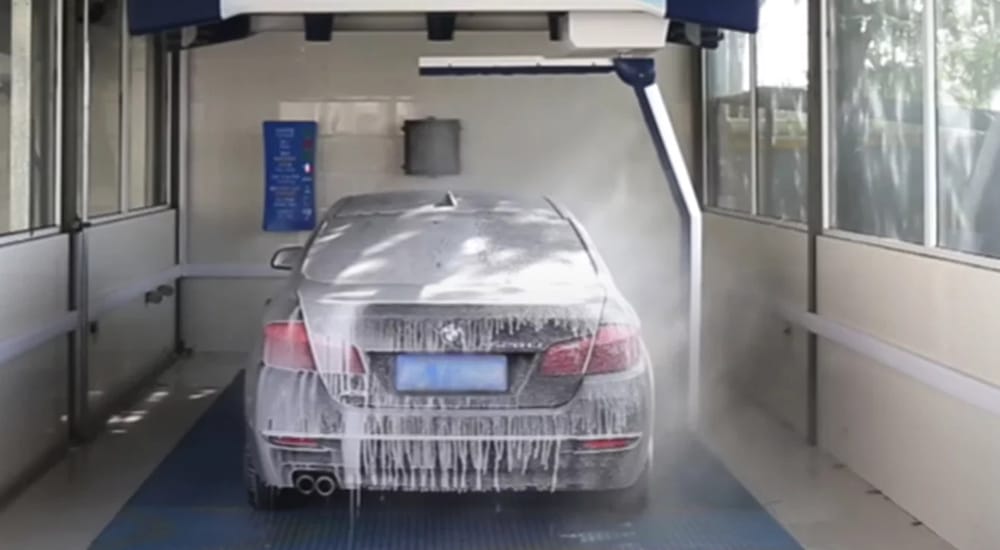
Foam and high-pressure water loosen contamination without brushes touching the paint.
Credit: kkewash.com
How Does a Touchless Car Wash Work?
1. Initial rinse
The machine first sprays water across the vehicle to remove loose dust, sand, and surface grit. This step matters because abrasive particles are more likely to scratch when they are dragged over paint.
2. Chemical pre-soak
A detergent is applied to the bodywork. In many automatic systems, this is an alkaline or high-pH cleaner designed to break down oily road film, insects, and traffic grime. Some washes also use an acidic product to dissolve mineral deposits and road salt. You can also read our guide on are soft touch car washes safe.
The chemicals need time to work. If the wash immediately rinses them away, cleaning performance will be limited.
3. High-pressure rinse
Jets then attack the vehicle from different angles. This removes softened grime without a brush physically scrubbing the surface. Pressure alone, however, cannot always remove bonded contamination.
4. Wax, sealant, or spot-free rinse
Optional programs may include spray wax, a polymer sealant, or a filtered-water rinse. These products can improve temporary gloss and water behavior, but they are not a replacement for a durable paint sealant or ceramic coating. You can also read our guide on are car washes tax deductible.
5. Forced-air drying
Large blowers push water from mirrors, trim, grilles, door handles, and body gaps. Air drying reduces towel contact, although it may not remove every drop.
Is Touchless Car Wash Better for Your Paint?
Usually, yes—if your main concern is reducing contact with the paint.
Scratches and swirl marks often result when abrasive dirt is rubbed across the clear coat. A touchless wash eliminates the brush or towel contact that causes that particular type of damage. It is especially useful for:
- Freshly polished vehicles.
- Dark-colored paint, where swirls are easier to see.
- Cars with delicate decals or vinyl graphics.
- Vehicles with an existing ceramic coating or paint protection film.
- Routine maintenance washes when the car is only lightly dirty.
That does not mean touchless washing is completely risk-free. Strong chemicals can gradually reduce wax or sealant durability, and high-pressure water can expose loose trim, damaged paint, or poorly bonded graphics. A touchless wash also cannot correct scratches that already exist. You can also read our guide on are brushless car washes better.
A common mistake is assuming that “no brushes” means the vehicle will receive a deep detail. Touchless systems reduce contact; they do not replace mechanical decontamination, hand washing, or paint correction.
Advantages of Touchless Car Washes
Reduced swirl-mark risk
The biggest benefit is the absence of physical scrubbing. Brushes and cloth strips can collect sand, salt, and road grit. If that contamination is dragged over paint, it can create fine scratches and circular swirl marks. You can also read our guide on best foam gun car wash for water hose.
A touchless wash avoids that specific problem. It is not a guarantee against every type of damage, but it is generally preferable when preserving a high-quality finish is the priority.
Fast and convenient cleaning
Most automatic touchless washes take only a few minutes, making them practical after rain, winter driving, or a dusty commute. You do not need buckets, towels, a hose, or a large driveway.
Frequent light washing is also easier on a vehicle than allowing road film and salt to accumulate for long periods.
Suitable for vehicles with fragile exterior details
No-contact washing can be useful for cars with:
- Vinyl wraps.
- Painted graphics.
- Delicate emblems.
- Aged clear coat.
- Certain paint protection films.
- Loose or easily damaged trim.
Always follow the product manufacturer’s care instructions, especially for matte paint, satin wraps, and aftermarket graphics.
Less towel contact
Touchless systems use air blowers rather than towels for most of the drying process. Fewer towel passes mean fewer opportunities to rub grit across the finish.
The trade-off is that air dryers may leave water in mirrors, handles, grilles, and panel gaps.
Convenient winter maintenance
In cold weather, a touchless wash can remove salt and slush from the body and undercarriage without requiring you to work outdoors with wet towels. If an underbody rinse is available, it is particularly useful after driving on salted roads.
Disadvantages of Touchless Car Washes
Cleaning may be incomplete
Touchless systems are most effective against loose or recently deposited dirt. They may leave behind:
- Dried bird droppings.
- Tree sap.
- Road tar.
- Grease.
- Heavy brake dust.
- Insect residue.
- Mud packed into wheel wells.
- Mineral water spots.
These substances often need safe mechanical cleaning or a specialized remover.
Strong detergents can affect protection
Touchless washes need chemicals strong enough to compensate for the lack of brushing. Repeated exposure may shorten the life of a carnauba wax, spray sealant, or other temporary protection.
This does not mean every touchless wash will damage clear coat. Modern automotive clear coats are designed to tolerate normal washing. The concern is more often the gradual removal of protective products, especially when using inexpensive or poorly maintained facilities.
If you have ceramic coating, follow the coating maker’s wash recommendations. A gentle pH-neutral hand wash may be better for regular maintenance, while a touchless wash is useful when you need fast, low-contact cleaning.
Water spots can remain
Air blowers do not always remove water from every surface. If the final rinse contains minerals, evaporation can leave white or dull-looking spots.
For better results:
- Choose a spot-free rinse when available.
- Avoid washing in direct, intense sunlight.
- Do not let detergent dry on the paint.
- Dry remaining water from mirrors and trim with a clean, soft towel.
- Treat existing mineral deposits with a product designed for automotive paint.
High-pressure water can reveal existing damage
Pressure does not normally harm sound factory paint when used correctly. However, it can worsen problems that already exist, including:
- Peeling clear coat.
- Loose decals.
- Failing paint edges.
- Damaged weather stripping.
- Poorly repaired body panels.
- Chipped paint around the hood or bumper.
Inspect vulnerable areas before entering the wash. If paint is already lifting, hand cleaning with minimal pressure is safer.
It may cost more than a basic wash
Touchless equipment is expensive to install and maintain. Some facilities charge more for no-contact programs, spot-free rinses, underbody cleaning, or protective sprays.
The higher price can be worthwhile when you value convenience and reduced contact, but it does not necessarily mean the car will be cleaner than after a careful home wash.
Touchless vs. Soft-Touch vs. Hand Washing
| Feature | Touchless wash | Soft-touch wash | Careful hand wash |
|---|---|---|---|
| Physical contact | None | Brushes or cloth | Wash mitts and towels |
| Swirl-mark risk | Lowest contact-related risk | Higher if equipment is dirty | Low with correct technique |
| Heavy dirt removal | Moderate | Usually better | Best when done properly |
| Convenience | Very high | Very high | Lower |
| Control over products | Limited | Limited | High |
| Risk from chemicals | Moderate | Moderate | Depends on products |
| Best use | Fast routine cleaning | Convenient deeper automatic wash | Maximum finish quality |
A soft-touch wash is not automatically bad. Modern equipment can be well maintained, and many vehicles are washed safely every day. The concern is that the cleaning material physically contacts the vehicle and may carry contamination from previous washes.
For enthusiasts, the safest overall approach is usually a thorough pre-rinse followed by a proper contact wash using the two-bucket technique.
When Is a Touchless Wash the Better Choice?
Choose touchless when:
- The car has light or moderate surface dirt.
- You want to reduce contact with the clear coat.
- You are short on time.
- The vehicle has fresh paint protection, decals, or sensitive graphics.
- You are washing off winter salt or road spray.
- You need a practical maintenance wash between detailed cleanings.
- You are uncomfortable using shared brushes at a self-service bay.
Touchless is particularly useful when the vehicle is washed regularly. Dirt that has not had time to bond is easier for chemicals and water pressure to remove.
When Is a Touchless Wash Not the Best Choice?
Use another method when:
- Mud is thick and dried onto the body.
- The vehicle has tar, sap, or grease.
- You need a show-car-level finish.
- Water spots are already severe.
- The car needs wheel, tire, grille, or interior detailing.
- The wash uses visibly dirty equipment or poorly maintained bays.
- You need to preserve a delicate wax with a gentler product routine.
For severe contamination, a pre-rinse and hand wash usually produce better results. Do not use a household dish detergent as a substitute for automotive shampoo; it can strip protection and is not formulated for vehicle finishes.
How to Get Better Results From a Touchless Wash
Select the right program
If available, choose a package that includes:
- A thorough pre-soak.
- Undercarriage rinsing during winter.
- A spot-free final rinse.
- Adequate air drying.
- Wheel or tire cleaning when needed.
The most expensive package is not always necessary. Extra “wax” or gloss options may provide only short-lived cosmetic benefits.
Inspect the wash bay
Look for a facility with:
- Clear, functioning spray nozzles.
- No obvious chemical buildup.
- Clean payment and entry areas.
- Strong, evenly operating blowers.
- Good drainage and general maintenance.
Poor maintenance can reduce cleaning performance even when the wash is technically touchless.
Rinse contamination promptly
Bird droppings, bugs, and road salt become harder to remove as they dry. A routine touchless wash is more effective when contamination has not bonded tightly to the paint.
Never scrape dried material with a card, key, or abrasive sponge. Soak it first and allow the cleaner or water to soften it.
Finish the missed areas safely
After leaving the wash, check:
- Side mirrors.
- Door handles.
- License-plate recesses.
- Lower rocker panels.
- Wheel spokes.
- Rear hatch seams.
- Under the trunk or liftgate lip.
Use a clean microfiber towel only after the surface has been adequately rinsed. If the towel starts dragging or becomes visibly dirty, replace it rather than continuing.
Maintain tires and equipment separately
A touchless body wash will not replace tire-pressure checks, wheel cleaning, or under-hood maintenance. After washing, inspect the tires and use the vehicle manufacturer’s recommended pressure; a reliable inflation setup can make routine vehicle care easier.
Is Touchless Washing Safe for Ceramic Coatings?
Generally, a touchless wash is compatible with a ceramic coating, but the exact detergent matters. A coating can reduce how strongly dirt bonds to the surface, making touchless cleaning more effective. It still does not make the vehicle self-cleaning.
Avoid assuming that every automatic wash is coating-safe. Some programs use aggressive detergents, abrasive polishing compounds, or spray products that are not recommended by the coating manufacturer.
For a coated vehicle:
- Use a facility with a clean pre-rinse and spot-free rinse.
- Avoid brushes and shared wash tools.
- Do not allow chemicals to dry on the surface.
- Use a coating-approved shampoo for occasional hand washes.
- Watch for reduced water behavior, which may indicate contamination rather than coating failure.
Environmental Considerations
A commercial car wash may collect and treat wastewater more effectively than washing a vehicle on a driveway, where oil, brake dust, detergents, and metals can flow into storm drains. Requirements vary by location and facility, so do not assume every wash handles runoff in exactly the same way.
The U.S. Environmental Protection Agency provides general information about pollution prevention and protecting waterways. Choosing a properly maintained commercial facility and avoiding unnecessary chemical use are sensible steps.
Touchless does not automatically mean the wash uses less water. Water consumption depends on the equipment, recycling system, rinse cycle, and facility settings. Ask the operator or check the posted program information if water use is an important consideration.
A Practical Washing Schedule
There is no single perfect interval for every vehicle. Wash more often when driving conditions expose the car to salt, mud, coastal air, construction dust, or heavy traffic film.
A practical routine is:
- Lightly driven vehicle: wash when visible grime accumulates.
- Daily commuter: wash regularly enough to prevent road film and salt buildup.
- Winter driving: rinse salt from the body and undercarriage promptly.
- Vehicle with wax or sealant: use a gentle maintenance wash and refresh protection as needed.
- Vehicle with ceramic coating: follow the coating manufacturer’s care instructions and avoid letting contamination accumulate.
Frequency is less important than technique. A poorly maintained wash used repeatedly can be less beneficial than a properly performed wash at a sensible interval.
Frequently Asked Questions
Does a touchless car wash scratch paint?
A touchless wash has a lower risk of contact-related scratches because brushes and cloth strips do not touch the vehicle. It can still expose loose paint, damaged clear coat, or weak trim to high-pressure water. Existing swirl marks will not be removed by a touchless wash.
Does touchless washing remove all dirt?
No. It usually removes loose dirt, road spray, dust, and some grime. Dried bird droppings, tar, sap, grease, and heavy mud may remain and require careful hand cleaning or a specialized product.
Is touchless better than a soft-touch car wash?
Touchless is better for minimizing physical contact. Soft-touch may clean heavy contamination more effectively because it scrubs the surface. The better option depends on whether paint preservation, convenience, or maximum cleaning power matters most.
Can I use a touchless wash with ceramic coating?
Usually, yes, but check the coating manufacturer’s recommendations. Avoid facilities that use products known to reduce coating performance or leave heavy residue. A gentle hand wash remains useful for long-term maintenance.
Does touchless washing remove wax?
Some touchless detergents can gradually reduce wax or spray-sealant durability, particularly with frequent use. If maintaining wax longevity is important, use a wash product recommended for that protection.
Can touchless washing remove bird droppings?
It may remove fresh droppings, but dried deposits can remain. Do not scrape them. Soak the area and remove it with a clean, paint-safe microfiber towel after it has softened.
Is touchless washing safe for matte paint?
It can be, but matte and satin finishes require manufacturer-specific care. Avoid automatic programs containing polishing compounds or gloss-enhancing products unless the finish manufacturer approves them.
Should I dry my car after a touchless wash?
Yes, if water remains on the vehicle. Use a clean, soft microfiber drying towel on a cool surface, or allow a quality spot-free rinse to air dry. Pay particular attention to mirrors, trim, emblems, and panel gaps.
Final Verdict: Is Touchless Car Wash Better?
A touchless car wash is better when your priorities are convenience, lower contact, and reduced risk of brush-induced swirl marks. It is an excellent choice for regular maintenance, lightly dirty vehicles, winter salt removal, and cars with delicate exterior details.
It is not always better for deep cleaning. Strong detergents may shorten the life of wax, and water pressure cannot reliably remove bonded contamination such as tar, sap, or dried mud.
The most balanced approach is to use touchless washing for quick maintenance and perform an occasional careful hand wash when the vehicle needs deeper cleaning. Choose the method that matches the car’s condition, inspect the wash facility, and never expect a no-contact machine to replace safe detailing technique.








