ByMax Lee
Missouri Commercial Vehicle Registration & Weight Limits
Missouri commercial vehicle registration and weight restrictions govern every truck and heavy rig operating on state roads. Getting this wrong can cost you thousands in fines, force your vehicle off the road, or even trigger a CDL suspension. Most drivers and fleet managers walk into this with gaps in their knowledge.
They know a truck needs plates. They do not know which plates, what weight class applies, or where the line is between legal and overloaded.
Federal law sets a maximum gross weight of 80,000 pounds and clear single-axle and tandem-axle limits. Missouri enforces those standards plus its own bridge formula and tonnage-based fee tiers through the Missouri Department of Revenue. As of 2026, the rules have shifted slightly on renewal timelines and certain excess-weight permit procedures.
This guide walks you through every step so you register correctly, stay legal, and avoid costly mistakes.
YouTube / BigRigTravels (YouTube thumbnail (fair-use with source credit))
Why Missouri Commercial Vehicle Registration and Weight Restrictions Matter
Missouri sits in the middle of some of the busiest freight corridors in the country. I-70 runs straight across the state from Kansas to Illinois. I-44 connects Oklahoma to the Midwest.
I-55 carries traffic from Chicago down toward Louisiana. If you operate a commercial vehicle in this state, weight and registration compliance is not optional.
Getting it right means staying on the road, keeping your operating authority intact, and avoiding surprise citations. Getting it wrong can mean steep fines, out-of-service orders, and added insurance costs. The Missouri State Highway Patrol enforces weight limits at permanent and mobile scales statewide.
They do not warn first. They ticket.
The complexity comes from layered jurisdiction. Federal weight formulas apply on interstate highways. Missouri has its own bridge formula for state roads.
You may also need IRP apportioned registration if you cross state lines. Add UCR fees and possible HVUT, and the paperwork multiplies quickly. Understanding each piece keeps you legal and saves money.
Quick Answer: What You Need to Register and Stay Legal
Missouri commercial vehicle registration depends on gross weight, use type, and whether you run intrastate or interstate. Vehicles over 10,001 pounds GVWR need commercial registration. The exact fee bracket depends on your registered gross weight class.
You also need proper plates, a current title, and proof of insurance. If you operate across state lines, file IRP through your base jurisdiction. Always verify your weight against federal and state limits before hitting the road.
Missouri’s Weight Classes and Registration Thresholds
Missouri groups commercial vehicles into weight classes for registration and fee purposes. These classes determine your annual tag cost and whether additional permits become necessary. The thresholds align closely with federal standards but carry state-specific fee schedules.
Key Weight Thresholds in Missouri
| Weight Range (lbs) | Typical Classification | Notes |
|---|---|---|
| Under 10,001 | Non-commercial passenger | No commercial registration required |
| 10,001 to 26,000 | Light commercial | Commercial plates required |
| 26,001 to 33,000 | Medium commercial | CDL not automatically required |
| 33,001 to 40,000 | Heavy commercial | CDL generally required |
| 40,001 to 80,000 | Heavy commercial / tractor | CDL required for most operations |
| Over 80,000 | Oversized / permit required | Exceeds federal gross limit |
The CDL threshold kicks in at 26,001 pounds GVWR or GCWR for most commercial configurations. Some vehicles between 26,001 and 33,000 pounds may qualify for a non-CDL commercial license depending on cargo type and configuration. Always check current FMCSA guidelines for updates on endorsements and licensing requirements.
YouTube / Haul Gauge (YouTube thumbnail (fair-use with source credit))
Commercial registration also triggers annual inspection requirements. Missouri requires periodic commercial vehicle safety inspections for vehicles operating above certain weight thresholds. Keep your inspection sticker current and your records organized.
A missed inspection can lead to an out-of-service order just like an overweight citation.
Federal vs. Missouri Weight Limits: What Actually Applies
Federal weight limits set the baseline for all states. Missouri enforces them and adds its own layer for bridge protection and road preservation. Knowing both sets of rules prevents costly misunderstandings at the scale.
Federal Weight Limits (Apply Nationwide)
| Limit Type | Maximum Allowable |
|---|---|
| Gross combination weight | 80,000 lbs |
| Single axle | 20,000 lbs |
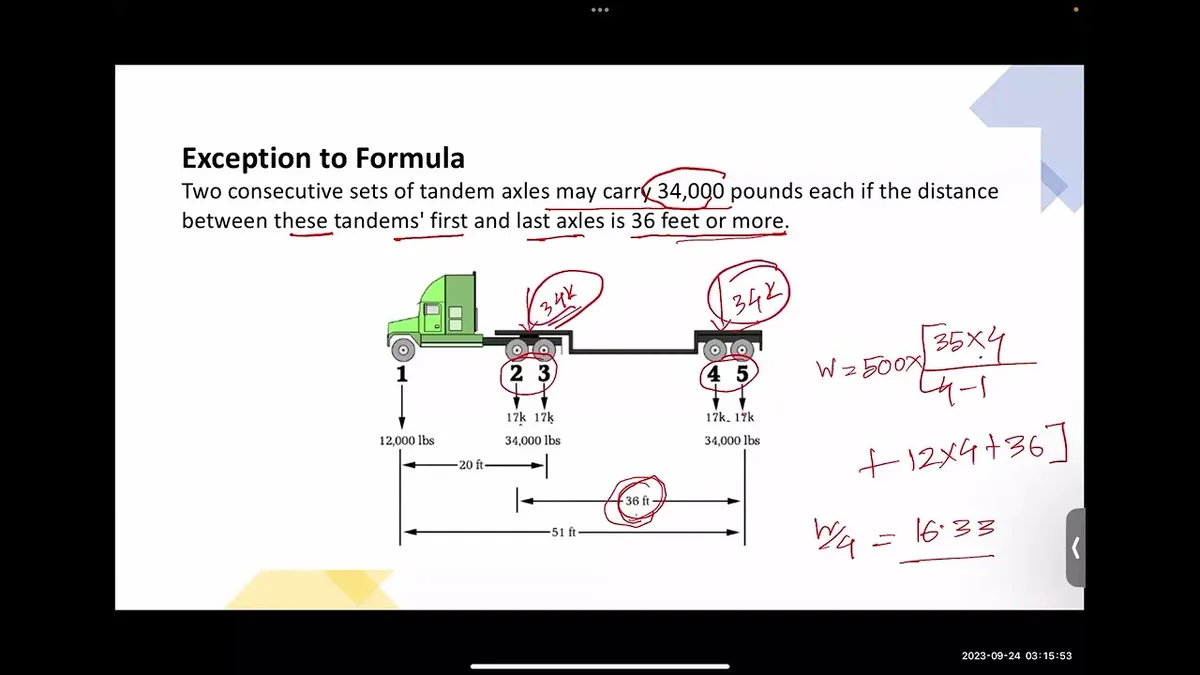
| Tandem axle | 34,000 lbs |
| Bridge formula | Varies by axle spacing |
The bridge formula limits weight based on the distance between axle groups. A truck with widely spaced axles can carry more total weight than one with closely grouped axles. This protects bridges from concentrated stress points.
The formula uses this calculation:
W = 500 × (L × N / (12 × N + 36))
Where W equals maximum weight in pounds, L is the distance between axle groups in feet, and N is the number of axles. Misreading this formula is a common mistake. Overloading on a short wheelbase can violate bridge formula even when your gross weight stays under 80,000 pounds.
YouTube / Zahid hasan Prince (YouTube thumbnail (fair-use with source credit))
Missouri follows federal bridge formula rules on interstate highways. On state roads, MODOT may enforce stricter limits on certain routes classified as S-Routes or B-Routes. S-Routes carry heavier commercial traffic and allow standard federal weights.
B-Routes have lower limits due to weaker bridge infrastructure. Route signage in Missouri marks these designations clearly. Ignoring B-Route restrictions can result in fines and permit violations.
IRP Apportioned Registration vs. Missouri-Only Plates
The choice between IRP apportioned registration and a flat Missouri commercial registration depends entirely on where you operate. Mixing them up wastes money and creates compliance gaps.
IRP registration applies when you operate commercially in two or more states. You file through your home or base jurisdiction. You pay proportional fees based on miles driven in each member jurisdiction.
You receive a cab card for each state and apportioned license plates. The International Registration Plan covers 48 U.S. states and most Canadian provinces.
Missouri-only non-apportioned registration applies when you operate exclusively within state lines. You pay a flat fee based on your registered gross weight class. You do not file mileage reports to other jurisdictions.
This option is simpler but limits you to intrastate operation.
| Feature | IRP Apportioned | Missouri Intrastate Only |
|---|---|---|
| Operating area | Interstate (multi-state) | Missouri only |
| Fee structure | Proportional by miles | Flat weight-class rate |
| Cab cards | Required per state | None needed |
| Renewal filings | Quarterly or annual mileage report | Annual renewal only |
| Cost efficiency for local fleets | Higher if mostly intrastate | Lower for purely local operation |
Running IRP when you only drive in Missouri costs you extra. Running Missouri plates when you cross state lines exposes you to penalties in every neighboring jurisdiction.

YouTube / TIme is Money TV (YouTube thumbnail (fair-use with source credit))
UCR registration is a separate requirement for most interstate commercial carriers. It is not tied to weight or registration plates. UCR covers annual fleet-size reporting fees paid to your base state.
Missouri participates in UCR. Even small fleets with one or two trucks must register and pay the applicable UCR fee bracket each year.
Step-by-Step: Registering a Commercial Vehicle in Missouri
Registering a commercial vehicle in Missouri follows a clear sequence. Each step builds on the last. Skipping one usually means coming back and doing it twice.
Step 1: Confirm Your Vehicle Classification
Determine your vehicle's GVWR and intended use. If the GVWR exceeds 10,000 pounds or the vehicle is designed to transport goods for hire, it qualifies as commercial. Gather your title, bill of sale, VIN verification, and proof of insurance before visiting any office.
Step 2: Decide Intrastate vs. Interstate Operation
If you run only within Missouri, choose non-apportioned commercial registration. If you cross state lines regularly, plan to file IRP through your base jurisdiction first. Missouri accepts IRP applications but requires your base state designation.
YouTube / FOX4 News Kansas City (YouTube thumbnail (fair-use with source credit))
Step 3: Complete the Application
Fill out the Missouri commercial vehicle application form at your local driver license office or through the Missouri DOR portal. Provide your VIN, weight class, tire information, and insurance details. Attach copies of your title and any prior registration.
Step 4: Pay Registration Fees
Fees vary by weight class. The DOR publishes a current fee schedule online. Payment is accepted by check, money order, or credit card at designated offices.
Obtain a receipt and confirm your plate assignment.
Step 5: Display Plates and Maintain Records
Mount your commercial plates securely. Keep your registration certificate, IRP cab cards, and UCR confirmation in the vehicle at all times. Renew before expiration to avoid late penalties and potential out-of-service risk during inspections.
Missouri allows online renewal for many commercial registrations. Log into the Missouri DOR account portal to check eligibility, update your information, and pay annually. Set a calendar reminder well before your expiration date.
Renewal windows typically open 60 days before expiration.
How to Determine Your Vehicle’s Correct Weight Class
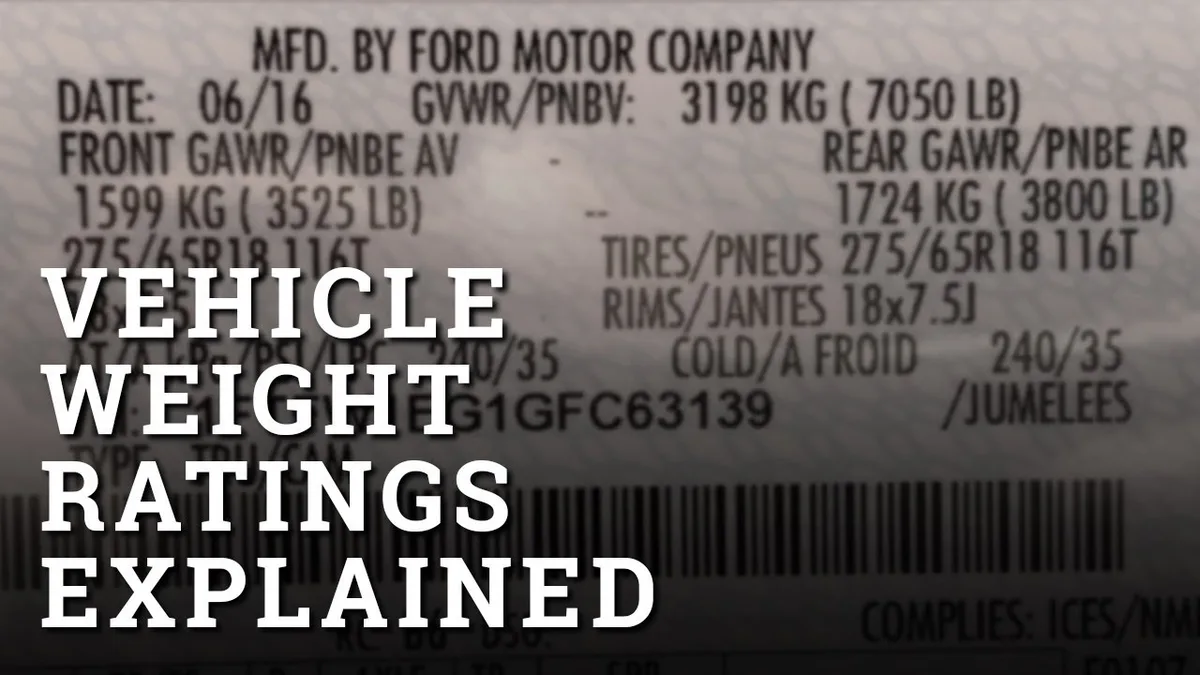
Start with the manufacturer’s GVWR sticker. This is the maximum loaded weight the vehicle is designed to carry. It is not the same as your current load or empty weight.
The GVWR is printed on the door jamb, in the owner’s manual, or on the vehicle’s federal certification label.
If your vehicle pulls a trailer, use the GCWR instead. This is the combined weight of the truck and trailer at maximum capacity. The GCWR determines whether you need a CDL and which registration class applies.
Never guess these numbers. Weigh your loaded vehicle at a certified scale if you are unsure.
| Weight Type | Definition | Where to Find It |
|---|---|---|
| GVWR | Max weight of vehicle + cargo | Door jamb sticker, manual |
| GCWR | Max weight of vehicle + trailer + cargo | Towing guide, manual |
| Curb weight | Empty vehicle weight | Manufacturer specs |
| Payload | Max cargo weight | GVWR minus curb weight |
Missouri uses GVWR or GCWR to assign your registration class. A vehicle with a GVWR of 12,000 pounds falls into the light commercial category. A truck with a GCWR of 35,000 pounds requires heavy commercial registration.
The DOR will verify these numbers during registration. Discrepancies can delay processing or trigger audits.
Missouri’s Weight-Based Registration Fees (By Tonnage)
Missouri charges commercial registration fees based on your declared gross weight. The fee schedule is published annually by the DOR. Fees increase in tiers as weight increases.
Paying for a higher weight class than you need wastes money. Paying for too low a class risks penalties.
Here are the current fee brackets as of 2026:
| Gross Weight (lbs) | Annual Fee |
|---|---|
| 10,001 to 12,000 | $42 |
| 12,001 to 18,000 | $52 |
| 18,001 to 26,000 | $72 |
| 26,001 to 33,000 | $92 |
| 33,001 to 40,000 | $112 |
| 40,001 to 54,000 | $152 |
| 54,001 to 80,000 | $202 |
| Over 80,000 | Requires permit |
These fees cover standard commercial plates. IRP apportioned registration uses a different calculation based on miles traveled in each jurisdiction. Missouri’s portion of the IRP fee is prorated by the percentage of miles you drive in the state.
Additional fees may apply for specialty plates, temporary permits, or late renewals. The DOR website lists all current charges. Always confirm the latest rates before submitting payment.
Fees are subject to change with annual budget adjustments.
Overweight Permits: When You Need Them and How to Get Them
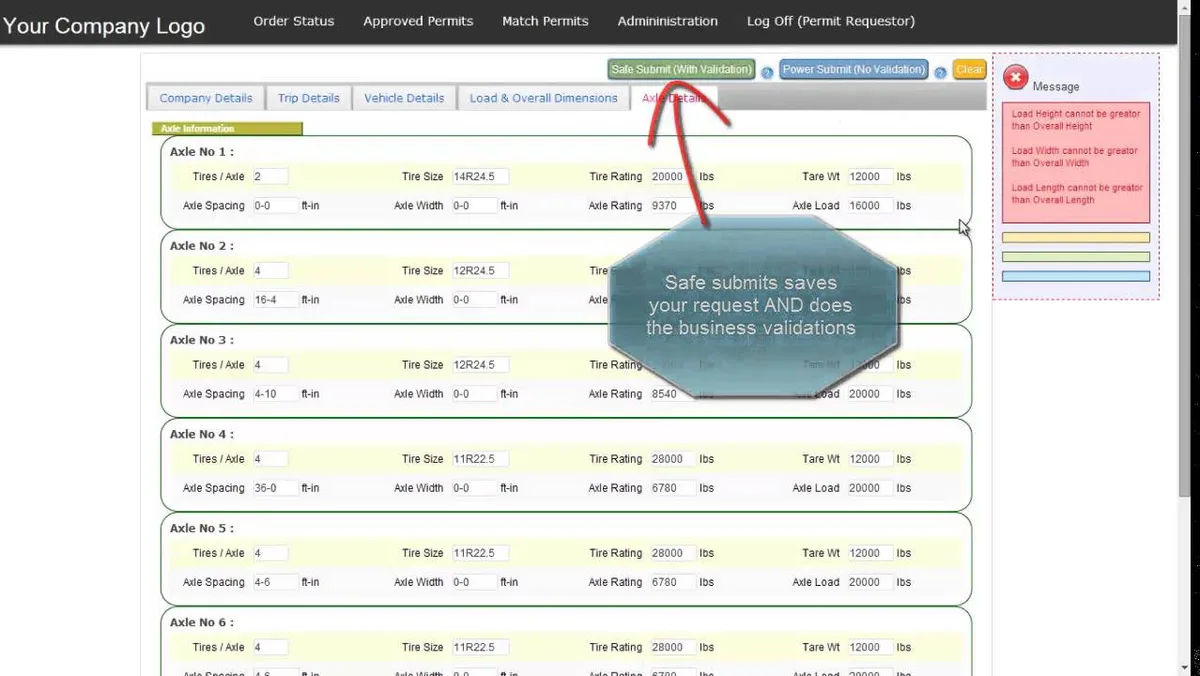
You need an overweight permit if your vehicle exceeds legal weight limits. This includes gross weight, single axle weight, tandem axle weight, or bridge formula limits. Missouri issues single-trip permits and annual permits for recurring overweight loads.
Single-trip permits are valid for a specific route and time frame. Annual permits cover repeated travel on approved routes. Both require detailed vehicle and load information.
You must specify axle weights, spacing, and total gross weight on the application.
YouTube / permit sys (YouTube thumbnail (fair-use with source credit))
Permit costs vary by weight and route. A single-trip permit for a load up to 120,000 pounds might cost around $30. Heavier loads or specialized routes can cost several hundred dollars.
Annual permits offer better value for frequent haulers but require strict route compliance.
Missouri also enforces seasonal weight restrictions on certain roads. These typically run from late winter through early spring when road surfaces are most vulnerable. Check MODOT’s seasonal restrictions map before planning overweight moves during these periods.
Common Mistakes That Trigger Fines or Out-of-Service Orders
The most common mistake is misclassifying your vehicle’s weight. Registering a 28,000-pound truck as a 26,000-pound vehicle saves a few dollars upfront. It costs far more in fines when caught at a weigh station.
Always round up to the next weight class if you are near the threshold.
Another frequent error is ignoring axle weight limits. You can be under the 80,000-pound gross limit but still illegal if one axle carries too much weight. This often happens with improperly loaded trailers.
Distribute your load evenly across all axles. Use scale tickets to verify axle weights before hitting the road.
| Mistake | Typical Fine | Additional Consequences |
|---|---|---|
| Incorrect weight class | $100–$500 | Registration suspension |
| Overweight single axle | $200–$1,000 | Out-of-service order |
| Expired registration | $50–$200 | Vehicle impoundment |
| Missing cab card | $100–$300 | IRP suspension |
| No UCR registration | $200–$500 | Operating authority revocation |
Failing to carry proper documentation is another easy way to get pulled out of service. Always have your registration, insurance, cab card, and permit documents in the cab. Digital copies on a phone are not always accepted.
Printed copies are safest.
Weigh station bypassing is a serious violation. Missouri uses PrePass and other electronic screening systems. If your transponder is not properly configured or you bypass without authorization, expect immediate enforcement action.
Bypass violations can result in fines up to $1,000 and mandatory weigh station stops for future trips.
Weigh Station Rules and What Happens If You’re Over
Missouri operates both permanent and temporary weigh stations. Permanent stations are typically located on major interstates. Temporary stations can appear anywhere, often during special enforcement periods.
All commercial vehicles over 10,000 pounds GVWR must stop when directed.
Weigh station personnel will check your registration, insurance, and weight compliance. They may also inspect your vehicle’s safety equipment. Brake tests, light checks, and tire inspections are common.
If everything is in order, you will be released quickly.
If you are found overweight, you will be issued an out-of-service order. You cannot legally move the vehicle until the weight is reduced to legal limits. This often means unloading cargo on the spot.
You will also receive a citation with a fine based on how much you exceeded the limit.
| Overweight Percentage | Typical Fine Range |
|---|---|
| 1–5% over | $100–$250 |
| 6–10% over | $250–$500 |
| 11–15% over | $500–$1,000 |
| Over 15% | $1,000+ and possible criminal charges |
Repeated violations can lead to increased scrutiny and higher penalties. Missouri participates in the Commercial Vehicle Safety Alliance’s out-of-service criteria. Multiple violations can result in your carrier being flagged for additional inspections nationwide.
CDL Requirements Tied to Weight in Missouri
A CDL is required for any vehicle with a GVWR or GCWR of 26,001 pounds or more. This includes most heavy commercial trucks and combinations. Some vehicles between 26,001 and 33,000 pounds may qualify for non-CDL commercial licenses if they meet specific exemptions.
Missouri also requires CDL endorsements for certain cargo types. Tank vehicles, hazardous materials, and passenger vehicles each have separate endorsement requirements. Check the FMCSA guidelines for the latest endorsement rules.
Renewals, Deadlines, and Keeping Your Paperwork Current
Missouri commercial registrations expire annually. Renewal notices are mailed about 60 days before expiration. You can renew online, by mail, or in person at a DOR office.
Keep your cab card, registration certificate, and insurance proof in the vehicle at all times. Missouri State Highway Patrol officers can request these documents during traffic stops or weigh station inspections. Missing paperwork can result in fines and out-of-service orders.
When to Call a Professional (And When You Can DIY)
DIY registration works for most standard commercial vehicles operating within Missouri. The process is straightforward if you have all your documents in order. Use the DOR’s online portal for the fastest service.
Call a professional for IRP apportioned registration or multi-state operations. A compliance specialist can handle the paperwork, ensure accurate mileage reporting, and avoid costly mistakes. This is especially useful for fleets with vehicles in multiple weight classes.
FAQs About Missouri Commercial Registration and Weight Limits
What is the maximum weight for a commercial vehicle in Missouri?
The maximum gross weight is 80,000 pounds on federal interstates. Single axle limits are 20,000 pounds. Tandem axle limits are 34,000 pounds.
Missouri enforces these limits plus its own bridge formula on state roads.
Do I need a CDL for a 26,000-pound truck in Missouri?
Yes. Any vehicle with a GVWR or GCWR of 26,001 pounds or more requires a CDL. Some exemptions apply for specific vehicle types and operations.
How much does it cost to register a commercial vehicle in Missouri?
Fees range from $42 for vehicles between 10,001 and 12,000 pounds to $202 for vehicles between 54,001 and 80,000 pounds. IRP apportioned registration uses a different fee structure based on miles traveled.
Can I get a temporary permit for an overweight load?
Yes. Missouri issues single-trip and annual permits for overweight loads. Costs vary by weight and route.
Always apply before moving the load.
What happens if I’m caught overweight at a weigh station?
You will receive an out-of-service order and a fine. The fine amount depends on how much you exceeded the limit. You cannot move the vehicle until the weight is reduced to legal limits.