If you live in Colorado and own a vehicle, you have to deal with the Colorado vehicle specific ownership tax SOT calculation based on age and value. It is an annual tax you pay when you renew your registration. Most people get it wrong the first time.
They either overpay because they use the wrong starting number, or they underpay and get hit with penalties later.
The state uses a fixed formula. It is 85% of the original MSRP, not what you actually paid. And the percentage drops every year until year 10, when the tax becomes a flat $3.
As of 2026, those rates have not changed. Knowing exactly how they apply could save you hundreds. Let us walk through the whole thing step by step.
Quick Answer
Colorado SOT is based on 85% of the vehicle's original MSRP. Multiply that by the rate for the vehicle's age. Year 1 is 2.1%.
It drops each year. After year 10, the tax is $3. Use model year, not calendar year, to find the age.
A half-year credit applies if you register mid-year.
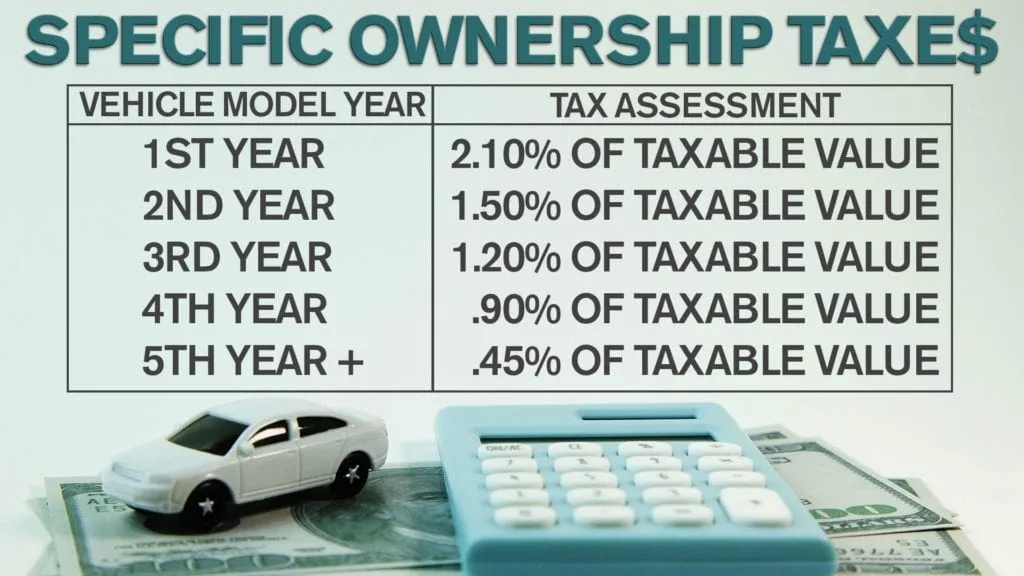
Image source: Bing (Web (fair-use with source credit))
Why Most People Overpay Their Colorado SOT (And How to Avoid It)
The biggest mistake is using the car's purchase price or Kelley Blue Book value as the starting point. That is wrong. Colorado law says you must use 85% of the manufacturer's suggested retail price (MSRP) from the year the car was new.
Even if you bought the car used for $15,000, the state taxes you on a number that is closer to the original sticker price.
The second mistake is guessing the age bracket. People think a 2022 model bought in 2025 is a 4-year-old car and use the rate for year 4. But the state counts from the model year, not the calendar year.
A 2022 model first registered in early 2022 is in its 4th year of ownership in 2025. That means year 4 rates apply.
How do you avoid overpaying? Find the original window sticker or a dealer quote that shows the base MSRP for your exact make, model, and trim. Confirm the age bracket using the model-year rule.
Check that the DMV's renewal notice uses the correct taxable value. If they used the purchase price instead of the MSRP, you can request a correction.
The One Number You Must Get Right: 85% of MSRP (Not Purchase Price)
This is the foundation of the whole calculation. Colorado's Department of Revenue defines the taxable value as 85% of the manufacturer's suggested retail price. That number never changes because it is tied to the original sticker price.
It does not go down as the car ages. Only the rate drops.
If your car's original MSRP was $40,000, the taxable value for SOT is:
$40,000 × 85% = $34,000
That $34,000 is the number you multiply by the age-based rate. Even if you got a $5,000 discount and paid $35,000, the state still uses $34,000.
What if you do not have the original MSRP? Contact the manufacturer's customer service with your VIN. Look up the build sheet on the manufacturer's website.
Some dealers will also provide it. The most accurate source is a window sticker (Monroney label) or a dealer invoice. Using NADA or KBB value will give you a different number and could lead to overpayment or underpayment.
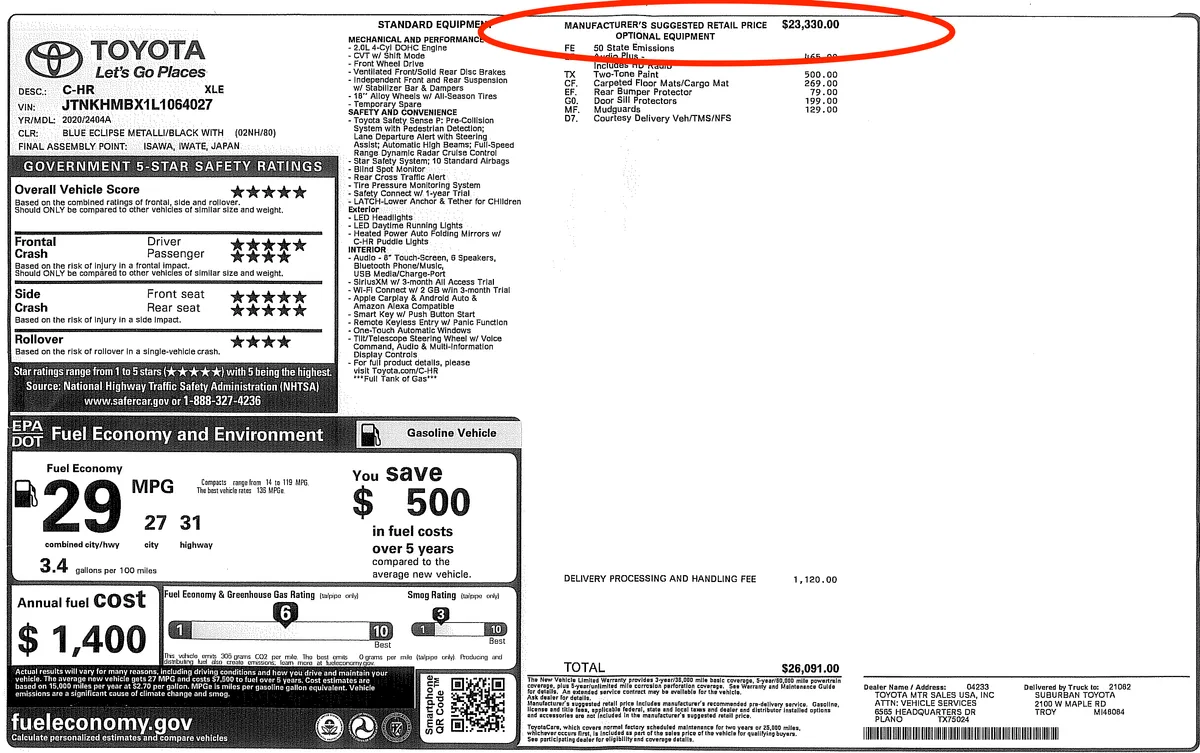
Image source: Bing (Web (fair-use with source credit))
How "Age" Is Legally Defined for SOT – Model Year vs. Calendar Year
Colorado determines a vehicle's age based on model year, not the year it was manufactured or the year you bought it. A vehicle is in its first year of ownership from the model year start until December 31 of that same calendar year. Each subsequent year adds one.
For example, a 2023 model first registered in March 2023 is in year 1 from March to December 2023. On January 1, 2024, it enters year 2. On January 1, 2025, it enters year 3.
By January 1, 2026, it is in year 4.
Now consider a 2023 model bought used in 2025. The car is in its 3rd year of existence. So the SOT rate for year 3 applies.
That is 1.2%, not 2.1% like a new car.
The key formula: age = current calendar year minus model year plus one. For a 2020 model in 2026: 2026 − 2020 + 1 = 7 years old. Use the rate for year 7.
The Exact 7-Step SOT Calculation Process
Here is the official method. Do it once and you will never guess again.
Step 1: Find the original MSRP
Get the base MSRP as it was when new. Include factory-installed options. Do not include dealer add-ons or taxes.
Step 2: Multiply by 85%
Taxable value = MSRP × 0.85
Step 3: Determine the vehicle's age in years
Use the formula: Current calendar year − Model year + 1
Step 4: Match the age to the correct rate
Refer to the rate schedule below. Year 1 has the highest rate (2.1%). Each subsequent year drops until year 10+ where it is a flat $3.
Step 5: Multiply taxable value by the rate
SOT = Taxable value × Rate (for years 1 through 9 only).
Step 6: Apply the half-year proration (if applicable)
If you register the vehicle for the first time after April 1, you can use the half-year rate for that first year. That cuts the SOT in half for the remaining portion of the calendar year.
Step 7: Pay the SOT with your registration
The SOT is collected when you renew your registration. It is either included in the renewal notice or paid separately depending on your county.
Here is a quick reference table:
| Step | What to Do | Example |
|---|---|---|
| 1 | Get MSRP | $45,000 |
| 2 | Multiply by 85% | $38,250 |
| 3 | Age (2026 – 2022 + 1) | 5 years |
| 4 | Rate for year 5 | 0.7% |
| 5 | SOT = $38,250 × 0.007 | $267.75 |
| 6 | If first registration after July 1, half-year credit | $133.88 |
| 7 | Pay at renewal | $267.75 (or $133.88) |
The Official Rate Schedule: Year 1 Through Year 10+ (With Examples)
Here is the exact rate table from the Colorado Department of Revenue, effective as of 2026.
| Year of Ownership | Rate | Example SOT on $30,000 MSRP ($25,500 taxable) |
|---|---|---|
| 1 | 2.1% | $535.50 |
| 2 | 1.5% | $382.50 |
| 3 | 1.2% | $306.00 |
| 4 | 0.9% | $229.50 |
| 5 | 0.7% | $178.50 |
| 6 | 0.5% | $127.50 |
| 7 | 0.4% | $102.00 |
| 8 | 0.3% | $76.50 |
| 9 | 0.2% | $51.00 |
| 10+ | Flat $3 | $3.00 |
The rates drop fast. By year 9 you are paying just $51 on a $30k MSRP car. After year 10, you pay $3 forever.
But the taxable value stays fixed. So even after the car is old, you still pay 0.2% on the original $25,500. Only after year 10 does the flat fee kick in.
Here is a real-world example. Suppose you have a 2021 Ford F-150 with an MSRP of $55,000. In 2026, the taxable value is $55,000 × 0.85 = $46,750.
The vehicle is 6 years old (2026 − 2021 + 1 = 6). The rate is 0.5%. So SOT = $46,750 × 0.005 = $233.75.
That is affordable for a truck that originally cost $55k.
Image source: Bing (Web (fair-use with source credit))
The Half-Year Proration Rule – What Happens When You Buy Mid-Year
If you buy a car in July, you do not pay the full year's SOT. Colorado gives you a break. The half-year proration rule lets you pay 50 percent of the annual SOT for your first registration period, provided you register the vehicle after April 1.
When you register a vehicle for the first time, the state charges SOT from the month of registration through the end of the calendar year. If that period is six months or less, you get the half-year rate. If you register in August, you pay half the year 1 SOT for that calendar year.
Starting January 1 of the next year, you pay the full SOT based on the vehicle's age at that point.
One catch: the half-year rule applies only to the first registration of that vehicle in Colorado. If you already owned the car and are just renewing, you pay the full annual amount. If you register in January through March, you pay the full year's SOT because the registration covers nearly 12 months.
Suppose you buy a $40,000 MSRP car in June 2026. Taxable value: $34,000. Year 1 rate: 2.1 percent.
Full SOT: $714. Because you registered after April 1, you pay $357 for the remainder of 2026. In January 2027, the car moves to year 2, and you pay the full year 2 SOT.
Image source: Bing (Web (fair-use with source credit))
Common SOT Mistakes That Cost You Money
Using the purchase price instead of MSRP. This is the number one error. Even if you got a killer deal, the state uses 85 percent of the original sticker. A $30,000 used car might have had a $45,000 MSRP.
That nearly doubles your tax.
Miscounting the vehicle's age. Use the formula every time. 2026 minus 2021 plus 1 equals 6 years, not 5. One year makes a big difference in the rate.
Forgetting the half-year credit. Buyers who register in the second half of the year often pay the full SOT because they do not know about the proration. Check the month on your bill. If you registered in July or later, you should see a 50 percent reduction.
Ignoring the flat $3 cap. Once your vehicle hits 10 years old, the SOT drops to $3. You do not need to keep calculating percentages. If the DMV system still shows a higher amount, point them to the law.
Paying late. Late fees on SOT add up quickly. The state charges 10 percent of the unpaid tax per month, capped at 50 percent. A $400 SOT left unpaid for three months becomes $520.
SOT vs. Colorado Sales Tax – Why They Are Not the Same
Colorado has both a sales tax and a specific ownership tax. They are separate, and people often confuse them.
The sales tax is a one-time fee when you buy the vehicle. It is 2.9 percent of the purchase price (not MSRP) plus any local county taxes. You pay it at the dealership or when you title the car.
The SOT is an annual tax you pay every year you own the car. It is calculated on 85 percent of MSRP, not the purchase price, and the rate decreases with age.
| Tax Type | When Paid | Base Amount | Rate |
|---|---|---|---|
| Sales tax | One-time at purchase | Purchase price | 2.9% + local |
| SOT | Every year at registration | 85% of MSRP | 2.1% down to $3 |
If you are budgeting for a new car, you need to account for both. The sales tax might be $1,000 to $3,000 depending on price. The first year SOT on a $50,000 MSRP vehicle would be about $892.
That is separate from the sales tax.
Real-World SOT Examples (Cheap Car, Expensive Car, Older Car)
Economy car, $25,000 MSRP
- Taxable value: $21,250
- Year 1 SOT: $21,250 × 2.1% = $446.25
- Year 5 SOT: $21,250 × 0.7% = $148.75
- Year 10+: $3
Luxury SUV, $80,000 MSRP
- Taxable value: $68,000
- Year 1 SOT: $68,000 × 2.1% = $1,428
- Year 3 SOT: $68,000 × 1.2% = $816
- Year 8 SOT: $68,000 × 0.3% = $204
- Year 10+: $3
Used hatchback, original MSRP $20,000, bought at 8 years old
- Taxable value: $17,000
- Vehicle age in year 8: rate 0.3%
- SOT: $17,000 × 0.3% = $51
- Next year (year 9): $17,000 × 0.2% = $34
- Year after that (year 10+): $3
Notice how quickly the tax drops after year 5. By year 8, even an expensive car costs under $300.
Legal Compliance: Late Fees, Penalties, and When You Need Help
The state takes SOT seriously. If you do not pay it on time, the consequences escalate.
Late fee structure: You owe 10 percent of the unpaid SOT per month, up to a maximum of 50 percent of the original tax. If you are six months late on a $500 SOT, the penalty is $250. The tax plus penalty must be paid before you can renew.
Registration suspension: If you let SOT go unpaid for more than a year, the DMV may suspend your registration. Driving with an expired registration in Colorado can lead to tickets, fines, and even vehicle impoundment.
When to seek professional help: Most SOT calculations are straightforward. But if you own a commercial vehicle, a fleet, or a vehicle with a disputed MSRP (like a modified or kit car), consult a tax professional or the Colorado Department of Revenue directly. If you receive a notice saying you owe back SOT from a previous year, contact the DMV to request a detailed breakdown.
Staying compliant: Pay your SOT when you renew your registration each year. Keep a copy of your renewal notice. If you sell the car, the SOT obligation transfers to the new owner only after they register it.
You are still responsible for any unpaid SOT from the period you owned the car.
What to Do If the DMV Calculates Your SOT Incorrectly
Mistakes happen. Sometimes the DMV uses the wrong MSRP, the wrong age bracket, or forgets the half-year credit. You have the right to dispute it.
Start by gathering your evidence. That means the original window sticker, a manufacturer build sheet, or a dealer letter showing the exact MSRP. Have your registration history handy.
Visit your county motor vehicle office or call the Colorado Department of Revenue. Explain the error and show your proof. Most errors get corrected on the spot.
If they resist, ask to speak with a supervisor or file a formal written request for review.
For more tips on keeping your car in good shape while managing ownership costs, check out our car maintenance blog.
Expert Tip: Use the Flat $3 Fee to Your Advantage When Shopping Used
If you are buying a used car in Colorado, focus on vehicles that are 10 years or older. The SOT drops to a flat $3 per year, no matter how expensive the original MSRP was.
A 2015 luxury SUV with a $70,000 original MSRP will cost you only $3 annually in SOT. Compare that to a 2016 model that is still in year 9 at $140 or more. That difference adds up over a few years.
When you are negotiating, factor in the SOT savings. A car that is just one year older can save you hundreds in ownership tax. It is a smart financial move for budget-minded buyers.
Frequently Asked Questions About Colorado SOT
Is the SOT the same as property tax?
No. Colorado does not have a personal property tax on vehicles. The SOT is an ownership tax paid annually with registration, not a property tax.
What if I lease a car? Do I still pay SOT?
Yes. Leased vehicles are treated the same as owned vehicles. The SOT is based on the original MSRP and the same age schedule applies.
Do I pay SOT on a car I just bought out of state?
Yes, if you register it in Colorado. The SOT calculation uses the original MSRP, not what you paid. Bring the window sticker to the DMV.
Can I pay SOT in installments?
No. It must be paid in full at registration renewal. Some counties allow online payment by credit card.
Does the SOT apply to motorcycles and trailers?
Yes, but they have their own rate schedule. Motorcycles and trailers are taxed at different percentages. Check the official table from the Colorado DMV.
Final Summary: Your 30-Second SOT Rule of Thumb
When you need to estimate your Colorado SOT fast, use this formula. Take 85% of the original MSRP. Multiply by 0.021 for year 1.
The rate cuts roughly in half each year until it disappears at year 10. After year 10, it is $3.
If you are buying a used car, check the model year. A 10-year-old car costs $3 annually. A 9-year-old car might cost over $100.
That difference matters. Always keep your window sticker. Always verify the DMV's number.
A few minutes of checking can save you hundreds over the life of your vehicle.