Black Friday deals are live on Amazon · limited-time discounts, grab them before they’re gone
Grab the deals

ByMax Lee
How to Use Drive Through Car Wash: Quick Tips for Sparkling Clean Cars
A drive-through car wash is one of the fastest ways to remove road film, dust, salt, and light mud from your vehicle. The process is simple, but small details—such as choosing the right wash type, disabling automatic wipers, and selecting the correct gear—help prevent avoidable problems.
This guide explains how to use a drive-through car wash, what to do before entering, how conveyor and touchless systems differ, and how to get a cleaner result without risking your vehicle’s exterior. You can also read our guide on are drive thru car washes bad.
What Is a Drive-Through Car Wash?
A drive-through car wash is an automated facility that cleans the outside of your vehicle while you remain in or near the car. Depending on the facility, your vehicle may:
- Move through a conveyor tunnel while stationary wheels follow a track
- Remain parked while overhead and side equipment moves around it
- Pass through touchless arches that spray detergent and high-pressure water
- Receive optional services such as underbody rinsing, wheel cleaning, wax, or drying
Drive-through washes are designed for routine exterior cleaning. They are particularly useful after rain, winter road treatment, pollen buildup, or a dusty commute. They are less effective at removing thick caked-on mud, tree sap, tar, embedded brake dust, and heavily soiled interior surfaces.
Choose the Right Type of Automatic Wash
Not every automated wash uses the same equipment. Understanding the difference helps you choose a service that suits your vehicle and the level of dirt. You can also read our guide on how to drive through car wash.
| Wash type | How it cleans | Main advantage | Main limitation |
|---|---|---|---|
| Soft-touch tunnel | Cloth or foam material contacts the paint | Usually removes surface film effectively | Contact material can carry grit if poorly maintained |
| Touchless wash | Detergent and high-pressure water do the cleaning | No brushes or cloth touch the paint | May leave stubborn grime behind |
| In-bay automatic | Your vehicle stays in place while equipment moves around it | Convenient and often compact | Coverage and drying quality vary |
| Conveyor tunnel | The vehicle is pulled through multiple stages | Fast, consistent process | Requires careful attention to gear and track instructions |
A touchless wash reduces contact with the paint, but stronger detergents and high-pressure spray may be used to compensate. A soft-touch wash can clean more effectively in one pass, but the condition and maintenance of the wash media matter. For heavily soiled or delicate vehicles, a careful hand wash may provide better control; the paint-safe washing method explains how to reduce grit-related scratching at home.
Before You Enter the Car Wash
Take a minute to prepare your vehicle. Most wash-related problems occur because an exterior accessory is loose, a window is open, or the driver selects the wrong operating mode. You can also read our guide on how to get car wash to pay for damage.
Remove or secure exterior accessories
Remove anything that could catch on equipment or fall off, including:
- Roof-mounted bicycle, ski, or cargo racks
- Flag mounts, magnetic signs, and temporary decorations
- Loose trim, aftermarket spoilers, or damaged wheel-well liners
- Trailer hitches if the wash operator prohibits them
- Removable antennas or antenna extensions
Check the wash’s height, width, length, and ground-clearance restrictions. This is especially important for lifted vehicles, vans, campers, vehicles with roof boxes, and cars with unusual modifications. If you are unsure whether a modified vehicle will fit, review its clearance and equipment details and ask the attendant before paying.
Close and disable what needs closing
Before entering the wash:
- Close every window, sunroof, and convertible top.
- Confirm that the doors, trunk, and liftgate are fully latched.
- Fold in power mirrors if the facility instructs you to do so.
- Turn off automatic windshield wipers and rain-sensing wipers.
- Retract running boards or steps if your vehicle has them.
- Turn off automatic parking brake or brake-hold functions if instructed.
- Remove loose items from the dashboard and cargo area.
Do not assume the car wash will stop if a sensor detects an open window. You are responsible for preparing the vehicle correctly. You can also read our guide on how to use an automatic car wash.
Inspect the vehicle’s condition
A drive-through wash is not a repair service. Do not enter if your vehicle has:
- A loose bumper, mirror, grille, or body panel
- Cracked glass that may worsen under pressure
- A damaged soft top or unsealed convertible roof
- Loose vinyl graphics or peeling paint
- A broken antenna or trim piece
- A trailer, oversized spare tire, or accessory prohibited by the operator
Take a quick photograph of existing damage if the vehicle has a cracked light, dent, or loose trim. This creates a useful record if you later need to distinguish pre-existing damage from a new problem.

An automated wash tunnel uses several stages to rinse, clean, and dry the vehicle.
Credit: www.rockymountaincarwash.com
How to Use a Drive-Through Car Wash Step by Step
1. Select a suitable wash package
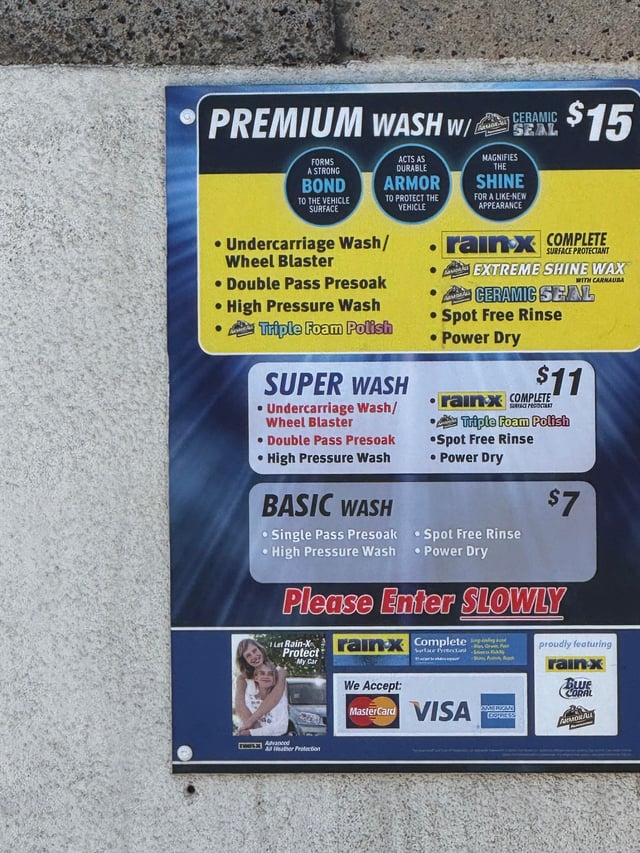
Read what each package actually includes instead of choosing only by the name. A basic wash may cover detergent, rinsing, and drying, while higher tiers may add wheel cleaner, underbody rinsing, sealant, or wax.
Choose based on your vehicle’s condition:
- Light dust or pollen: Basic rinse and wash
- Road salt or winter grime: Wash with underbody rinse
- Dirty wheels: Package with dedicated wheel cleaning
- Frequent maintenance: A moderate wash used regularly
- Heavy mud or sap: Pre-rinse or hand cleaning before the automated wash
Wax, sealant, and “ceramic” options can improve water behavior temporarily, but they do not replace proper paint protection or remove bonded contamination. Prices and services vary by location, so confirm the current menu at the facility rather than relying on older price charts.
2. Join the queue safely
Enter the marked line and leave enough room to stop without blocking traffic. Do not follow the vehicle ahead so closely that you cannot see its rear tires or brake lights.
Pay attention to:
- Height and width signs
- One-way arrows
- Staff directions
- Pedestrians crossing near the entrance
- Vehicles stopping unexpectedly
- The position of the payment kiosk or entrance gate
If your car has a low front bumper, wide tires, or unusual steering behavior, tell the attendant before entering the conveyor.
3. Pay and keep your receipt
Pay at the kiosk, cashier, or membership terminal. Keep the receipt, wash code, or membership confirmation until you have inspected the vehicle after exiting.
If you notice damage or a malfunction, report it promptly while you are still on the property. Ask the manager about the facility’s incident-report process and photograph the affected area before driving away.
4. Align the vehicle correctly
Follow the lane markings, traffic lights, arrows, and staff instructions. In a conveyor tunnel, the operator may direct you to place the driver-side tire on the conveyor track or guide rail.
Once aligned:
- Straighten the steering wheel
- Stop when instructed
- Keep your hands off the steering wheel unless staff says otherwise
- Avoid sudden braking or steering
- Do not attempt to reposition the vehicle after the conveyor engages
Correct alignment allows the equipment to contact the intended parts of the vehicle and reduces the risk of a tire leaving the track.
5. Select the correct gear and vehicle mode
The correct gear depends on the equipment:
- Conveyor tunnel: Usually select Neutral (N) and release the brake when instructed.
- In-bay automatic wash: Often requires Park (P), although some systems use Neutral.
- Touchless drive-through system: Follow the posted instructions; some require Park while others direct you to remain in Neutral.
Never rely on memory from a different car wash. Read the signs or follow the attendant’s instructions because conveyor designs differ.
Before the vehicle begins moving, disable features that could interfere with the process, such as:
- Automatic windshield wipers
- Automatic emergency braking, if the operator specifically instructs you
- Brake hold or automatic parking brake
- Adaptive cruise control
- Lane-centering assistance
Do not turn off a safety system unless the wash instructions require it and you can safely restore it afterward. If your owner’s manual gives special instructions for car washes, follow the manual.
6. Remain inside and keep the vehicle stationary
Keep windows, doors, and the sunroof closed throughout the wash. Do not touch the steering wheel, shift selector, or brake pedal while the vehicle is being pulled along a conveyor unless an emergency requires you to do so.
Stay calm if the equipment makes unfamiliar sounds. Brushes, air dryers, rotating wheels, and conveyor rollers can be noisy. However, alert staff immediately if you notice:
- A repeated hard impact
- A mirror or trim piece moving
- The vehicle stopping unexpectedly
- A warning light or alarm
- Water entering through a window or roof seal
7. Let every wash stage finish
A typical cycle may include:
- Pre-rinse
- Foam or detergent application
- Wheel and tire cleaning
- Brush or high-pressure cleaning
- Spot-free final rinse
- Wax or sealant application
- Air or cloth drying
The wash may not remove every mark. Road tar, insect residue, tree sap, and baked-on brake dust often require targeted treatment after the automatic cycle.
8. Exit only when directed
When the signal turns green or the attendant tells you to move:
- Select Drive (D), or follow the system’s exit instruction.
- Check mirrors and blind spots.
- Move slowly into the exit area.
- Avoid hard acceleration over wet pavement.
- Pull into a safe parking space for a final inspection.
Do not stop in the exit lane unless there is an emergency. Other vehicles may be leaving the tunnel behind you.
How to Get a Better Result
An automatic wash works best as part of regular maintenance rather than as a one-time solution for severe contamination.
Pre-rinse heavy dirt when permitted
Large clumps of mud, sand, or salt can increase the amount of abrasive material contacting the paint. If the facility provides a pre-rinse bay, use it according to the posted instructions. Never use a public pre-rinse area in a way that blocks the line.
Choose underbody cleaning after winter driving
Road salt and brine can accumulate on suspension components, wheel wells, and the underside of the vehicle. An underbody rinse is useful after repeated winter driving, especially before storing a vehicle for an extended period.
It will not replace a detailed inspection for corrosion, damaged shields, or leaking fluids. If you are checking the car after washing, also confirm that tires are properly inflated; a portable setup can help with regular tire pressure checks.
Dry hidden areas afterward
Air dryers may leave water around:
- Door handles
- Side mirrors
- Fuel or charging doors
- License plate recesses
- Trunk and hatch seams
- Window trim
- Grilles and emblems
Use a clean microfiber towel to remove remaining drops if water spots are a concern. Open the doors briefly in a safe parking area and wipe the jambs if the vehicle is still wet.
Clean the interior separately
Most drive-through washes clean only the exterior. Vacuum mats, wipe the dashboard, and clean interior glass separately. Avoid applying interior protectant to steering wheels, pedals, gear selectors, or other surfaces where extra slipperiness could reduce control.
What Not to Put Through a Drive-Through Wash
Some vehicles and conditions require extra caution. Ask the operator before entering if you have:
- A soft-top convertible
- A recently repaired or repainted panel
- Matte or satin paint
- Vinyl wraps or fragile decals
- Ceramic coating or paint-protection film
- A roof rack or cargo box
- A lifted truck or lowered sports car
- A damaged windshield or loose bodywork
- A vehicle with exposed sensors or aftermarket electronics
A factory-finished vehicle is generally designed to tolerate normal washing, but aftermarket modifications may have different requirements. For wrapped, matte, or specialty finishes, use the product manufacturer’s care instructions rather than assuming a standard wash is safe.
If your vehicle has dark window film, use a gentle, ammonia-free glass cleaner after the wash and follow the film manufacturer’s directions. Local rules concern how much light the glass transmits, so drivers should also understand applicable window-film requirements before modifying vehicle glass.
Drive-Through Washes and the Environment
Car washes use water and cleaning chemicals that can carry oil, metals, and road contaminants away from the vehicle. Commercial facilities are generally designed to manage wastewater through drains and treatment systems. Washing a car on a driveway can send contaminated runoff toward storm drains, depending on local drainage and regulations.
The U.S. Environmental Protection Agency provides broader information about stormwater pollution and runoff. In practice, using a commercial wash with proper drainage is often preferable to allowing detergent and oily runoff to flow into a street drain.
You can reduce waste by:
- Choosing a facility that recirculates water
- Avoiding unnecessary re-washes
- Selecting only services your vehicle needs
- Keeping chemicals out of storm drains
- Using a controlled wash area at home when local rules permit
Drive-Through Wash vs. Hand Washing
Both methods have a place in vehicle care.
| Factor | Drive-through wash | Careful hand wash |
|---|---|---|
| Time | Usually completed in minutes | Often takes significantly longer |
| Convenience | Minimal effort and equipment | Requires supplies and space |
| Surface dirt | Good for routine road film | Good control over each area |
| Stubborn contamination | May leave tar, sap, or bonded grime | Easier to treat directly |
| Paint-contact control | Depends on wash type and maintenance | You control the tools and pressure |
| Undercarriage access | Available only if included | Usually limited without equipment |
| Interior cleaning | Usually not included | Can be done at the same time |
| Best use | Regular maintenance cleaning | Detailed or paint-sensitive cleaning |
For everyday dust and road film, a reputable automated wash is practical. For a vehicle with delicate paint, heavy contamination, or a need for detailed results, hand washing is usually the better choice.
Common Mistakes to Avoid
- Entering with a loose bumper, mirror, or roof accessory
- Forgetting to close the windows or sunroof
- Leaving rain-sensing wipers switched on
- Selecting Park in a conveyor that requires Neutral
- Releasing the brake before the vehicle is correctly aligned
- Touching the steering wheel while the conveyor is moving
- Choosing a wash that is too narrow or low for the vehicle
- Expecting a basic wash to remove tree sap or tar
- Driving away without checking mirrors, trim, and glass
- Ignoring an impact or unusual noise during the cycle
- Using harsh household cleaners on window film or specialty paint
- Stopping in the exit lane to dry the vehicle
A common mistake is assuming every automatic wash operates identically. The entrance signs and attendant’s instructions take priority over general advice.
Air dryers remove surface water as the vehicle leaves the wash tunnel.
Credit: lucidowners.com
Frequently Asked Questions
What are the steps for using a drive-through car wash?
Choose a suitable package, prepare the vehicle, join the queue, pay, align the car with the entrance markings, and follow the gear instructions. Keep windows and doors closed, remain stationary during the cycle, and exit slowly when the signal or attendant permits.
Should I use Neutral or Park in a car wash?
Use the gear shown on the facility’s signs. Conveyor tunnels commonly require Neutral so the track can move the vehicle, while many in-bay systems require Park. Selecting the wrong gear can interfere with the wash mechanism or cause the vehicle to move unexpectedly.
Can I stay inside my vehicle?
Most automatic car washes allow or require you to remain inside. Keep your seat belt fastened if appropriate, close all openings, and do not open doors or windows while equipment is operating. Leave the vehicle only if staff or emergency conditions require it.
How long does a drive-through car wash take?
The cleaning cycle may take only a few minutes, but the total time depends on the queue, payment process, selected package, and facility design. Allow extra time during busy periods, after storms, and during winter road-salt season.
Are automatic car washes safe for paint?
They can be suitable for routine cleaning, but the risk depends on the wash system, equipment maintenance, paint condition, and how dirty the vehicle is. Touchless systems avoid brush contact but may use stronger chemicals; soft-touch systems clean through contact. Inspect specialty finishes and follow the vehicle or coating manufacturer’s care instructions.
Do drive-through car washes clean the underbody?
Only if an underbody spray is included in the selected service and the facility has the equipment. Ask before paying if undercarriage cleaning is important, especially after driving on salted roads.
Can I use a drive-through wash with a roof rack?
Some facilities permit certain factory or low-profile racks, while others prohibit all external racks. Check the height restriction and ask an attendant before entering. Remove loose cargo and accessories whenever possible.
What should I do if the wash damages my vehicle?
Move to a safe area, photograph the damage and surrounding equipment, keep your receipt, and report the issue to the manager immediately. Ask how to complete the facility’s incident report. Do not attempt to repair or polish the area before documenting it.
Final Checklist Before You Enter
Use this quick checklist:
- Windows, doors, trunk, and sunroof are closed
- Loose accessories and racks are removed or approved
- Mirrors and antenna are positioned as directed
- Wipers and rain sensors are switched off
- The vehicle fits the posted height and width limits
- The selected package matches the vehicle’s condition
- You know whether the wash requires Neutral or Park
- You can follow the lane markings and staff instructions
- You have a receipt or wash code
Conclusion
Using a drive-through car wash is straightforward when you prepare the vehicle and follow the facility’s instructions. Remove loose equipment, close every opening, disable automatic wipers, align carefully, select the correct gear, and remain stationary until the cycle ends.
For routine road film and everyday dirt, an automatic wash offers speed and convenience. For heavy contamination, delicate finishes, or detailed paint care, combine it with careful hand cleaning and a proper inspection afterward. A few minutes of preparation can produce a cleaner car and help prevent avoidable damage.








