Black Friday deals are live on Amazon · limited-time discounts, grab them before they’re gone
Grab the deals

ByMax Lee
How to Use an Automatic Car Wash: Quick & Easy Step-by-Step Guide
An automatic car wash can clean your vehicle in a few minutes without buckets, hoses, or hours of scrubbing. The process is straightforward, but small mistakes—such as leaving the wipers on, braking on a conveyor, or entering with a loose accessory—can cause problems.
This guide explains how to use an automatic car wash safely, how to choose between touchless and brush systems, what to do before and after the wash, and which vehicles or conditions require extra care. You can also read our guide on are car washes tax deductible.
Automatic Car Washes Explained
An automatic car wash uses programmed equipment to apply cleaning solution, rinse the vehicle, and sometimes add wax or forced-air drying. Depending on the location, your car either remains stationary inside a bay or moves through the building on a conveyor.
There are two common formats:
- In-bay automatic wash: You drive into a wash bay, stop in a marked position, and the equipment moves around your vehicle.
- Conveyor car wash: A track or conveyor guides your vehicle through several cleaning stages while you remain inside.
Always follow the instructions displayed at the specific facility. The correct gear selection, parking-brake setting, and steering-wheel position can differ between systems. You can also read our guide on are automatic car washes bad for your car.
Touchless vs. Brush Automatic Car Washes
Touchless car washes
Touchless systems clean with pressurized water, detergents, and sometimes high-pressure underbody sprays. Nothing mechanical contacts the paint.
Advantages:
- No brushes or cloth strips rubbing against the paint
- Useful for vehicles with fragile trim or certain aftermarket accessories
- Less risk of transferring dirt from another vehicle through shared contact materials
Limitations:
- May not remove heavy road film, dried insects, or greasy deposits as thoroughly
- Stronger chemicals or pressure may be used to compensate for the lack of physical contact
- Stubborn contamination may require hand cleaning afterward
Brush or soft-cloth car washes
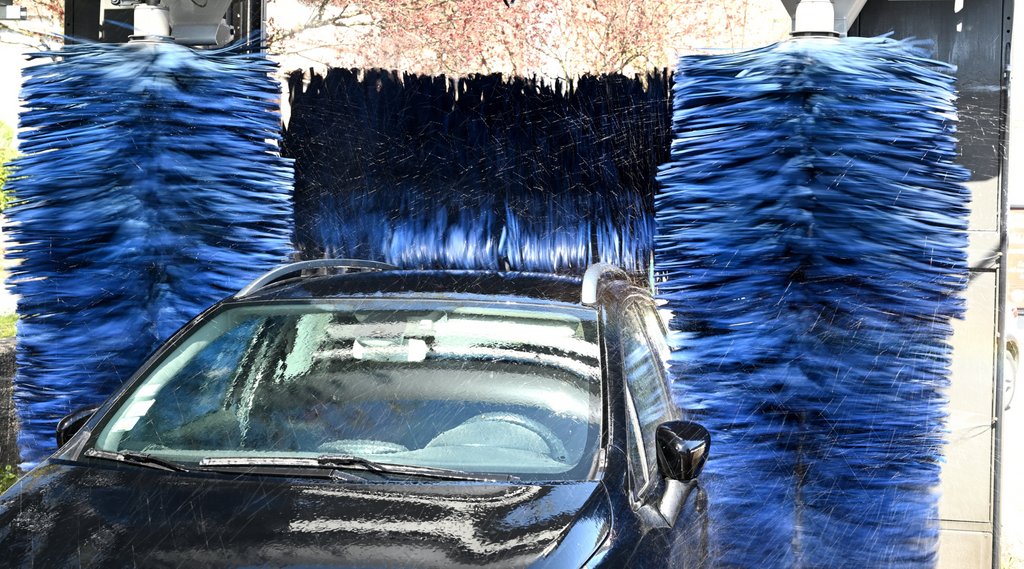
These systems use rotating brushes, foam rollers, or cloth strips to loosen dirt while detergent and water are applied.
Advantages:
- Usually removes more stubborn surface dirt than a basic touchless cycle
- Often includes more thorough mechanical agitation
- May provide better results when the vehicle has heavy road grime
Limitations:
- Shared cleaning materials can carry grit if they are poorly maintained
- Loose trim, decals, wipers, or exterior accessories can be damaged
- Repeated contact washing may contribute to fine swirl marks, especially on dark paint
If protecting paint is your highest priority, a well-maintained touchless wash is generally the lower-contact option. If maximum cleaning is more important, a reputable brush wash may perform better. Neither system replaces careful hand washing for delicate finishes. You can also read our guide on are automatic car washes bad for black cars.
For a paint-focused alternative, compare the process with this gentler wash routine.
What to Check Before Entering
Spend a minute preparing the vehicle. This prevents the most common problems and helps the wash work as intended.
Close and secure the exterior
Before entering the queue:
- Close all windows, the sunroof, and the convertible top.
- Confirm that every door, hatch, and trunk is fully latched.
- Remove or retract a magnetic antenna if the facility requires it.
- Fold in power-folding mirrors if the instructions permit it.
- Remove roof boxes, flags, suction-cup signs, and other temporary accessories.
- Remove or secure bicycle racks, cargo carriers, and other exterior equipment.
- Check that license plates and frames are firmly attached.
- Turn off automatic windshield wipers and rain-sensing wipers.
- Make sure the fuel door and charging-port door are closed.
Do not assume a “soft” accessory is safe. Loose trim, aftermarket spoilers, decorative lighting, vinyl edges, and partially detached weather seals can catch on brushes or high-pressure air. You can also read our guide on how to keep a black car clean between washes.
Inspect the vehicle’s condition
Avoid an automatic wash if your vehicle has:
- A loose bumper, mirror, grille, or underbody panel
- Severely peeling paint or lifted vinyl
- A damaged windshield or side glass
- A soft convertible top that is not fully secured
- A freshly repaired or repainted panel
- An unsecured roof rack or cargo load
A wash cannot repair existing damage, and water pressure may make a loose part worse. Older or specialty vehicles may be better served by careful hand washing; owners of historic vehicles can also review older-car ownership requirements before using equipment that may be unsuitable for fragile trim.
Consider vehicle clearance
Look for posted limits covering:
- Vehicle height
- Vehicle width
- Wheel or tire size
- Ground clearance
- Roof-mounted equipment
- Dual rear wheels or unusual body shapes
If you are unsure whether your vehicle fits, ask an attendant before paying. Clearance information is especially important for lifted trucks, vans, campers, and vehicles with roof accessories. This guide to vehicle clearance considerations may also help you think through dimensions before entering a restricted facility. You can also read our guide on best waterless car wash for tesla.
How to Use an Automatic Car Wash Step by Step
Step 1: Choose a suitable facility
Select a wash that matches your vehicle’s condition and equipment. Look for clear instructions, visible safety signs, clean bays, and equipment that appears maintained.
Avoid entering during conditions that could affect safety, such as severe freezing weather, flooding around the entrance, or an icy ramp. If temperatures are below freezing, check whether the facility is operating normally and whether water may freeze around doors, mirrors, or locks after the wash. You can also read our guide on will car wash scratch my car.
Step 2: Select the wash package
Wash menus vary, but common options include:
| Option | What it usually provides | When it may help |
|---|---|---|
| Basic wash | Soap, rinse, and a basic dry or air blow | Regular light cleaning |
| Premium wash | Additional rinse stages, wheel cleaner, or stronger drying | Moderate road grime |
| Wax or protectant | A temporary surface treatment | Extra gloss and water beading |
| Underbody wash | Water directed beneath the vehicle | Road salt or winter residue |
| Tire or wheel service | Wheel cleaning and tire dressing | Improving the appearance of wheels and tires |
A more expensive package is not automatically a better choice. Wax cycles are temporary and do not replace a professionally applied paint coating. Likewise, an underbody rinse can remove surface residue but will not fix corrosion or replace mechanical inspection.
If your vehicle has a ceramic coating or another paint treatment, check the coating manufacturer’s maintenance guidance before selecting strong detergents, waxes, or sealants. You can also read our guide on are touchless car washes bad for your car.
Step 3: Pay and read the instructions
Pay at the entrance kiosk, cashier, or membership terminal. Keep your receipt, code, token, or wash code until the service is complete.
Before moving forward, read the on-screen or posted directions. Pay particular attention to instructions about:
- Whether to stop or continue moving
- Whether to select neutral
- Whether to keep the engine running
- Whether to release the parking brake
- Whether to fold the mirrors
- Whether to remove or disable automatic features
Do not rely on memory from another car wash. Equipment layouts and procedures differ.
Step 4: Line up with the entrance
Drive slowly toward the bay or conveyor. Follow the painted arrows, traffic lights, wheel guides, and signals from the attendant.
For a conveyor system, align the vehicle’s drive wheels with the track or guide system as directed. Keep the steering wheel straight unless the signage says otherwise. Stop when the light, sign, or attendant tells you to stop.
Never turn sharply or attempt to reposition once the conveyor has engaged.
Step 5: Select the correct gear
The required gear depends on the wash design:
- Conveyor systems: They commonly require the vehicle to be in neutral so the track can move it.
- In-bay systems: They may require park, neutral, or another specific setting.
- Vehicles with automatic parking brakes or Auto Hold: You may need to disable those features if the facility instructs you to do so.
- Manual-transmission vehicles: Follow the facility’s directions exactly; some systems may require neutral with the clutch released.
If the sign says to select neutral, do so only after the vehicle is properly positioned. Keep your foot off the brake once the conveyor begins unless an emergency requires you to stop.
Step 6: Keep the vehicle stationary during the wash
Once the wash starts:
- Keep windows, doors, and the sunroof closed.
- Do not steer unless directed.
- Do not press the accelerator.
- Do not brake on a moving conveyor.
- Do not shift gears while the vehicle is being pulled.
- Do not exit the vehicle.
- Do not reach outside to adjust mirrors or equipment.
If you notice a serious problem, use the facility’s emergency instructions or alert an attendant. Do not open a door simply because the machine pauses; automatic systems often stop briefly between stages.
Step 7: Wait for the exit signal
The wash may include a pre-rinse, detergent application, brushes or high-pressure jets, wheel cleaning, a final rinse, and drying. Stay focused on the exit signal rather than assuming the cycle is finished when the water stops.
In practice, the final drying stage may not remove every drop of water. Crevices around mirrors, door handles, badges, grilles, and license plates commonly retain moisture.
Step 8: Exit carefully
When the system signals that you can leave:
- Shift into drive or first gear as directed.
- Release the brake smoothly.
- Move forward slowly.
- Follow the exit lane and watch for pedestrians.
- Do not stop in the conveyor exit unless an attendant tells you to.
Avoid immediately accelerating hard. Water can remain on the glass, mirrors, brakes, and pavement, reducing visibility or traction for a short distance.
What to Do After the Wash
Move to a designated parking or drying area before inspecting the vehicle. Do not block the exit for the next customer.
Check:
- Windshield, side glass, and mirrors
- Door handles and window seals
- License plates and cameras
- Wheels and wheel arches
- Lower doors and rocker panels
- Rear hatch, grille, and bumper corners
- Roof channels and areas beneath the mirrors
Use a clean, soft microfiber towel for remaining water if the facility permits hand drying. Do not use a towel that has fallen on the ground; trapped grit can scratch the paint.
If you plan to apply a detail spray, sealant, or polish, wait until the surface is clean and mostly dry. Wax or protectant applied by the machine is usually a light maintenance product, not a permanent finish.
After an underbody wash, inspect for hanging panels or loose splash shields. The wash itself is not a mechanical inspection, and it does not replace checking for corrosion or damage. For broader under-vehicle ownership concerns, you can review information about catalytic-converter protection.
Common Mistakes to Avoid
Leaving automatic wipers enabled
A sensor may activate the wipers when water hits the windshield. The blades can strike wash equipment or operate unnecessarily. Switch automatic wiping off before entering.
Braking on a conveyor
Braking can interfere with the conveyor and may cause the vehicle to stop unexpectedly. Use the brake only when necessary or when instructed.
Entering with loose equipment
Loose antennas, roof-mounted items, dangling trim, and unsecured racks are common causes of wash-related damage.
Choosing the strongest package every time
Extra wax, tire dressing, or underbody treatment may not be necessary for every wash. Select services based on your vehicle’s condition rather than the package name alone.
Using a wash with an active defect
A cracked mirror, loose bumper, peeling wrap, or unsecured panel can worsen during high-pressure rinsing or mechanical contact.
Assuming all car washes use the same controls
One facility may require neutral while another requires park. Always follow the instructions at the entrance.
Ignoring tire and wheel condition
A wash can expose low tire pressure, a loose hubcap, or a damaged valve stem. Afterward, visually inspect the tires and use a reliable gauge when needed. If you maintain your own equipment, this tire-inflation equipment guide explains why compressor capacity and duty cycle matter.
How Often Should You Use an Automatic Car Wash?
The right schedule depends on driving conditions, weather, and how much dirt accumulates on the vehicle.
Consider washing more often after:
- Driving on salted or heavily treated roads
- Long trips through rain, mud, or construction zones
- Exposure to bird droppings, tree sap, or insects
- Coastal driving or contact with salty air
- Winter conditions that leave residue beneath the vehicle
Bird droppings, tree sap, and bug residue should not remain on paint longer than necessary because they can become difficult to remove and may etch the finish. A quick automatic wash is useful for removing loose contamination, but heavy buildup may need targeted hand cleaning.
When a Hand Wash Is the Better Choice
Choose a careful hand wash instead of an automatic system when:
- The vehicle has delicate or loose exterior parts
- You need to clean around vinyl graphics or lifted decals
- The paint is freshly repaired
- You want maximum control over wash mitts and drying towels
- The vehicle has a fragile classic finish
- You need to remove a specific contaminant without aggressive equipment
Automatic washes are convenient maintenance tools, not a universal solution. For a lightly dirty daily driver, they can be practical. For a highly contaminated, newly painted, or collectible vehicle, controlled hand washing is usually safer.
Frequently Asked Questions
Do I put my car in neutral at an automatic car wash?
Often, yes—especially on a conveyor wash. However, some in-bay systems require park or another setting. Read the entrance instructions and follow the attendant’s directions instead of assuming neutral is always correct.
Should I turn off the engine?
Not unless the facility tells you to. Many washes require the engine to remain running so you can operate the vehicle when the cycle ends. Others may provide different instructions. Follow the posted procedure.
Can I use an automatic car wash with a roof rack?
It depends on the rack and the facility. A permanently installed, low-profile rack may be allowed, while loose crossbars, cargo boxes, flags, and bike carriers may not be. Check posted clearance and equipment rules before entering.
Can automatic car washes scratch paint?
Any contact wash can contribute to fine marks if brushes or cloth materials are contaminated with grit, although maintenance quality varies widely. Touchless washes avoid direct mechanical contact but may not remove heavy dirt as completely. No wash type is entirely risk-free.
Is touchless washing safer for ceramic coating?
Touchless washing reduces physical contact, but the detergent and drying process still need to be compatible with the coating manufacturer’s instructions. A touchless wash is not automatically safe for every coating or sealant.
Can I use an automatic wash in winter?
Usually, but freezing conditions require extra caution. Water can freeze around door seals, mirrors, locks, and brakes. Avoid washing when conditions make the entrance or exit icy, and drive carefully afterward.
How long does an automatic car wash take?
The active wash cycle commonly takes only a few minutes, but the total time depends on the queue, payment process, equipment, and drying stage. Leave enough time to inspect the vehicle safely after exiting.
Does an automatic car wash clean the underside of my car?
Only if you select or use a system with an underbody rinse. Even then, it generally removes loose residue rather than repairing corrosion, cleaning every hidden area, or replacing a professional inspection.
Final Checklist
Before entering:
- Close windows, doors, and the sunroof.
- Disable automatic wipers.
- Remove or secure loose exterior accessories.
- Check vehicle height, width, and ground clearance.
- Choose touchless or contact equipment based on your vehicle’s needs.
- Read the facility’s gear and braking instructions.
During the wash:
- Position the vehicle carefully.
- Select the required gear.
- Keep your hands and feet off the controls.
- Do not open doors or windows.
- Wait for the exit signal.
After the wash:
- Exit slowly and safely.
- Inspect glass, mirrors, wheels, trim, and cameras.
- Dry remaining water with a clean microfiber towel.
- Check for loose panels or accessories.
- Drive cautiously until visibility and traction are normal.
Using an automatic car wash is quick and simple when you prepare the vehicle, follow the facility’s instructions, and choose equipment suited to its condition. For routine dirt on a normal daily driver, it can be an efficient way to keep the exterior clean without spending an hour washing at home.








