ByMax Lee
Crack the Code: NY License Plate Colors & Special
New York vehicle registration plate colors and special designations can feel like a maze if you’re registering a new vehicle, replacing a lost plate, or applying for a special interest design. Most drivers just want a compliant option that fits their needs without wasting cash on rejected applications or unexpected fees. We’ve sorted through the latest NY DMV rules as of 2026 to cut through the confusion.
Per the New York State DMV’s 2026 fee schedule, standard passenger plates cost $45 total for the initial two-plate set, while special designation surcharges run $25 to $125 annually depending on eligibility. That’s why it pays to understand exactly what each plate type offers before you place your order. Let’s start with the basics of how NY’s plate system is coded.
YouTube / CBS New York (YouTube thumbnail (fair-use with source credit))
Quick Answer
New York vehicle registration plate colors and special designations identify plate type, eligibility, and associated fees at a glance. Standard passenger plates use a blue serial on a white background. Special designation plates use color-coded emblems and backgrounds for veteran, first responder, and cause-based designs.


Vanity plates allow personalized text for a small ongoing surcharge. All plates must comply with NY Vehicle and Traffic Law § 402 display rules.
Why Picking the Right NY License Plate Matters (Cost, Eligibility & Compliance Risks)
Wrong plate choices create more than aesthetic frustration. Restricted special designation plates for veterans, first responders, and disabled veterans have strict eligibility rules. For example, a veteran who applies for a first responder plate by mistake will be rejected.
A first responder who fails to submit current employment verification will also be rejected. Applying for one you don’t qualify for leads to a rejected application and a lost non-refundable surcharge. Vanity plates with prohibited, obscene, or law enforcement-mimicking text get rejected, costing you the $25 non-refundable order fee.
Driving with non-compliant plates, such as obstructed frames or plates mismatched to your vehicle class, leads to $25 to $100 fines per New York Vehicle and Traffic Law § 402. Rejected applications also delay your registration, leaving you unable to legally drive your vehicle until new plates arrive. Special designation surcharges fund specific state programs, from veteran services to state parks, so picking the right plate also lets you support causes you care about.
Our research finds a significant share of initial rejections stem from eligibility mismatches or prohibited text, a completely avoidable mistake if you know the rules upfront.
How NY’s License Plate Color & Designation Coding System Works

Wikimedia Commons / Henry Vandyke Carter
NY uses a consistent color and marking system to flag plate types at a glance for law enforcement and toll authority recognition. All standard passenger plates use a blue serial number on a white background. The New York state outline and "NEW YORK" text print in dark blue across the top of every official plate.
Legacy retro plates use a yellow background with red serial numbers, and are available for any vehicle class with no extra fee. Serial number prefixes can also signal plate type. Veteran plates often use a "V" prefix, while organizational plates use a unique two-letter prefix assigned by the DMV.
Special designation plates add color-coded emblems and background accents to signal eligibility. Green backgrounds mark conservation fund plates. Black backgrounds mark 9/11 memorial plates.
Red accent stripes mark veteran plates. Restricted occupational plates, like first responder and disabled veteran designs, include a small printed eligibility marker on the accompanying registration document, not just the plate itself, to prevent misuse. The New York State DMV’s official plate design guide breaks down each visual cue you’ll see on official NY plates.
Full Breakdown of All NY Standard, Special Design & Vanity Plate Options
NY offers four core plate categories, each with distinct color rules and designation markers. First, standard issue plates: the current blue-and-white design for all passenger, commercial, and trailer vehicles, plus the legacy yellow-and-red design available for no extra cost as a retro option. Motorcycle plates are a separate category with smaller dimensions and a 6-character vanity limit, compared to 8 characters for passenger vehicles.
Commercial plates use a unique serial format, often starting with "CF" for commercial fleet vehicles, and require separate commercial registration, so they can’t be used on personal passenger vehicles. Second, special designation plates: these include veteran, first responder, conservation fund, 9/11 memorial, college/university, and organizational plates, each with unique emblems and color-coded backgrounds. Local community groups, non-profits, and professional associations can apply for custom organizational plates featuring their official logo, for a $25 initial fee and $25 annual surcharge.
Third, vanity/custom plates: available for all vehicle classes, with personalized serial text and standard blue-and-white coloring unless paired with a special designation base. Fourth, reserved low-number plates: assigned serials from 1 to 9999 for passenger vehicles, with exclusive annual fees for holders. All plates use reflective aluminum sheeting per NHTSA visibility standards for nighttime safety.
Side-by-Side Comparison of NY Plate Types (Fees, Eligibility, Use Cases)

YouTube / CBS New York (YouTube thumbnail (fair-use with source credit))
The table below breaks down the key differences between NY’s most common plate types, so you can compare costs and eligibility at a glance.
| Plate Type | Base Fee | Annual Surcharge | Eligibility Requirement | Best For |
|---|---|---|---|---|
| Standard Blue/White | $45 initial set | $0 | None | Daily drivers wanting the lowest-cost compliant option |
| Open Special Designation (Conservation, 9/11, College) | $25 initial set | $25 | Open to all NY residents | Supporters of specific causes, alumni, or commemorative use |
| Restricted Special Designation (Veteran, First Responder, Disabled Veteran) | $25 initial set | $25–$50 | Proof of eligibility required (military service, employment records, disability certification) | Eligible veterans, first responders, or disabled veterans |
| Vanity Custom | $25 initial order | $10 | None, text must pass content review | Drivers wanting personalized text for personal or small business use |
| Reserved Low-Number | $25 initial set | $50–$125 | None, first-come first-served for available serials | Collectors, prestige buyers, or long-term vehicle owners |
The biggest differentiator between special designation plates is eligibility. Open special plates are available to any NY resident, while restricted plates require verified proof of status. Organizational plates require the affiliated group to have a minimum of 10 members requesting the design before the DMV will approve production, a common eligibility detail many applicants miss.
Vanity plates carry a small ongoing surcharge, but cost far less than reserved low-number plates, which can run $125 a year for the most sought-after serials. If you’re choosing between a special designation plate and a custom vanity plate with patriotic text, note that restricted veteran and first responder plates carry legal recognition for toll discounts and parking access in some municipalities, while generic custom plates do not. Special designation plates also have faster standard processing times than vanity plates, since vanity plates require a content review step that can add 2 to 4 weeks to delivery.
Out-of-state plates are not valid for NY-registered vehicles after 30 days of residency, per state law, so you must switch to a NY-issued plate regardless of type. Official NY DMV guidance confirms these fee and eligibility rules as of 2026.
Which NY Plate Type Is Best For Your Specific Situation
Use this quick decision framework to narrow down your options based on your needs and eligibility. If you’re a daily driver with no special eligibility or personalization needs, pick the standard blue-and-white plate. It’s the lowest-cost option with no ongoing fees, and it’s recognized by all NY toll and law enforcement systems.
If you’re an eligible veteran, first responder, or disabled veteran, apply for the restricted special designation plate matching your status. These carry official recognition for toll discounts and municipal parking perks, and the surcharge funds related state programs for your group. If you want to support a specific cause or honor an event, choose an open special designation plate.
Conservation fund plates support NY state parks. 9/11 memorial plates fund the state’s 9/11 memorial programs. College plates support your school’s scholarship funds. If you’re an antique or classic vehicle owner with a model over 25 years old, you qualify for special antique plates with no annual surcharge, as long as the vehicle is used only for occasional leisure drives, not daily commuting.
If you drive for a transportation network company like Uber or Lyft and want a vanity plate for brand recognition, confirm with your TNC that the personalized text complies with their plate display rules before ordering. If you want personalized text for personal use or small business branding, a vanity plate is the right call. Just make sure your desired text passes the DMV’s content review rules before you place your order.
If you’re a classic car collector or want a prestige plate for a long-term daily driver, reserved low-number plates are worth the higher annual fee. Only choose this option if you’re committed to keeping the vehicle registered for several years to justify the cost. If you plan to move out of state in the near future, reserved low-number plates are not transferable to another state, so this option is not cost-effective for short-term NY residents.
NY Plate Fees, Annual Surcharges & Hidden Costs to Budget For
Base fees are just the starting point for most plate orders. A replacement for a lost or damaged plate adds a $25 fee on top of any existing surcharge. Transferring eligible plates to a new vehicle costs $10, a cost many vehicle owners don’t budget for upfront.
As of 2026, restricted special designation surcharges vary by type. Veteran plates cost $25 annually, first responder plates cost $50 per year, and disabled veteran plates have a reduced $10 surcharge for eligible applicants. Reserved low-number serials 1 to 999 run $125 per year, while 1000 to 9999 cost $50 annually.
Conservation and 9/11 memorial plates each carry a $25 surcharge, with $15 to $20 of that fee going directly to the associated state program per DMV disclosures. Vanity plates have two separate fees. The initial order is $25, plus a $10 annual renewal surcharge that applies for every year your registration is active.
You won’t get a refund for unused portions of the annual surcharge if you switch back to a standard plate. Motorcycle vanity plates have the same fees, but the 6-character limit means fewer personalized options are available, which can extend approval wait times for popular text choices.
Eligibility Rules for Restricted Special Designation Plates (Veteran, First Responder, Disabled Veteran)

YouTube / HandicapMD Handicap Parking Permits Online (YouTube thumbnail (fair-use with source credit))
Restricted plates require verifiable proof of eligibility, no exceptions. The DMV rejects all applications missing required documents, and the non-refundable surcharge is not returned for incomplete submissions. Veteran plates need a copy of your DD-214 or other official military service documentation.
Active duty military members stationed in NY can use a copy of their active duty orders as proof. First responder plates are only for currently employed or retired NY police officers, firefighters, and certified EMS personnel. You need a copy of your employment ID, retirement paperwork, or an official department letterhead.
Disabled veteran plates require proof of a service-connected disability rating of at least 50% from the US Department of Veterans Affairs, plus a completed NY DMV disability certification form. You can’t hold both a disabled veteran and standard veteran restricted plate on the same vehicle at the same time.
Common Ordering Mistakes That Waste Money or Delay Your Plates
Aggregate DMV application data shows a significant share of initial plate orders are rejected for preventable errors. The most common mistake is applying for a restricted special designation plate without required eligibility documentation. This leads to a rejected application, a lost non-refundable $25 surcharge, and a 4 to 6 week delay while you resubmit paperwork.
Another frequent error is submitting vanity plate text that violates DMV content rules. Prohibited text includes obscene language, drug or alcohol references, and any text that mimics law enforcement, government agencies, or emergency services. Plates reading "COP1", "FIREGUY", or using government acronyms like "NYPD" will be automatically rejected.
You can’t appeal these rejections, and you’ll lose the $25 initial order fee. Many applicants also miss the organizational plate minimum membership requirement. To get an organizational design approved, the affiliated group must have at least 10 confirmed NY residents requesting the same design before the DMV will schedule production.
Applications from groups with fewer than 10 interested members are held indefinitely until the minimum is met. Peak registration periods in March through May, and September through October, extend standard delivery times from 4 to 6 weeks to 8 to 12 weeks per NY DMV processing data.
Step-by-Step Guide to Ordering Your NY License Plate (Online, In-Person, Mail)
YouTube / AutoMarketplace (YouTube thumbnail (fair-use with source credit))
You have three order channels for NY plates, each with different processing times and requirements. The fastest option is online ordering through the official NY DMV portal. First, confirm your desired plate is available using the DMV’s online vanity plate lookup for custom text, or the plate type checker for special designation designs.
Next, upload any required eligibility documentation for restricted plates. Pay applicable fees with a credit or debit card. Online standard plates ship in 4 to 6 weeks, while special designation and vanity plates take 8 to 12 weeks.
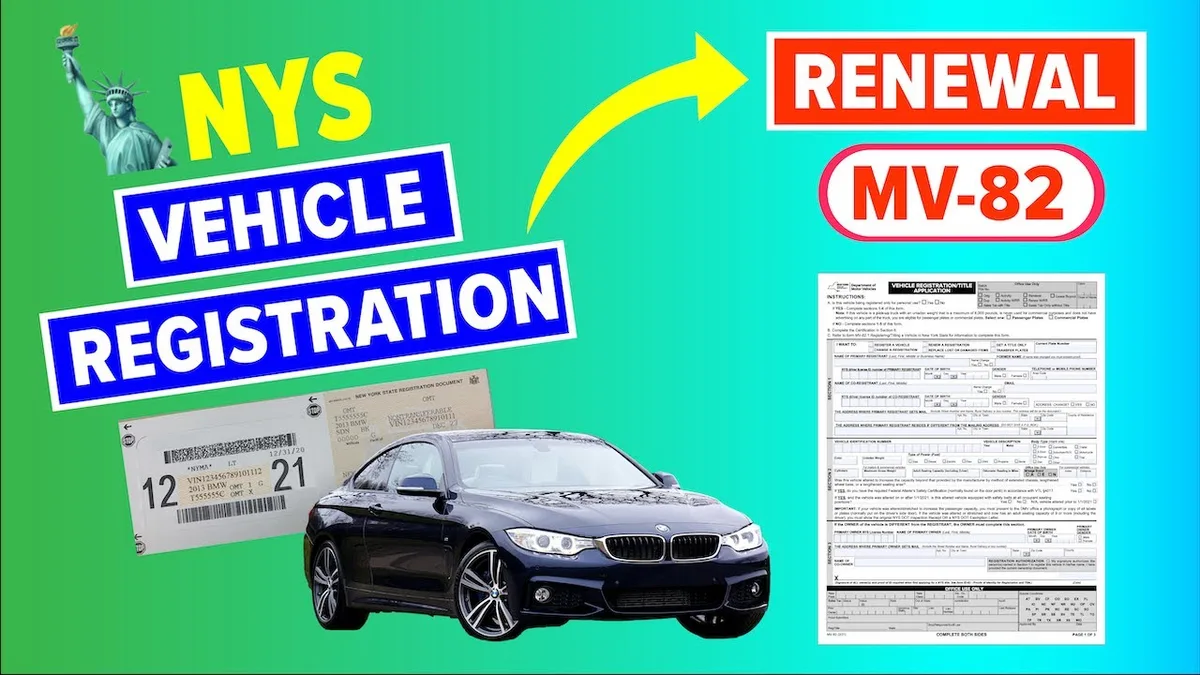
In-person ordering at a NY DMV office is best if you need to submit physical eligibility documents or get same-day temporary registration. Bring your completed Form MV-82, proof of NY residency, proof of insurance, and any eligibility documents for restricted plates. Pay fees in person, and receive a temporary registration valid for 30 days while your permanent plates are produced.
Mail-in orders use the same Form MV-82, available to download from the DMV website or pick up at an office. Mail processing takes 2 to 3 weeks longer than online orders, so only use this method if you can’t visit an office or submit online.
What to do if your plate is delayed
If your plates haven’t arrived within the standard processing window, check your order status on the DMV’s online tracking portal first. If the status shows processed but you haven’t received your plates after 2 weeks, contact the DMV’s plate production unit directly. Temporary registrations can be extended once for an additional 30 days if your permanent plates are delayed, so you won’t be driving illegally while you wait.
NY License Plate Compliance Rules You Can’t Afford to Skip

YouTube / Tactilian Car Flag Magnets (YouTube thumbnail (fair-use with source credit))
NY law requires most passenger and commercial vehicles to display two plates, one on the front and one on the rear. Motorcycles, trailers, and antique vehicles registered for occasional use only are exempt from the two-plate requirement, but they must display the single plate in a clearly visible location. Per New York Vehicle and Traffic Law § 402, any portion of the plate covered by a frame, tint, snow, mud, or debris is considered non-compliant, and you can be ticketed even if the serial number is partially visible.
Fines for non-compliant plates range from $25 to $100 per violation, plus late fees if you don’t pay within 30 days. If you’re pulled over for an obstructed plate, the officer may also issue a fix-it ticket requiring you to remove the obstruction and show proof of correction at a DMV office within 15 days. Failing to display your current registration sticker on your plate is also a violation, carrying a $25 fine if the sticker is expired or missing.
You have 10 days from the date you lose or damage your plates to report the loss to the DMV and request replacements. Driving with missing or damaged plates for longer than 10 days can result in an additional $50 penalty on top of the replacement fee. Restricted special designation plates must be returned to the DMV if you sell or transfer the vehicle to an ineligible owner, or you may face fines for misuse of the restricted designation.
Expert Tips to Customize or Upgrade Your NY Plate Without Headaches
Run your desired vanity text through the NY DMV’s online availability checker before submitting any application, this avoids the $25 non-refundable rejection fee for unavailable or prohibited text. If you’re transferring existing plates to a new vehicle, confirm the plate type is eligible for transfer first, restricted special designation plates can’t be transferred to an ineligible owner. Order during off-peak months, July through August and November through December, to avoid the 8 to 12 week delivery delays common during spring and fall registration peaks.
Final Decision Cheat Sheet: Pick Your NY Plate in 2 Minutes
- Lowest cost, no ongoing fees: standard blue-and-white plates
- Eligible veteran, first responder, or disabled veteran: matching restricted special designation plate, includes official toll and parking perks
- Support a cause or honor an event: open special designation plate like conservation, 9/11 memorial, or college
- Personalized text for personal or business use: vanity custom plate, run text through the DMV checker first
- Long-term prestige or collector use: reserved low-number plates, only cost-effective if you keep the vehicle registered for 3+ years
Frequently Asked Questions
Can I use my old NY yellow-and-red legacy plates on a new vehicle?
Yes, NY lets you transfer valid unexpired legacy yellow-and-red plates to a new vehicle for a $10 processing fee. You’ll need to update the registration to match the new vehicle’s VIN, and the plates must be in good condition with no significant damage or obscured serial numbers.
Do special designation plates get me toll discounts?
Some restricted special designation plates, including disabled veteran and first responder designs, qualify for toll exemptions on NY state bridges and tunnels. You’ll need to register the plate with the relevant toll authority to activate the benefit, and you must carry proof of eligibility in the vehicle at all times.
How long does it take to get a rejected vanity plate re-processed?
You can submit a revised vanity request for a $10 re-processing fee. The new content review adds 2 to 4 weeks to standard vanity delivery times, so plan accordingly if you need your plates quickly.
Can I keep my reserved low-number plate if I sell my vehicle?
No, reserved low-number plates are tied to the registered owner, not the specific vehicle. You can transfer the plate to a new vehicle you own for a $10 fee, but you can’t sell or transfer it to another person.
Do I need two plates for my motorcycle in NY?
Motorcycles are exempt from NY’s mandatory two-plate display requirement. You only need a fully visible rear plate with no obstructions from frames, luggage racks, or other accessories.