ByMax Lee
Mississippi Radar Detector Laws for Cars & Trucks
YouTube / Gun Slinger 221 (YouTube thumbnail (fair-use with source credit))
Mississippi radar detector legality in passenger and commercial vehicles depends entirely on what you're driving. The rules split cleanly between personal cars and commercial rigs, and getting it wrong can cost you far more than a speeding ticket.
Per Federal Motor Carrier Safety Administration standards, commercial vehicles over 10,000 lbs GVWR face a blanket ban, while Mississippi state law allows detectors in passenger cars. Here's how to know which side of the line you're on.
Quick Answer: Yes for Passenger Cars, No for Commercial Vehicles
Mississippi allows radar detectors in passenger vehicles. They are illegal in commercial vehicles over 10,000 lbs. CDL holders cannot use them in any commercial vehicle.
Federal law overrides state law for commercial drivers.

YouTube / Exclusive Tech Products (YouTube thumbnail (fair-use with source credit))
How Mississippi Defines Passenger vs. Commercial Vehicles
Mississippi follows the federal standard for commercial vehicles. If a vehicle is used in commerce and weighs over 10,000 lbs, it counts as commercial. This covers most semi-trucks, box trucks, and large delivery vans.
Passenger vehicles are simpler to classify. If the vehicle is registered for personal use and stays under the weight threshold, it qualifies as a passenger vehicle. This includes sedans, minivans, and most pickup trucks when they're not used for business purposes.

YouTube / schneiderjobs (YouTube thumbnail (fair-use with source credit))
The key test comes down to purpose and weight. A pickup towing a camper for a family vacation stays a personal vehicle. The same pickup hauling landscaping equipment for pay becomes commercial.
The line isn't always obvious, so check your registration and intended use before making a decision.
The Federal Rule That Overrides Mississippi for CDL Holders
The Federal Motor Carrier Safety Administration bans radar detectors in all commercial motor vehicles. This rule applies nationwide and is not unique to Mississippi. It covers any vehicle requiring a Commercial Driver's License.
Even if your commercial vehicle weighs under 10,000 lbs, holding a CDL triggers the federal ban. This includes vehicles transporting hazardous materials or designed to carry more than 15 passengers.

YouTube / The Buzbee Law Firm (YouTube thumbnail (fair-use with source credit))
Mississippi cannot override this federal requirement. If you hold a CDL and drive commercially, a radar detector belongs nowhere in your cab. The FMCSA maintains clear guidance on their official website for commercial drivers who need clarification.
Violations can result in penalties beyond simple fines, including potential CDL disqualification.
What Happens If You're Caught with a Radar Detector in a Commercial Vehicle?
You will receive a traffic citation at minimum. Mississippi fines vary by jurisdiction, but the real danger falls on your CDL status. Federal regulations allow authorities to disqualify your commercial driving privilege for this violation.
The fine itself may range from a few hundred dollars upward depending on county and circumstances. The CDL consequences carry far more weight for professional drivers. A single violation can trigger a formal review of your entire driving record.

YouTube / ABC24 Memphis (YouTube thumbnail (fair-use with source credit))
Law enforcement does not need to prove you actively used the device. Simply having it inside the cab of a commercial vehicle satisfies the possession element of the offense. The rule treats any detector presence as a violation regardless of whether it was powered on or hidden in a glove compartment.
Why the Confusion Exists (And How to Avoid It)
Mississippi's permissive state law for personal vehicles creates a false sense of universality. Drivers assume the allowance extends to every vehicle they operate. Federal law intersects at the commercial threshold, producing two contradictory rules for identical-looking devices.
Many drivers fail to recognize that their vehicle qualifies as commercial. A company van, a work pickup, or a fleet vehicle all fall under the federal ban even when registered in Mississippi. The mismatch between state and federal rules generates uncertainty, especially for independent contractors and small business owners.
Step-by-Step: Check If Your Vehicle Qualifies as Commercial
Start by reviewing your vehicle registration document. If the registration marks the vehicle as commercial, the federal prohibition applies immediately. Next, locate the Gross Vehicle Weight Rating on your door jamb sticker or in the owner's manual.
Any rating above 10,000 lbs designates a commercial motor vehicle.
Check whether you hold a CDL. If you do, the federal ban covers every commercial vehicle you operate regardless of weight. The rule applies equally to light vans and heavy tractor-trailers.
YouTube / Motor Matchups (YouTube thumbnail (fair-use with source credit))
When your situation falls into a gray area, answer these three questions. Is the vehicle registered for personal use only? Does it weigh 10,000 lbs or less?
Do you hold a CDL? Answer no to all three, and a radar detector is legal for your situation. Answer yes to any one, and assume the device is prohibited.
Radar Detectors vs. Laser Jammers: What's Actually Legal?
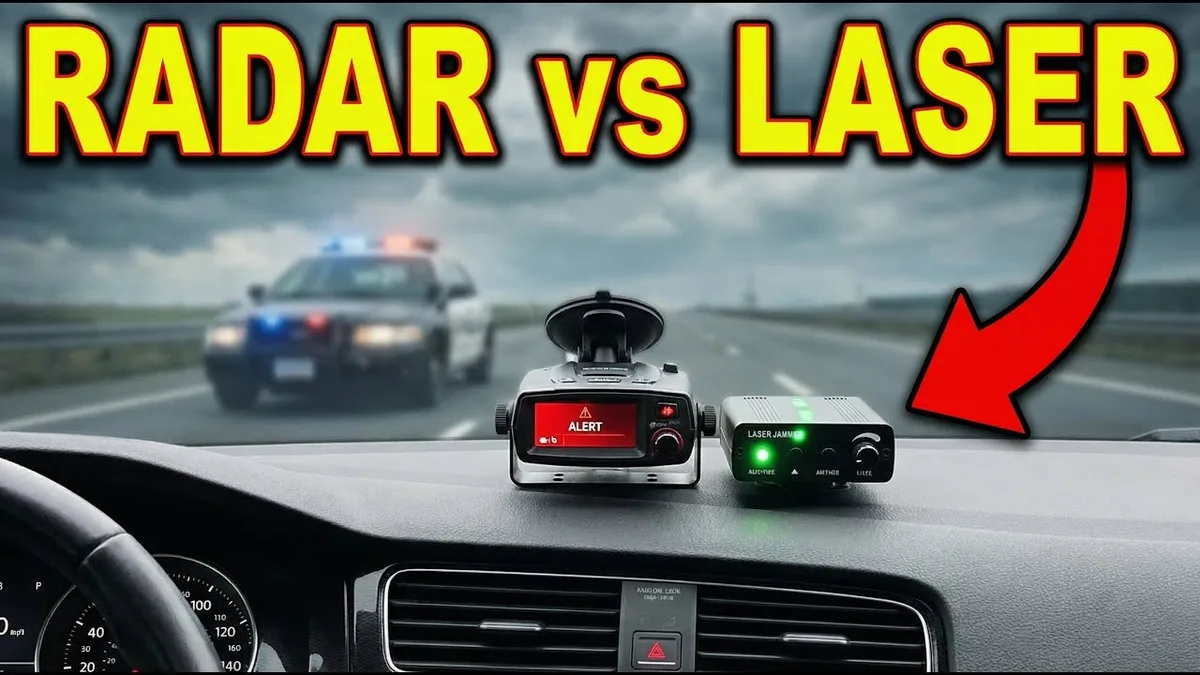
Radar detectors are permitted in Mississippi passenger vehicles. Laser jammers face a blanket prohibition statewide and federally. The distinction rests on how each device interacts with law enforcement equipment.
A radar detector passively receives radio signals emitted by police speed measurement tools. A laser jammer actively transmits signals designed to interfere with those same tools. Mississippi treats active jamming devices as illegal across all vehicle types, not just commercial ones.
If you examine a device label and see language about jamming, scrambling, or interfering with police equipment, that product is unlawful. Stick to passive detection units exclusively. This rule aligns with federal statutes that prohibit any interference with authorized law enforcement technology.
Mississippi's Enforcement: What to Expect on the Road
The Mississippi State Highway Patrol enforces radar detector restrictions actively, particularly for commercial operators. Officers target trucks and buses along major corridors where federal compliance receives heightened scrutiny. They do not need evidence of active detector use to issue a citation.
For passenger vehicle drivers, enforcement remains uncommon. Officers typically prioritize moving violations over device possession. Should a detector come to attention during a routine stop for another infraction, the officer will note its presence and confirm legality for your vehicle class.
Commercial drivers face the highest risk of detection and citation. Patrol units frequently monitor commercial corridors knowing the federal ban applies uniformly. If you operate commercially, leave the detector out of your vehicle entirely.
Common Mistakes That Get Drivers in Trouble
Assuming state permission applies to every vehicle type tops the list of errors. A landscaper's pickup serves a business purpose and likely qualifies as commercial despite its personal appearance. Always verify registration status and primary use before installing any detection device.
Ignoring CDL implications represents another frequent mistake. A light commercial vehicle still triggers the federal ban if your license requires a commercial endorsement. The weight threshold becomes irrelevant once a CDL enters the equation.
Some drivers attempt to avoid detection by storing the device in a glove box or console. Officers can and do cite drivers for possession alone. The regulation does not require the detector to be visible or operational.
Placement inside the cabin satisfies the violation regardless of concealment efforts.
Real-World Scenarios: Who Can Use a Radar Detector in Mississippi?
Match your situation against these common profiles to determine your legal standing. Each example demonstrates how the rules shift based on vehicle classification and purpose.
| Scenario | Detector Legal? | Reason |
|---|---|---|
| Sedan used for daily commuting | Yes | Passenger vehicle, personal use only |
| SUV used for family trips | Yes | Personal registration, under weight limit |
| Pickup for weekend hobbies | Yes | Not commercial, not business use |
| Van for small business deliveries | No | Commercial purpose triggers federal ban |
| Semi-truck with CDL | No | Federal rule, CDL restriction applies |
| Box truck under 10,000 lbs for work | No if CDL required | Check licensing requirement carefully |
| RV used primarily for recreation | Yes | Recreational vehicles qualify as passenger vehicles |
| Tow truck used for commercial hauling | No | Commercial vehicle classification |
If your circumstances diverge from every example above, return to the three-part test. Confirm your registration type, verify your vehicle weight, and determine whether you hold a CDL. Pass all three checkpoints and your detector usage is legal.
Fail any single checkpoint and assume prohibition applies.
This framework works because Mississippi adopts federal commercial vehicle standards without adding extra layers of restriction for personal drivers. The system stays straightforward once you identify which category matches your situation.
Frequently Asked Questions
Can I use a radar detector in my pickup truck in Mississippi?
It depends on how you use the truck. A pickup dedicated to personal transportation faces no restriction. The moment you employ it for business activity, the federal ban takes effect.
Verify your registration classification first. Commercial registration means no detector. Personal registration with no business use means you are clear to install one.
Does the ban apply to all trucks or just big rigs?
The federal rule covers commercial vehicles exceeding 10,000 lbs GVWR. CDL holders encounter the ban across all vehicle weights when operating commercially.
A light cargo van requiring a CDL falls under the prohibition. A recreational off-road truck used privately does not, provided it remains outside commercial service.
What happens if I keep the detector in my glove box?
Possession constitutes a violation inside any commercial vehicle. Storing a detector anywhere within the cab gives officers grounds for a citation. You do not need to be actively using the device.
The law treats any presence in a commercial vehicle as noncompliant. Remove the device completely when operating commercially to eliminate this risk entirely.
Are laser jammers legal in Mississippi?
No. Mississippi prohibits laser jammers across all vehicle categories. Federal law likewise bans any device engineered to disrupt police speed measurement equipment.
You may install a passive radar detector in a qualifying passenger vehicle. Any active jamming technology remains illegal everywhere in the state and nationwide.
What penalties apply for violating the commercial vehicle ban?
Fines vary by county and circumstance but typically land between $200 and $500 for first-time offenses. CDL disqualification carries far greater consequence for professional drivers.
A single violation can initiate formal review of your commercial driving record. Repeat infractions substantially increase the probability of license suspension or revocation.
Do passing commercial drivers need to comply with Mississippi's rules?
Yes. Federal commercial vehicle regulations apply on all U.S. highways regardless of state boundaries. A commercial driver transiting Mississippi must comply with the radar detector ban just as they would in any other state.
Your vehicle classification determines the rule, not your geographic location. Commercial rigs face identical prohibitions on Mississippi interstates as they do elsewhere.
Final Verdict: Should You Use a Radar Detector in Mississippi?
The answer rests on two variables: your vehicle classification and your licensing status. Drive a personal passenger vehicle and Mississippi presents zero barriers to detector ownership and use. Mount it properly, set your sensitivity levels, and proceed with confidence.
Drive commercially and the federal prohibition stands unbroken. No exemptions exist for necessity, ignorance, or convenience. Even temporary passage through Mississippi as a commercial operator demands full compliance with the ban.
When ambiguity clouds your assessment, default to the restrictive interpretation. Treat the detector as prohibited until you can definitively confirm purely personal vehicle status and absence of CDL requirements. The financial and professional cost of a violation far exceeds the expense of simply not installing the device.
Mississippi occupies the permissive end of the national spectrum compared to states like Virginia and Washington, where passenger vehicle detectors face outright bans. For Mississippi motorists, the decisive question remains the personal-or-commercial distinction. The rules clarify quickly once you establish your vehicle category.
If you want to understand how neighboring states handle similar questions, comparing how other states regulate radar detectors for different vehicle types provides useful perspective. State laws range from fully permissive to completely prohibitive, and knowing the landscape helps you make informed decisions wherever your travels take you.