ByMax Lee
Guide to Arizona Move Over Law for Utility Vehicles in 2026
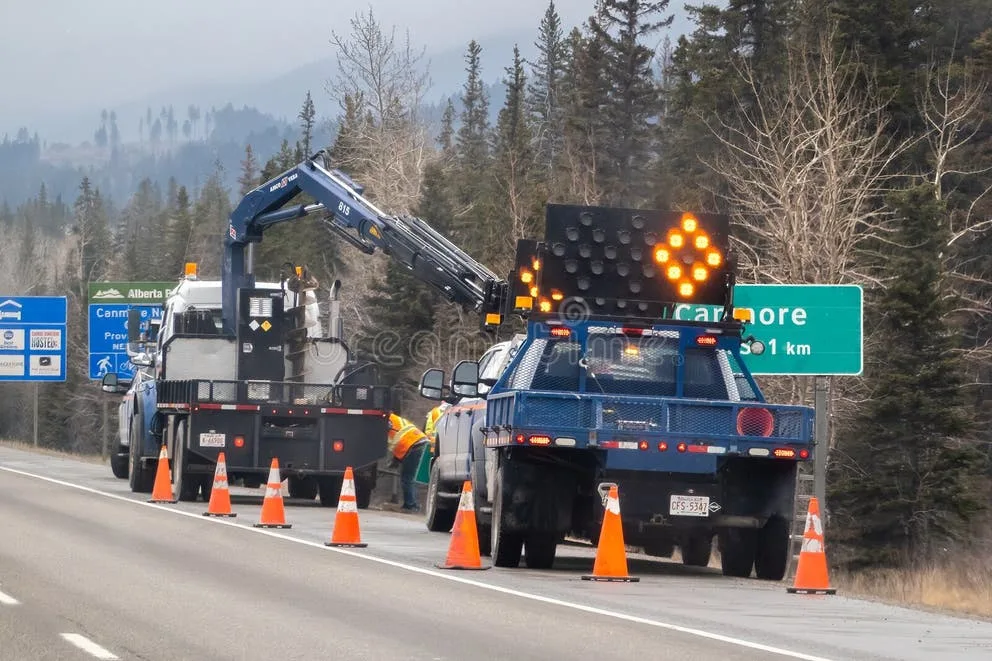
If you drive in Arizona, you've seen the flashing amber lights of a utility truck on the shoulder. The Arizona move over law for utility vehicles isn't a suggestion. It's the law, and it applies to you.
Most drivers know to move over for police cars and ambulances. Fewer realize the same rule covers utility trucks, tow trucks, and maintenance vehicles. The fine starts around $250 for a first offense.
Points on your license can follow. Let's walk through exactly what this law says and what you need to do to stay legal.
Quick Answer
The Arizona move over law for utility vehicles requires you to move over or slow down for any utility service vehicle stopped with flashing amber lights. If you can safely change lanes, do it. If you can't, reduce your speed to a reasonable and prudent level.
Violations carry fines starting around $250 and three points on your driving record. The law covers utility trucks, tow trucks, and road maintenance vehicles.
Why This Law Catches So Many Arizona Drivers Off Guard
The confusion usually comes down to one thing. People assume "move over" only applies to emergency vehicles with red and blue lights. That's what driver's ed taught us.
But Arizona law takes a broader approach. Under A.R.S. § 28-775, the requirement extends to any utility service vehicle stopped on the roadside with flashing amber lights. That includes electric company trucks, gas line repair vans, water utility pickups, telecom service vans, and tow trucks.
Image source: Bing (Web (fair-use with source credit))
Here's why it's so easy to miss. Amber lights don't always register as "emergency" in your brain. You see yellow or amber flashing, you think "construction zone." You might not realize the same legal obligation applies.
The other blind spot is road type. On a four-lane highway, moving over is straightforward. On a two-lane road, there's no extra lane to shift into.
The law accounts for that, but many drivers don't know what to do in that situation.
Our research shows that awareness campaigns from the Arizona Department of Public Safety have helped, but the message still doesn't reach everyone. If you're a new Arizona resident or a snowbird spending the winter here, you might never have seen a public service announcement on this.
The bottom line is simple. If you see a stopped vehicle with flashing lights on the side of an Arizona road, assume the law applies. Whether it's blue, red, or amber, your job is the same.
Move over if you can. Slow down if you can't.
The Core Rule: Move Over or Slow Down for Utility Vehicles Too
The rule is straightforward. Arizona Revised Statute § 28-775 requires drivers to take action when approaching a stationary vehicle displaying flashing lights.
Here's the plain language version.
If you're on a highway with two or more lanes in your direction, you must move into a lane that is not adjacent to the stopped vehicle. Give that vehicle at least one full lane of space.
If you cannot safely move over because of traffic or road conditions, you must slow down. The law says you need to reduce your speed to a "reasonable and prudent" level. That means driving at a speed that is safe given the conditions, the weather, the traffic, and the presence of roadside workers.
This applies to:
- Police vehicles with red and blue lights
- Emergency vehicles like fire trucks and ambulances
- Utility service vehicles with flashing amber lights
- Tow trucks with flashing amber lights
- Maintenance vehicles from state or local agencies
As of 2026, the law remains in effect across all Arizona roadways. There is no expiration date or seasonal exception. It applies year round, in every county, on every public road.
What does "reasonable and prudent" mean in practice? Courts and officers typically look at factors like the posted speed limit, traffic volume, whether road workers are visible outside the vehicle, and weather conditions. Dropping your speed by 10 to 15 miles per hour below the limit is often considered reasonable.
There's no exact number written into the statute.
The key takeaway is this. You have two options. Move over or slow down.
One of them must happen every single time.
Breaking Down Arizona Revised Statute § 28-775
What the Law Says About Utility Service Vehicles
Let's get into the legal language. Arizona Revised Statute § 28-775 defines a "utility service vehicle" as any vehicle used by a public or private utility company. That includes companies providing electricity, natural gas, water, telecommunications, and cable television services.
The law doesn't care whether the vehicle is owned by the utility company itself or by a contractor working on their behalf. If the vehicle is performing utility work along the roadside and has flashing amber lights activated, it's covered.
That's an important distinction. You don't need to guess whether the truck belongs to the city or a subcontractor. The flashing lights are the trigger.
If the amber lights are on, the law applies.
Here's a quick breakdown of who is covered under the law.
| Vehicle Type | Lights Required | Law Applies? |
|---|---|---|
| Police car | Red and blue | Yes |
| Fire truck | Red | Yes |
| Ambulance | Red | Yes |
| Utility truck | Amber | Yes |
| Tow truck | Amber | Yes |
| Road maintenance vehicle | Amber | Yes |
| Private passenger car with hazards | Amber or red | No |
The law casts a wide net. Any vehicle with flashing lights that is stopped on the roadside and performing work is covered. The only real exception is a private passenger car with hazard lights on.
Even then, common sense should tell you to give it space.
When the Law Applies (Flashing Lights Requirement)
The law only kicks in when the vehicle's lights are actively flashing. A utility truck parked on the shoulder with no lights on doesn't trigger the move over requirement. That said, it's still smart to give it room.
The flashing lights serve as the warning signal. They tell you that someone is working near the vehicle or that the vehicle itself is a hazard. When you see those lights, the law expects you to react.
For utility vehicles, the required light color is amber. Arizona law allows utility vehicles to display amber flashing lights when stopped for work purposes. Those lights can be mounted on the roof, on the front or rear of the vehicle, or on a trailer.
The key thing to remember is that the lights don't have to be bright or obvious from a long distance. If you can see them, you are expected to respond. That means scanning the road ahead and being ready to adjust your lane position or speed well before you reach the stopped vehicle.
This is especially important on curves or during dusk, dawn, and nighttime driving. Flashing lights can be harder to spot in those conditions. Reduce your speed a bit earlier and give yourself more time to react.
Move Over vs. Slow Down: How to Decide Based on the Road
This is where most drivers get tripped up. You know you need to do something. But which action should you take?
The decision comes down to one question. Can you safely change lanes?
If the answer is yes, move over. If the answer is no, slow down.
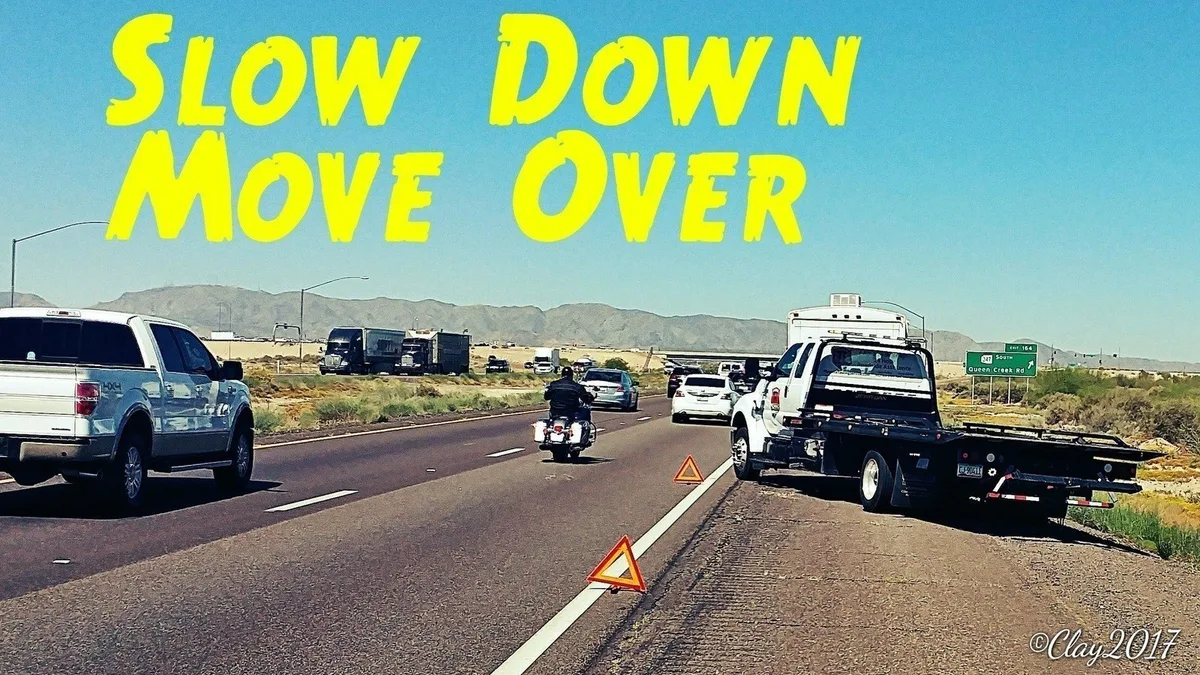
Image source: Bing (Web (fair-use with source credit))
Scenario 1: Multi-lane highway with open adjacent lane
You're driving on I-10 near Phoenix. You see a utility truck stopped on the right shoulder with amber lights flashing. The lane next to you on the left is clear.
Move over. Signal, check your blind spot, and change lanes. Once you're in the left lane, you can continue at normal speed.
The law is satisfied.
Scenario 2: Multi-lane highway with heavy traffic
Same situation, but traffic is heavy. The adjacent lane is full of cars moving at highway speed. You can't safely merge.
In this case, you slow down. Drop your speed to a reasonable and prudent level. The exact speed depends on conditions, but 10 to 15 miles per hour below the limit is a good target.
Scenario 3: Two-lane road
This is the tricky one. You're on a two-lane highway in rural Arizona. There's a utility truck on the shoulder.
You can't move over because there's no second lane in your direction. The oncoming lane has traffic. Your only option is to slow down.
Reduce your speed significantly as you pass the vehicle. Give the workers as much space as you can by moving toward the center line without crossing it.
In our research, this two-lane scenario is where drivers are most likely to get citations. Officers watch for drivers who blow past stopped utility vehicles at full speed on narrow roads.
Scenario 4: Multiple stopped vehicles
Sometimes you'll come across a line of utility trucks or a work zone with multiple vehicles. The same rule applies. Move over if you can, slow down if you can't.
The law applies to each stopped vehicle individually, but a single lane change or speed reduction that covers all of them is sufficient.
Step-by-Step: How to Handle a Stopped Utility Vehicle Safely
Let's make this practical. Here's exactly what to do when you see a utility vehicle with flashing amber lights ahead.
Step 1: Spot the vehicle early
Scan the road ahead, especially the shoulders. Look for flashing amber lights. On highways, big utility trucks are usually easy to spot.
On smaller roads, watch around curves and hills.
Step 2: Check your mirrors and blind spots
As soon as you see the vehicle, start checking for traffic beside and behind you. You need to know whether you have room to change lanes. Glance at your left mirror, your right mirror, and your rearview mirror.
Check your blind spot with a quick head turn.
Step 3: Decide move over or slow down
Based on what you see, choose your action. If the adjacent lane is clear, signal and change lanes. If the lane is occupied or there's no adjacent lane, prepare to slow down.
Step 4: Execute your action
If moving over, signal early, merge smoothly, and stay in the new lane until you've passed the vehicle. If slowing down, ease off the accelerator. Tap your brakes if needed to alert drivers behind you.
Do not slam on the brakes unless it's an emergency.
Step 5: Pass the vehicle
Pass the stopped utility vehicle at a safe speed and with as much space as possible. On multi-lane roads, staying in the non-adjacent lane is enough. On two-lane roads, move toward the center line without crossing it.
Step 6: Return to normal driving
Once you've passed the vehicle, you can return to your original lane if you moved over. Resume normal speed gradually. Don't accelerate hard right after passing.
There might be workers or equipment on the road.
Here's a quick summary table.
| Situation | Action | Notes |
|---|---|---|
| Multi-lane, clear adjacent lane | Move over | Signal and merge safely |
| Multi-lane, blocked adjacent lane | Slow down | Drop speed 10-15 mph below limit |
| Two-lane road | Slow down | Give wide berth, watch for workers |
| Multiple stopped vehicles | Move over or slow down | One action covers all if done properly |
| Construction zone with signage | Follow posted speed | Move over if signs direct you |
The most important thing is to plan ahead. If you see flashing lights from a distance, you have time to make a safe decision. Wait until you're right on top of the vehicle, and you'll be forced into a rushed reaction.
That's when mistakes happen.
Fines, Points, and Record Impact for Violations
Getting caught breaking the move over law in Arizona comes with real consequences. The state doesn't treat this as a minor infraction.
For a first offense, the base fine is typically around $250. Court costs and surcharges can push that higher. Expect to pay between $250 and $500 total when you factor in all the fees.
Repeat offenses carry steeper fines. The courts have discretion here, but you can expect the amount to increase significantly for a second or third violation within a three-year period.
You'll also get points added to your driving record. The Arizona Department of Public Safety assigns three points for a move over violation. Three points might not sound like much, but it adds up fast.
Accumulate eight points in any 12-month period, and the state can suspend your license.
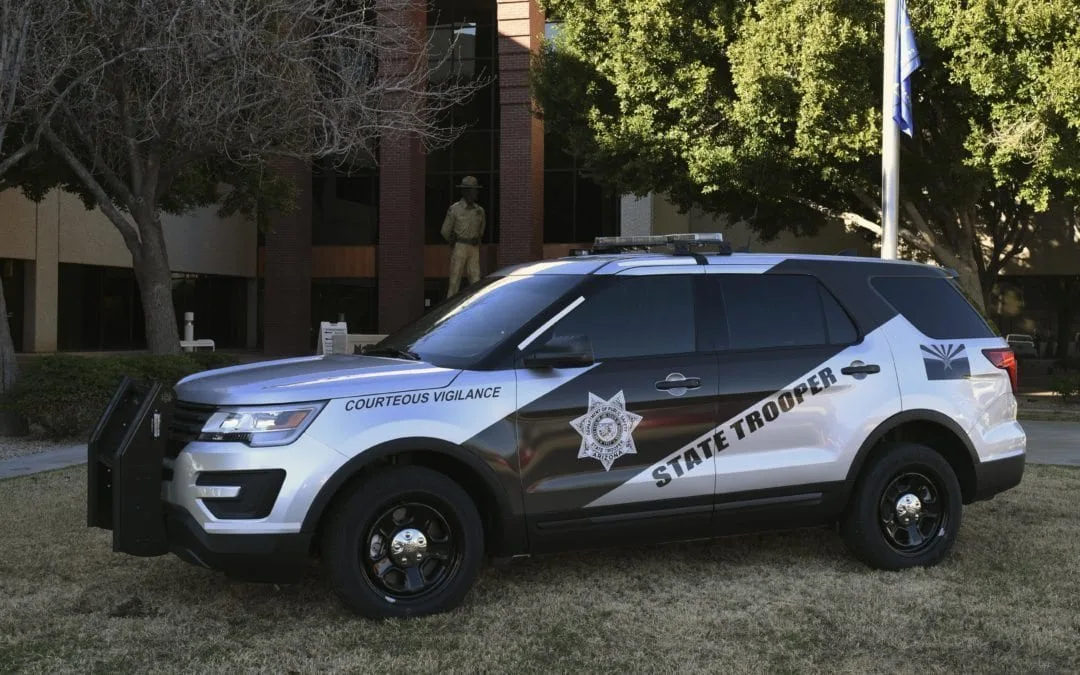
Image source: Bing (Web (fair-use with source credit))
There's another hidden cost. Insurance companies check your driving record. A conviction for a move over violation can raise your premiums.
Our research suggests the average increase is 15 to 20 percent for a single moving violation.
Some drivers can avoid the points by completing a defensive driving course. Arizona allows you to take a course through the Traffic Survival School program once every 12 months. This typically dismisses the citation if the court approves.
Check with the court listed on your ticket for eligibility.
For more tips on keeping your driving record clean, visit our Blog for regular updates on Arizona traffic laws and vehicle care.
Common Mistakes Arizona Drivers Make (And How to Avoid Them)
Mistake 1: Only moving over for red and blue lights
This is the most common error. Drivers assume amber lights mean "caution" not "legal requirement." Treat every flashing light the same way on Arizona roads. Move over or slow down regardless of color.
Mistake 2: Slowing down when they should move over
Some drivers slow down even when the adjacent lane is wide open. That's not wrong legally, but it creates confusion for drivers behind you. If you can safely change lanes, do it.
Signal, merge, and keep moving.
Mistake 3: Moving over when they should slow down
The opposite problem. A driver in heavy traffic forces a lane change into a space that's too small. That causes a chain reaction of braking.
If you can't merge safely, stay in your lane and reduce speed. Forcing a merge is more dangerous than slowing down.
Mistake 4: Waiting too long to decide
Spot the vehicle early. Make your decision early. Execute early.
Hesitation leads to sudden lane changes or hard braking. Both increase your risk of a collision.
Mistake 5: Forgetting about two-lane roads
On a two-lane highway, you can't move over. Some drivers panic and either stop completely or speed up to "get past" the vehicle. Neither is correct.
Slow down smoothly. Give the workers space by moving toward the center line.
Mistake 6: Not checking for utility vehicles in work zones
Construction zones often have multiple utility vehicles and workers present. The move over law applies in addition to any posted work zone speed limits. Follow both requirements.
Maintaining good visibility and clean windows helps you spot those lights sooner. Check out our guide on Pre Car Wash Spray for keeping your windshield clear in all conditions.
Real-World Scenarios: Two-Lane Highway vs. Multi-Lane Interstate
Let's put this into context with specific Arizona roads you might recognize.
Scenario: I-10 near Phoenix (multi-lane)
You're heading west on I-10 through the metro area. Traffic is moving at 65 mph. You see a utility truck on the right shoulder with amber lights flashing.
The lane to your left is open for at least a quarter mile. Move over. Signal, check your blind spot, and shift left.
Pass the truck. Merge back when it's clear.

Image source: Bing (Web (fair-use with source credit))
Scenario: State Route 87 near Payson (two-lane)
You're driving north on SR 87 toward Payson. It's a two-lane highway with oncoming traffic. You see a gas company truck on the right shoulder with amber lights flashing.
There's no second lane to move into. Oncoming traffic prevents crossing the center line. Slow down.
Drop your speed to 45 or 50 mph from the 65 mph limit. Pass the truck carefully. Watch for workers walking near the vehicle.
Scenario: I-17 near Camp Verde (two lanes each direction, heavy traffic)
You're on I-17 north of Phoenix. It's a busy Saturday with heavy traffic. A tow truck with amber lights is on the right shoulder.
The left lane is packed. You can't merge safely. Slow down.
Drop to 55 mph or lower if needed. Keep your eyes on the road ahead and the tow truck as you pass.
Night driving adds extra challenges. You might find our article on What To Expect In A Drive Through Car Wash helpful for understanding visibility issues in low light conditions.
FAQs About Utility Vehicles and the Move Over Law
What counts as a utility vehicle under Arizona law?
A utility service vehicle includes any vehicle used by a public or private utility company for services like electricity, natural gas, water, telecommunications, or cable television. It also includes tow trucks and road maintenance vehicles. The key requirement is that the vehicle must display flashing amber lights while stopped.
Do I have to move over for a utility truck with no lights on?
No. The law only applies when the vehicle has its flashing lights activated. That said, you should still give any stopped vehicle on the shoulder plenty of space.
A parked utility truck without lights may still have workers nearby or equipment on the road.
What happens if I can't safely move over or slow down?
The law requires you to take one of the two actions. If both are genuinely impossible due to road conditions, an officer has discretion. In practice, slowing down is almost always possible.
Even reducing your speed by 5 to 10 mph shows you made an effort to comply.
Can I take a defensive driving course to avoid a ticket?
Yes. Arizona allows drivers to take a Traffic Survival School course once every 12 months. If the court approves, completing the course can dismiss the citation and prevent points from being added to your record.
Check with the court listed on your ticket.
Does the law apply to all Arizona roads or just highways?
The law applies to all public roads in Arizona. Whether you're on a major interstate like I-10 or a small rural highway, the same requirement holds. The specific action you take depends on the road type and traffic conditions, but the legal obligation is the same everywhere.
Your Quick Reference Checklist for Every Drive
Use this checklist to build the move over habit.
- Scan the shoulder ahead for flashing lights of any color
- Identify stopped vehicles early, especially on curves and hills
- Check your mirrors and blind spot immediately
- Decide: move over if safe, slow down if not
- Signal early if changing lanes
- Reduce speed smoothly if staying in your lane
- Give workers and vehicles maximum space
- Resume normal speed only after passing safely
- Repeat the process for each stopped vehicle you encounter
Building awareness takes practice. After a few weeks, the response becomes automatic. You'll spot the lights, make the decision, and execute without thinking.
Knowing how to handle your vehicle in every situation is part of being a responsible Arizona driver. For related car care advice, check out our article on Manual Cleaning Equipment Using In Car Wash to keep your vehicle in top condition.
Stay safe out there.