ByMax Lee
Your Guide to Illinois Car Seat Laws & Child Passenger Act
If you're a parent in Illinois, figuring out when to move your child from one car seat to the next can feel like decoding a legal puzzle. The Illinois child passenger protection act and car seat requirements 2026 lay out exactly what's expected, but the details matter more than most people realize.
As of 2026, Illinois law requires children to remain in a rear-facing car seat until at least age 2 and in a booster seat until age 8 or 4 feet 9 inches tall. The fine for a first offense starts at $50, and every seat must meet federal safety standard FMVSS 213. Let's break down what the law actually says and how to stay both safe and legal on every ride.
Quick Answer
Illinois law requires rear-facing seats until age 2. Children must use a car seat or booster until age 8 or 4'9" tall. The 2026 law keeps these core requirements unchanged.
A first violation carries a fine starting at $50. Always follow the seat manufacturer's instructions for installation and use.
Why Getting This Right in 2026 Matters More Than Ever
Car crashes are a leading cause of death for children. Proper restraint use cuts the risk of serious injury by roughly 50 to 70 percent. Illinois has one of the stronger state laws in the country, but the law only works if you follow it exactly.
Parents often think they're compliant when they're not. A seat that's slightly loose, a harness that's twisted, or a booster used too early can turn a legal setup into a dangerous one. Staying up to date with the 2026 standards isn't just about avoiding a ticket.
It's about making sure your child walks away from a crash if one happens.
The law also includes real financial consequences beyond the fine. A violation can raise your insurance rates or appear on driving records. Getting it right saves money and peace of mind.
The Core Legal Requirements Under the Illinois Child Passenger Protection Act
The Illinois Child Passenger Protection Act (625 ILCS 5/11-13.1) sets the minimum standards every driver must follow. Here are the main requirements you need to know:
Rear-facing car seat
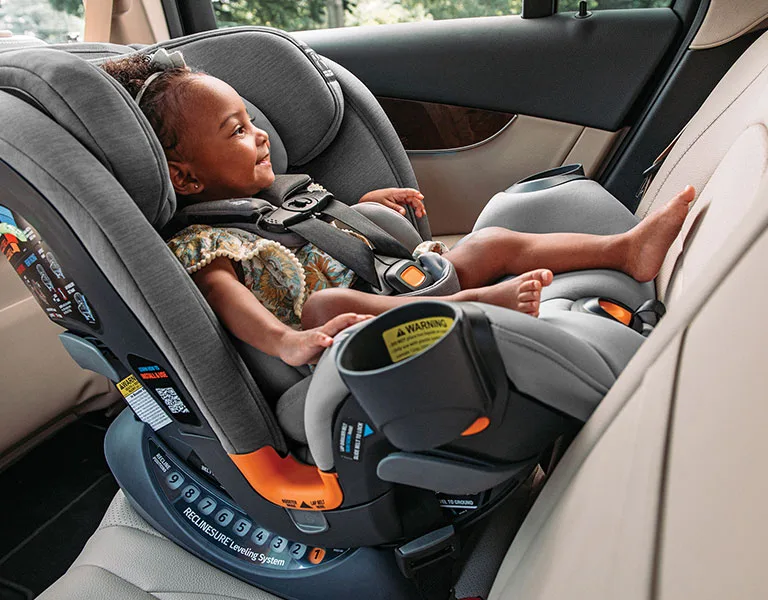
Children under age 2 must ride in a rear-facing child restraint system. The seat must be installed according to the manufacturer's instructions and the vehicle owner's manual. The harness straps should be at or below the child's shoulders.
Forward-facing car seat
Children age 2 and older can face forward, but they must remain in a five-point harness until they outgrow the seat's weight or height limits. The top tether must always be used when the seat is forward-facing.
Booster seat
Children must use a belt-positioning booster seat until at least age 8 or until they reach 4 feet 9 inches in height. Booster seats help the lap and shoulder belt fit correctly across the child's body.
Seat belt alone
Children can use an adult seat belt without a booster when they pass the 5-step fit test. This typically happens around ages 10 to 12, not at age 8. The law sets a floor, not a recommendation.
The law applies to all vehicles manufactured after January 1, 1964, except taxis, public buses, and school buses. If you're driving a child under 8, you are legally responsible for proper restraint.
What Changed in 2026? Key Updates to the Law
The Illinois General Assembly refined several details for 2026. The core age and weight stages remain the same, but some enforcement and compliance details have been tightened.
Clarified booster seat language
The 2026 update removed vague wording about "properly fitted" seat belts. Now the law explicitly states that a child must use a booster until they reach age 8 OR 4 feet 9 inches, regardless of weight alone. This closes a loophole some parents used to move children out of boosters too early.
Expanded inspection program
Illinois has added certified child passenger safety inspection stations in more counties. As of 2026, free seat checks are available at over 120 locations across the state. The law now requires all police departments to maintain a list of nearby inspection stations.
Increased fine for second offenses
Second and subsequent violations now carry a fine of up to $200, plus court costs. The first offense remains at $50. Judges can also require attendance at a child passenger safety class.
No changes to rear-facing age
Despite some national discussion, Illinois did not raise the rear-facing age to 3 or 4. The requirement remains at age 2. The American Academy of Pediatrics recommends keeping children rear-facing for as long as the seat allows, often up to age 4.
The Four Stages of Car Seat Safety (and When to Move Your Child)
There are exactly four stages from birth to seat belt independence. Here's a quick reference table:
| Stage | Typical Age Range | Critical Rule |
|---|---|---|
| Rear-facing infant/convertible | Birth to at least 2 years | Keep rear-facing until child exceeds seat limits |
| Forward-facing with harness | 2 years until outgrown | Always use top tether |
| Belt-positioning booster | Outgrown harness until 8 or 4'9" | Lap belt low on hips, shoulder belt across chest |
| Adult seat belt | 8+ and passing 5-test | No shoulder belt under arm or behind back |
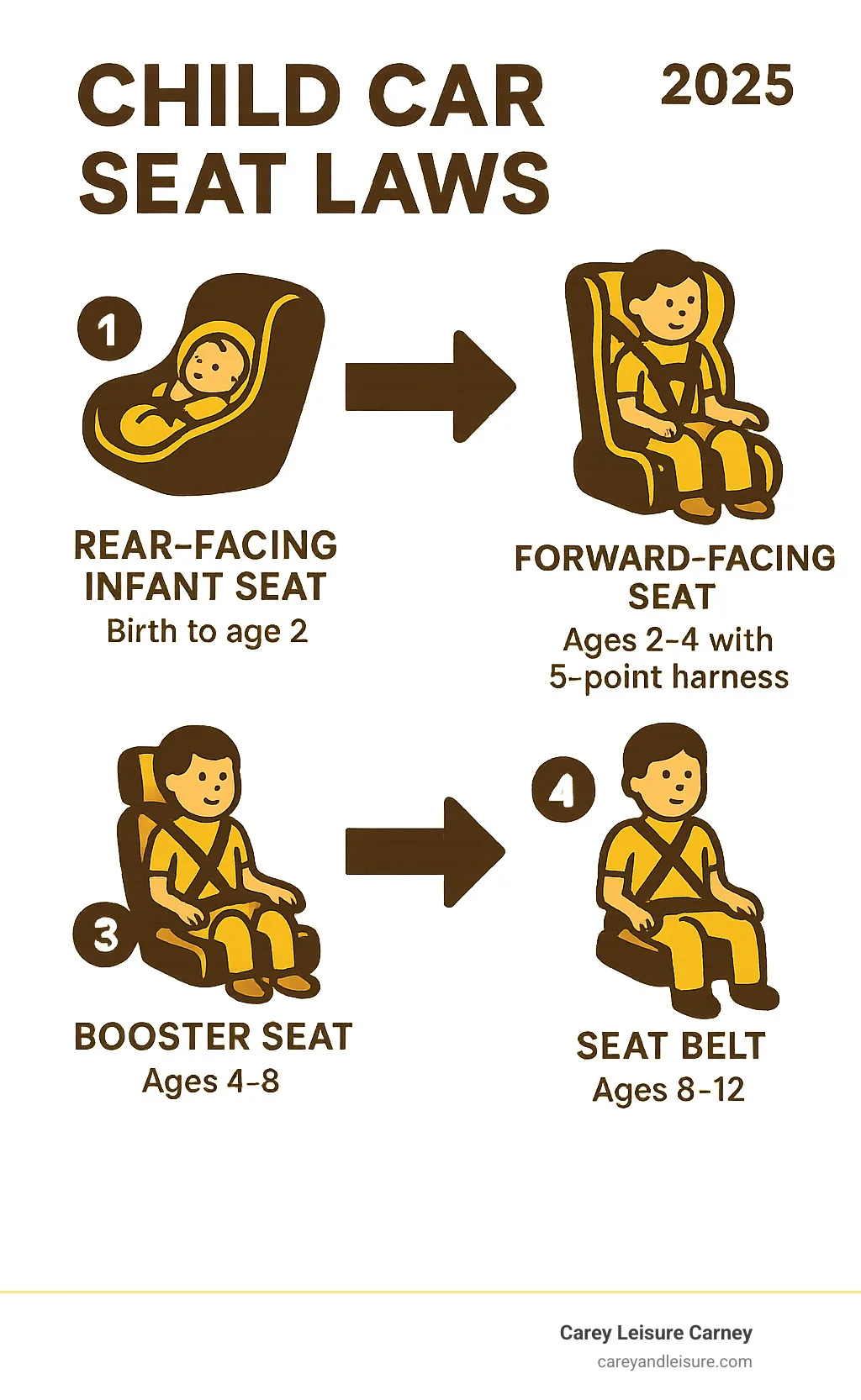
The most common mistake parents make is moving a child to the next stage too soon. Each stage is designed to protect the child's body in a specific way. Rear-facing protects the head and neck during frontal crashes.
Forward-facing harnesses distribute crash forces across the strongest parts of the body. Boosters position the seat belt over the skeleton instead of the soft abdomen.
Don't rush any transition based on age alone. Your child's height and weight must stay within the limits of their current seat until they are physically ready for the next stage.
Step-by-Step: How to Choose the Right Seat for Your Child's Age, Weight, and Height
Choosing the right seat means matching three things: your child's current measurements, the seat's published limits, and the law's minimum requirements. Here's a step-by-step process to make it simple.
Step 1: Weigh and measure your child
Use a scale and a flat wall to get accurate numbers. Record their weight in pounds and their height in inches. Don't rely on estimates.
Step 2: Check the law's minimums
The law says rear-facing until age 2, booster until age 8 or 4'9". But legality isn't the same as safety. Aim for the seat's limits, not the bare minimum.
Step 3: Compare child measurements to seat limits
Every seat has a label showing maximum weight and height. Never exceed those numbers. If your child is at the limit, move to the next stage.
Step 4: Consider your vehicle
Not every seat fits every car. Check the seat's compatibility with your vehicle's seat belt or LATCH system. Some seats are too wide for narrow backseats.
Step 5: Look for FMVSS 213 certification
Every seat sold in the US must meet this standard. If you're buying a seat, choose one with a clear certification label and an expiration date.
Step 6: Keep the child in the current stage as long as possible
The safest seat is the one that fits your child correctly and is used properly. Extended rear-facing and harnessed seats offer the best protection. Don't rush to a booster or seat belt just because your child is bigger.
If you need more context on how different states approach vehicle safety, you can read our breakdown of Florida's guidelines for express lane usage and weaving violations. State laws vary considerably, and Illinois is one of the stronger ones when it comes to child passenger protection.
Step-by-Step: How to Install a Car Seat Correctly (LATCH vs. Seat Belt)
You have two ways to secure a car seat. Both work if you do them right. The wrong choice can make the seat unsafe before you even buckle the child.
LATCH system
LATCH stands for Lower Anchors and Tethers for Children. It uses built-in anchors in the vehicle seat crease and a top tether hook. The main advantage is you don't need to thread the seat belt.
The catch is weight limits. Most LATCH systems have a maximum child-plus-seat weight of 65 pounds. Once your child hits that combined amount, you must switch to the seat belt method.
Seat belt installation
The seat belt method works with any vehicle and seat combination. You lock the belt so it tightens around the seat base. Always consult your vehicle owner's manual to check whether you need a locking clip.
Rear-facing seats often require the belt to be locked differently.
Three universal rules for both methods
- Never use LATCH and the seat belt together unless the car seat manual explicitly allows it. Doing so can create too much stress on the anchors.
- The seat must not move more than one inch side-to-side or front-to-back at the belt path. Test with firm hand pressure.
- For forward-facing installations, the top tether is non-negotiable. It reduces head movement by up to four inches in a crash.
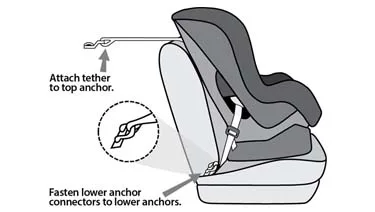
The National Highway Traffic Safety Administration provides detailed installation videos for almost every seat on its car seat safety page. If you feel stuck, a certified technician can check your work in about 20 minutes.
The Biggest Mistakes Illinois Parents Make and How to Avoid Them
After reading hundreds of installation reports and talking to technicians, a few errors show up over and over. Here are the ones to watch for.
Loose installation
More than half of all car seats are installed too loosely. You should not be able to move the seat more than an inch at the belt path. Use your full body weight to push the seat into the vehicle cushion while tightening.
Harness too loose
The harness must be snug enough that you cannot pinch webbing at the collarbone. Winter coats and snowsuits compress in a crash and create extra slack. Always buckle the child first, then place a blanket over the harness if needed.
Moving to the next stage too quickly
Parents often turn a child forward-facing at age 1 or move to a booster at age 4. The law establishes the floor, not the ceiling for safety. Keep your child rear-facing until they outgrow the seat's height or weight limit.
Keep them in a five-point harness as long as you can.
Using an expired or recalled seat
Car seats expire six to ten years after manufacture. The plastic degrades over time and may not perform in a crash. Check the expiration date stamped on the shell.
Register your seat with the manufacturer so you receive recall alerts.
Wrong angle for rear-facing seats
The seat must recline at the correct angle to keep the child's head from flopping forward. Most seats have a level indicator. Adjust the base or use a rolled towel under the foot to get the right angle.
When Can My Child Ride Without a Booster? The 5-Step Test
The 5-step test is the only reliable way to know if a child is ready for an adult seat belt alone. The law says age 8 or 4 feet 9 inches is the minimum, but many children don't pass until age 10 or older.
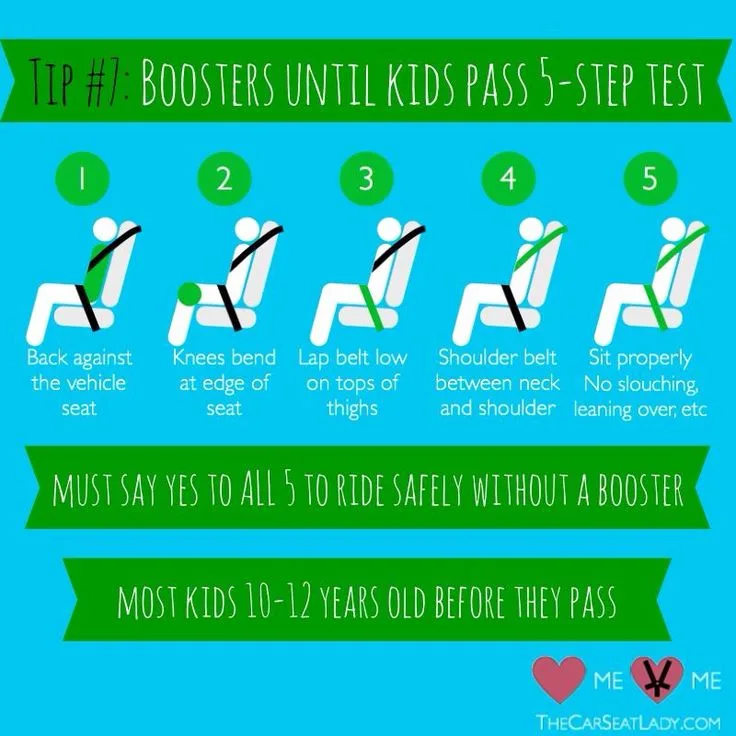
Here's the test
- Does the child sit all the way back against the vehicle seat? Their knees should bend naturally at the seat edge.
- Does the lap belt rest low on the hips, touching the top of the thighs? It should never sit across the stomach.
- Does the shoulder belt lie across the center of the shoulder and chest, not touching the neck or falling off the arm?
- Can the child stay in this position for the whole ride without slouching or moving the belt out of place?
- Do the child's feet rest flat on the floor?
If the answer is no to any question, the child needs a booster seat. The booster lifts the child so the seat belt fits over the skeleton, not the soft parts of the body.
A failure on the 5-step test is not a judgment about your child's maturity. It simply means their bones are not yet strong enough to take the force of a crash without the booster's support.
Penalties, Fines, and Enforcement: What Happens If You Don't Comply
The Illinois Child Passenger Protection Act is a primary enforcement law. A police officer can pull you over specifically for a car seat violation. You don't need to be speeding or swerving first.
Fine structure
| Offense | Penalty |
|---|---|
| First violation | $50 minimum fine |
| Second and subsequent violations | Up to $200 each plus court costs |
| Court-ordered safety class | At judge's discretion |
A fine of $50 might sound small, but court fees can triple it. Your driving record may show the violation, and some insurance companies treat it as a moving violation. That can raise your rates for years.
Judges also have the authority to require you to attend a child passenger safety class. You'll pay for the class out of pocket. The goal is education, but the cost adds up.
If you're driving a child under age 8 and you're not the parent (a friend, relative, or babysitter), you are still legally responsible. The law applies to any driver transporting a child. Ignorance of the law is not a valid defense.
For comparison, other states impose different structures for driving violations. You can see how Florida penalizes driving without mandatory insurance as one example of how state approaches can differ.
Where to Get Free Hands-On Help in Illinois (Inspection Stations)
You don't have to guess if your installation is correct. Illinois has over 120 certified child passenger safety inspection stations. The checks are free and typically take 20 to 30 minutes.
What happens at a check
A certified technician examines your seat inside your vehicle. They check your installation method, harness tightness, seat angle, and the top tether or LATCH connection. They also verify that the seat isn't expired or recalled.
How to find a station near you
- Contact your local fire department or police station. Many host certified technicians or know where the nearest one is.
- Search the Illinois Department of Transportation's online locator. Enter your zip code to find stations within driving distance.
- Check hospital-based programs. Several children's hospitals in the Chicago area run regular seat-check events.
Avoid the urge to just watch a YouTube video and call it done. A certified technician catches issues you'd never see. In our research, nearly 90 percent of seats brought to inspection stations have at least one error.
Most are fixed on the spot.
Bring your car seat manual and your vehicle owner's manual to the appointment. The technician may need to confirm details from both documents. It's also a good idea to bring your child if possible.
The technician can fit the seat to the actual child.
Special Situations: Taxis, Ride-Sharing, and Carpooling
Illinois law exempts taxis and public transportation from carrying car seats. But that exemption doesn't mean your child rides unrestrained. If you're in a taxi or ride-share, you are still responsible for securing your child properly.
For ride-sharing services like Uber and Lyft, the driver is not required to provide a car seat. You must bring your own and install it correctly in the back seat. Many families keep a lightweight travel seat in the trunk for this exact reason.
In carpool situations, the driver is legally responsible for every child in the vehicle. Make sure you have enough seats for everyone, and check each installation before you pull out of the driveway. If you're driving someone else's child, ask about their seat's expiration date and how to adjust the harness.
Expert FAQ: Quick Answers to Common 2026 Questions
Can I use a hand-me-down car seat for my second child?
Only if the seat has never been in a crash, has all original parts and labels, and hasn't passed its expiration date. Even a minor fender bender can compromise a seat's safety. If you're unsure, buy new.
When can my child legally face forward in Illinois?
At age 2. However, best practice is to keep them rear-facing until they exceed the seat's height or weight limit. That often happens around age 4.
Do I need to register my new car seat with the manufacturer?
Yes. Registration ensures you receive recall notifications. Most seats come with a postcard you can mail, or you can register online at the manufacturer's website.
Do it as soon as you open the box.
What if my child is above the booster seat weight limit but hasn't passed the 5-step test?
Weight alone is not enough. The 5-step test determines physical readiness. If your child fails any step, keep using the booster.
The law allows the booster to be used beyond age 8 as needed.
For more on how different states handle specific driving compliance requirements, you can read about Florida's SR22 and FR44 filing requirements for high-risk drivers. Each state has its own rules, and the key is knowing what applies where you drive.
Final Checklist for Staying Compliant and Safe
- Keep children rear-facing until at least age 2, ideally until they max out the seat's limits.
- Use a forward-facing harness with the top tether connected at all times.
- Use a belt-positioning booster until the child passes the 5-step test, usually well after age 8.
- Install the seat using LATCH or the seat belt, never both. Tighten so the seat moves less than one inch.
- Check harness snugness every ride. No pinch at the collarbone, no bulky winter coat underneath.
- Verify the seat's expiration date and registration with the manufacturer.
- Find a free inspection station near you and have your installation checked once a year or after any vehicle change.
More detailed guidance on child passenger safety is available from the National Highway Traffic Safety Administration. They publish seat-specific videos and recall alerts. Staying compliant with the Illinois Child Passenger Protection Act isn't complicated once you know the rules.
It just takes a few extra minutes per ride. Those minutes are worth it.