You’re turning left onto I-17 north of Phoenix with a loaded utility trailer behind you. The coupler pops off the ball. In that split second, only one thing keeps that trailer from crossing the median.
Your safety chains.
Arizona trailer towing safety chain requirements exist for exactly this moment. Most drivers don’t think about them until it’s too late. As of 2026, Arizona Revised Statute 28-983 sets clear rules for how those chains must be installed, sized, and attached.
The penalties range from fines to serious liability. Let’s cover what the law says and how to stay legal every time you tow.
Quick Answer
Arizona law requires at least two safety chains. They must cross under the trailer coupler. Chains attach to the tow vehicle frame or hitch.
Minimum chain diameter depends on your trailer’s weight. Use latch hooks instead of basic S-hooks. A violation is a class 2 misdemeanor.
Why Getting This Right Matters More Than You Think
Most people assume the coupler and ball do the real work. They do, until they don’t. A coupler can fail from rust, a worn latch, or a ball that’s the wrong size.
A pothole on US 60 near Globe can bounce a hitch ball right out of a worn coupler.
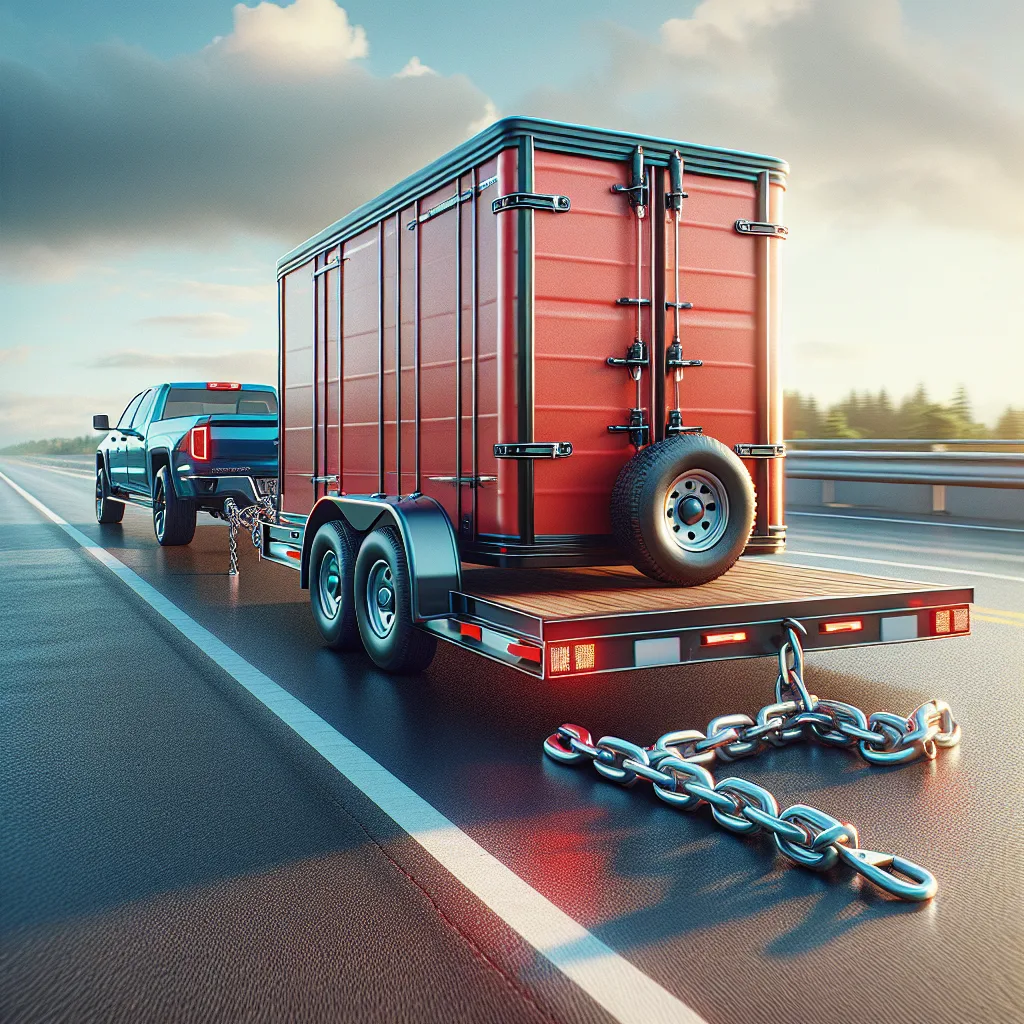
Safety chains are your backup plan. If the coupler separates, crossed chains catch the trailer tongue and hold it off the pavement. Without them, you get a runaway trailer at highway speed.
That’s not a ticket situation. That’s a crash situation.
Our research shows that most Arizona drivers cited for chain violations aren’t intentionally breaking the law. They simply don’t know the specifics. They assume “chains attached” is enough.
The law disagrees, and so does physics. A trailer that separates at 65 mph doesn’t care about good intentions.
Then there’s liability. If your trailer comes loose and damages another vehicle or hurts someone, missing safety chains can turn a bad day into a lawsuit. Arizona courts look at whether you followed the statute.
If you didn’t, you’re on the wrong side of negligence.
Check out our vehicle ownership guides for more on keeping your tow vehicle road legal.
The Actual Law: What ARS 28-983 Says (and Doesn’t Say)
Arizona Revised Statute 28-983 is your starting point. It’s not long or complicated, but the details matter.
The law says every trailer must have at least two safety chains. Those chains must connect from the trailer to the towing vehicle. They must cross under the trailer coupler.
And they have to attach to the vehicle frame or a component that’s part of the towing system. Hooking chains to the bumper, the ball mount itself, or any removable accessory is generally not allowed.
Here’s what the law does not specify.
- It does not give exact chain diameters or grades for every trailer weight. That comes from general safety standards and manufacturer specs.
- It does not say “you must cross the chains” in so many words. But the phrase “arranged so as to prevent the trailer coupler from dropping to the ground” effectively requires crossing.
- It does not exempt utility trailers, boat trailers, or RVs. The same rule applies to all.
The penalty for violating ARS 28-983 is a class 2 misdemeanor. That carries a fine up to $750 and potentially jail time. In practice, most citations land in the $100 to $250 range.
But if your uncoupled trailer causes an accident, that fine is the least of your worries.
Arizona DPS officers often check chains during routine traffic stops, at agricultural inspection stations, and at port-of-entry weigh stations for commercial trailers. They know what to look for.
What You Actually Need – Chain Types, Sizes, and Hardware
Not all chain is the same, and not every hook is legal.
Chain Diameter and Grade by Trailer Weight
You need chain strong enough to hold your trailer’s gross vehicle weight rating (GVWR), not just the empty trailer weight.
| Trailer GVWR | Minimum Chain Diameter | Recommended Grade |
|---|---|---|
| Up to 3,500 lbs | 3/16 inch | Grade 43 |
| 3,500 to 5,000 lbs | 1/4 inch | Grade 43 |
| 5,000 to 10,000 lbs | 1/4 inch | Grade 70 |
| 10,000+ lbs | 5/16 inch | Grade 70 |
Grade 70 chain has a higher working load limit for the same diameter. It costs more, but for heavier trailers it’s the right choice. The chain must be marked with its grade.
If you can’t read the markings, replace it.
Hook Types: Why Your S-Hooks Might Be a Problem
The hook that connects chain to vehicle frame is critical. S-hooks are common on cheap trailer wiring kits. They’re also dangerous.
An S-hook can bounce open on rough roads. Once it opens, the chain drops and your backup plan is gone.
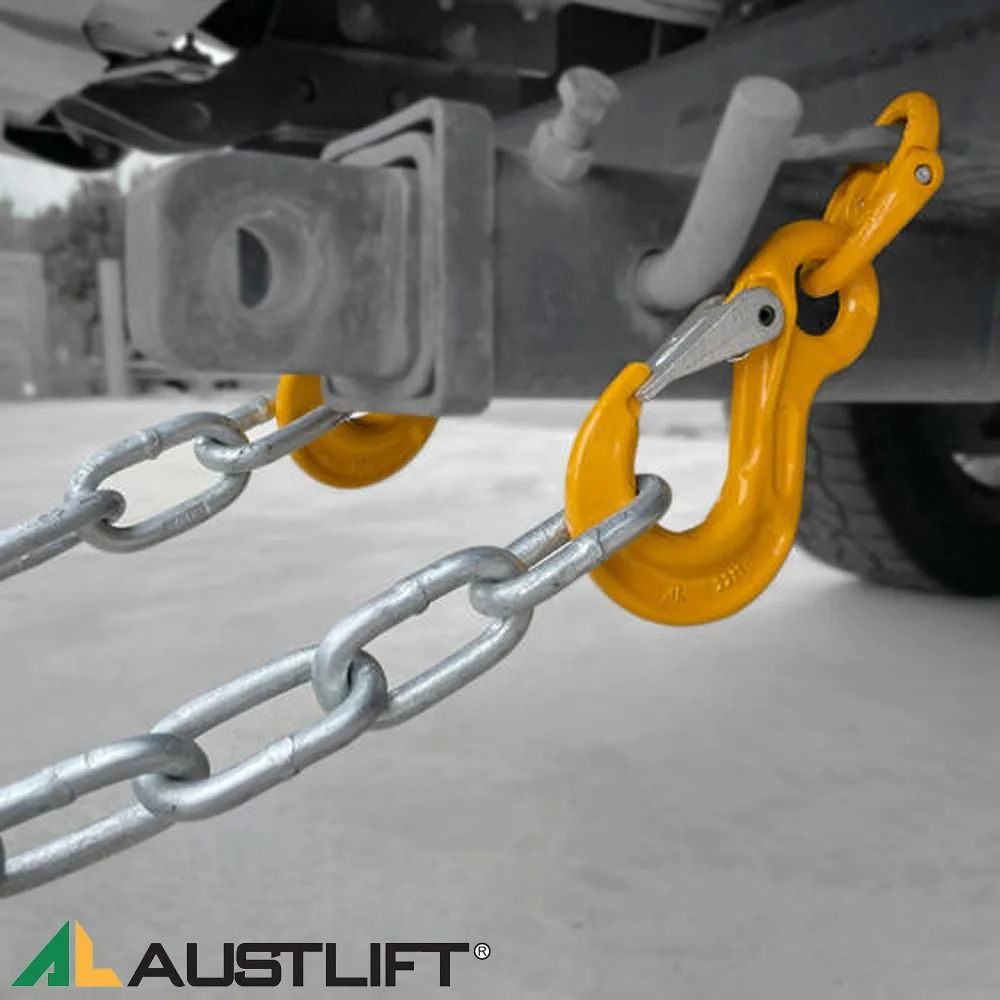
Latch hooks close completely and stay closed until you open them. They cost a few dollars more per set. That’s cheap insurance.
Many latch hooks include a spring-loaded gate that won’t open under tension.
Replace any S-hooks with latch hooks before your next trip. It’s a ten minute job and the safest upgrade you’ll make all year.
Chain length matters too. Too short and the chains bind in turns. Too long and they drag on the pavement, throwing sparks and wearing through links.
The ideal length lets the chains hang with a slight droop when the trailer is level. It also keeps the coupler no more than about six inches above the road if it comes off.
Step-by-Step: How to Attach Safety Chains the Right Way
This is where most people get it wrong. Even experienced towers sometimes skip a step.
- Step 1: Inspect your chains and hooks. Look for rust, cracked links, bent hooks, or worn latch springs. Replace anything questionable before you hitch up.
- Step 2: Hitch the trailer normally. Coupler on the ball, latch closed, pin inserted. Safety chains are your backup, not your primary connection.
- Step 3: Cross the chains under the coupler. Left side chain goes to the right side of the vehicle. Right side chain goes to the left. The crossing point should be directly under the coupler.
- Step 4: Attach hooks to the vehicle frame or designated points. Use the factory attachment holes on the hitch receiver or frame brackets. Never hook chains to the ball mount itself or the bumper.
- Step 5: Adjust slack. Remove any excess chain length. Use a chain shortening clip or wrap the chain around itself. The chains should have just enough slack to let the trailer turn fully without binding.
- Step 6: Secure loose ends. Tape or zip tie the excess chain end to prevent flopping.
- Step 7: Do a tug test. Pull forward a few feet with the brakes on. Make sure the chains don’t bind and the hooks stay secure.
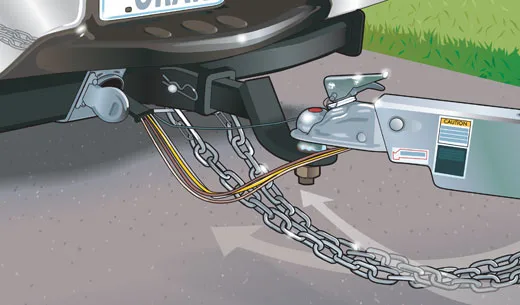
Seven steps, five minutes. Every time you tow, run through this checklist. It becomes automatic after a few trips.
If you don’t cross the chains, the trailer tongue can drop straight down and hit the pavement when the coupler fails. Crossed chains form a cradle that catches the tongue. This isn’t a style choice.
It’s the difference between a controlled stop and a crash.
Common Mistakes That Get People Ticketed (or Worse)
Based on what we’ve seen from roadside inspections and enforcement reports, these are the most common Arizona mistakes.
Not crossing the chains. This is number one by a wide margin. Left chain to left side, right chain to right side. That’s a straight attachment.
It fails the cradle test. Arizona law requires the crossing pattern.
Using chain that’s too light. A 3/16 inch chain on a 7,000 pound boat trailer is a disaster waiting to happen. Match chain diameter and grade to your trailer’s GVWR.
Hooking to the wrong point. The bumper, the ball mount, a welded tab that wasn’t designed for chains. Use the frame or factory attachment points on the receiver.
Forgotten connections. Some people skip chains on short trips to the dump or the hardware store. Short trips don’t get a pass from the law or from gravity.
Rust-covered hooks that won’t close. In Arizona, monsoon moisture and dust create surface rust. Hooks that don’t fully close can pop open. Clean and lubricate the hinge points every few months.
Chains that drag. Dragging chains throw sparks, wear down links, and can catch on pavement joints. Adjust length so the lowest point is at least a few inches off the road.
Overlooking the breakaway cable. If your trailer has brakes, the breakaway cable works with the safety chains. It activates the trailer brakes if the coupler separates. Route it separately so the chains and cable don’t tangle.
Our article on car shampoo for PPF covers a different topic, but the same idea applies. Small details make a big difference. Reading up on proper vehicle care habits helps you stay thorough with safety checks too.
Boat Trailers vs. Utility Trailers vs. RVs – Does It Change?
The short answer is no. Arizona law applies the same safety chain requirements to every trailer type. But the practical details shift depending on what you’re towing.
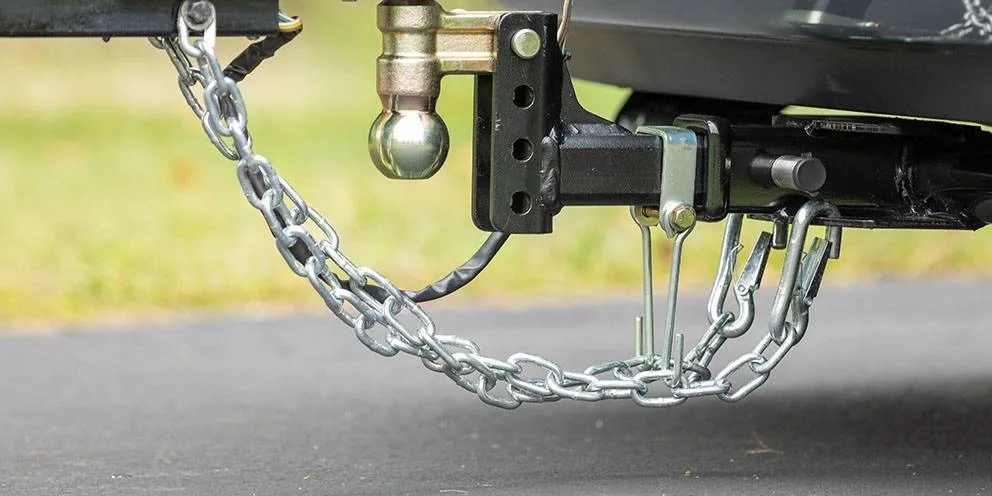
Boat trailers deal with constant water exposure. Chains rust faster. Hooks seize up.
The breakaway cable often corrodes at the connection point. Check these more often if you launch at Lake Havasu or Roosevelt. Saltwater launches are worse.
Rinse everything with fresh water after each trip.
Utility trailers face different problems. They bounce over rough job sites. Chains wear against frame members.
Dirt and gravel get into the links and accelerate wear. Many utility trailers use cheap S-hooks from the factory. Swap those out before you trust them with a heavy load.
RVs and travel trailers are heavier. The chains need to match that weight. Many RVs have a breakaway system that pulls a pin to apply the electric brakes.
Route the cable so it doesn’t tangle with the chains. If they tangle, neither system works the way it should.
Horse trailers deserve their own mention. They’re heavy, tall, and carry living cargo. The stakes are higher.
Use Grade 70 chain, latch hooks, and inspect everything before every trip.
For more on keeping your equipment in good shape, check out our guide on heavy equipment wash soap. It covers the basics of cleaning gear that spends its life in harsh conditions.
What Happens If You Get Pulled Over – Fines and Liability
Arizona DPS officers can inspect your trailer setup during a routine traffic stop, at a port of entry, or at an agricultural inspection station.
The citation for a safety chain violation falls under ARS 28-983 as a class 2 misdemeanor. The maximum fine is $750. Most drivers report fines between $100 and $250.
Court costs add to that.
But the fine isn’t the real cost. If your trailer separates and causes damage, injured parties can use your safety chain violation as evidence of negligence. In Arizona, negligence per se applies when you violate a safety statute.
You don’t get to argue that you were “careful enough.” You broke the law. The law assumes you were negligent.
Insurance companies take the same view. If your trailer comes loose and you weren’t properly chained, your insurer may deny coverage or raise your rates significantly. A $200 chain setup could prevent a $50,000 liability claim.
If you’re towing commercially, the stakes are higher. Commercial vehicle inspections include a full trailer equipment check. You can be placed out of service until the issue is fixed.
That costs you time and money far beyond the ticket.
Expert Tips for Arizona Conditions (Heat, Monsoon, Mountain Driving)
Arizona’s climate creates specific problems for safety chains.
Heat and expansion. Chain steel expands in the desert heat. A chain adjusted in the morning at 70 degrees may hang looser at 110 degrees in the afternoon. If you adjust for minimum slack in the morning, check it again when the pavement gets hot.
Monsoon moisture. July through September brings sudden downpours and high humidity. Chains develop surface rust fast in these conditions. Hooks that worked fine in June may be stiff by August.
Clean and lubricate your chains and hooks at least twice during monsoon season.
Dust and grit. Southern Arizona’s sand wears down chain links by acting as an abrasive. It also clogs latch mechanisms. Blow out your hooks with compressed air after off-road towing.
Mountain grades. If you tow up I-17 to Flagstaff or over the Mogollon Rim, your trailer puts extra strain on everything. Descending grades with a heavy trailer can cause the coupler to shift if your chains are too loose. Tighter chains give you more control in a failure scenario.
Sun damage. UV exposure degrades nylon webbing on breakaway cables and rubber boots on some chain attachments. Replace these every few years.
Our tips on manual cleaning equipment might seem unrelated, but the same logic applies. Maintenance prevents problems. A clean, well-lubricated hook is a safe hook.
Quick Safety Chain Checklist (Print This)
Before every tow, run through these checks. It takes two minutes.
- Chains are crossed under the coupler in an X pattern
- Hook type: latch hooks, not open S-hooks
- Hook attachment: secured to vehicle frame or hitch receiver, not ball mount
- Chain diameter: matches trailer GVWR (see table above)
- Chain grade: Grade 43 or 70, markings visible
- Slack: chains don’t bind in turns, don’t drag on pavement
- Rust and damage: no cracked links, no bent hooks, no corrosion
- Latch function: hook gates close fully and stay closed
- Breakaway cable: routed separately, not tangled with chains
- Test: tug forward after hitching, verify chains stay secure
Print this list and keep it in your glove box. Check every item every time.
Before every tow, run through these checks. It takes two minutes.
- Chains are crossed under the coupler in an X pattern
- Hook type: latch hooks, not open S-hooks
- Hook attachment: secured to vehicle frame or hitch receiver, not ball mount
- Chain diameter: matches trailer GVWR (see table above)
- Chain grade: Grade 43 or 70, markings visible
- Slack: chains don’t bind in turns, don’t drag on pavement
- Rust and damage: no cracked links, no bent hooks, no corrosion
- Latch function: hook gates close fully and stay closed
- Breakaway cable: routed separately, not tangled with chains
- Test: tug forward after hitching, verify chains stay secure
Print this list and keep it in your glove box. Check every item every time.
The Bottom Line on Staying Legal and Safe
Safety chains are not optional equipment. They are not a suggestion. Arizona law requires them, properly sized, crossed, and attached to the frame.
Skipping that step saves you thirty seconds and costs you hundreds of dollars at minimum.
The right setup is straightforward. Grade 43 or Grade 70 chain at the correct diameter for your trailer weight. Latch hooks that stay closed.
A crossing pattern under the coupler. Attachment to the vehicle frame. That’s it.
Check your chains before every trip. Five minutes of attention can prevent a crash that changes everything.
Frequently Asked Questions
Do I need safety chains for a small utility trailer in Arizona?
Yes. Arizona law requires safety chains on any trailer, regardless of size or weight. A small 4×8 utility trailer still needs at least two chains in the crossing pattern.
Can I use an S-hook instead of a latch hook for safety chains?
S-hooks are not recommended. They can bounce open on rough roads. Latch hooks close completely and stay closed under tension.
Replace S-hooks before your next tow.
What’s the penalty for not having safety chains in Arizona?
A violation of ARS 28-983 is a class 2 misdemeanor. The maximum fine is $750, but most citations range from $100 to $250 plus court costs. You may also face civil liability if the trailer causes damage.
How often should I inspect my trailer safety chains?
Inspect them before every trip. Look for rust, cracked links, bent hooks, and latch function. In Arizona’s climate, inspect more often during monsoon season and after off-road towing.
Do boat trailers need special safety chains?
The same law applies. But boat trailers need extra attention because of water exposure. Rinse chains and hooks with fresh water after each launch.
Check for rust and corrosion more frequently.
Can I attach safety chains to the hitch ball mount?
No. The law requires attachment to the vehicle frame or a component that is part of the towing system. The ball mount is removable and not considered a safe attachment point.
Use the factory holes on the hitch receiver or frame brackets.