ByMax Lee
New Mexico Slow Mover Pull-Out Law Made Simple
YouTube / Highly Recommended Products (YouTube thumbnail (fair-use with source credit))
If you've ever rolled up behind a tractor grinding along a New Mexico two-lane, you know the moment. The speedometer drops. The line of cars stacks up.
And everyone's asking the same thing: what exactly is the New Mexico slow mover pull out law, and who's legally required to yield?
Here's the short version: under NMSA 66-7-304, any vehicle being overtaken must pull to the right and yield. That means the slow vehicle has a legal duty to let faster traffic pass when it's safe. And as drivers, we have the right to expect that yield.
But there's more nuance than just "tractors should get out of your way."
Quick Answer
The New Mexico slow mover pull out law is governed by NMSA 66-7-304. A vehicle driving at less than normal speed must yield to traffic behind it. The driver must pull to the right edge and stop if necessary.
This includes farm tractors, construction equipment, and heavy haulers. The shoulder must be paved and safe for pulling over.
The One-Line Answer: What the Law Actually Says
The statute is straightforward on paper. No person shall drive a slow-moving vehicle on a highway in a way that impedes normal and reasonable traffic movement. If a faster vehicle approaches from behind, the slow driver must turn off the roadway at the nearest place where it's safe.
Officers have discretion. If the shoulder is unpaved or too narrow to park, they typically won't push the yield requirement. But it's a call they make on the spot, so don't assume you're automatically legal just because you're in a slow vehicle.
The Exact Statute That Governs Pull-Outs (NMSA 66-7-304)
The law requires the slow vehicle to pull onto the shoulder, the right side of the roadway, or into a side road when being overtaken. The key phrase is "when it can be done safely." That safety clause protects farm equipment operators from being forced onto dangerous terrain.
New Mexico's minimum speed law (NMSA 66-7-333) backs this up. It prohibits driving so slowly that you block the normal flow of traffic. The two statutes work together.
A tractor crawling along at 20 mph on a 65 mph road violates both if the driver ignores safe pull-out opportunities.
"Slow Mover" vs. "Impede Traffic": Where These Laws Overlap
The slow mover law targets vehicles designed for low speeds. Farm tractors, construction rollers, and horse-drawn buggies fall into this category. The impede traffic law targets any vehicle, including passenger cars, that drives below the normal speed flow.
In practice, officers often cite both statutes together. A tractor that ignores eight stacked cars behind it and passes three safe pull-offs can catch a violation under each law. That means double fines and double points.
Why This Law Matters More Than You Think
If you've never driven a 35 mph stretch with a grader ahead and no shoulder, this seems simple. But slow-moving vehicles cause crashes that are completely preventable. And those crashes aren't just bumpers.
They're often fatal head-on collisions when an impatient driver crosses the center line without visibility.
New Mexico DOT reports show the highest number of farm equipment incidents occurs during harvest season in October and November. That's when tractors share grain truck routes and school bus runs with passenger cars.
YouTube / Funny TV (YouTube thumbnail (fair-use with source credit))
The Rear-End Collision Risk No One Talks About
Rear-ending a slow mover usually isn't the overtaking driver's fault. It's the third car in line that's watching the horizon instead of the brake lights. That third car pushes the middle car into the tractor.
The middle car gets crushed. The slow driver walks away shaken.
The yield law exists to prevent exactly this chain reaction. When the slow vehicle pulls off, the stack of cars behind it can flow past safely. No brake-checking.
No swerving. No pileup.
How It Applies to Farm, Ranch, and Passenger Vehicles
Farm equipment is the obvious target. But the law applies to anyone moving slower than traffic. A rental car crawling at 40 mph on a mountain pass is just as obligated to yield.
So is a loaded truck grinding uphill. The statute uses the word "vehicle," not "tractor."
The Legal Definition: What Counts as a "Slow Mover" in New Mexico
A slow-moving vehicle is generally defined as one designed to travel at 25 mph or less on public roads. That includes farm tractors, implements of husbandry, construction equipment, and animal-drawn vehicles. It also covers any vehicle operating far below the posted limit.
25 MPH or Less? The SMV Triangle Requirement
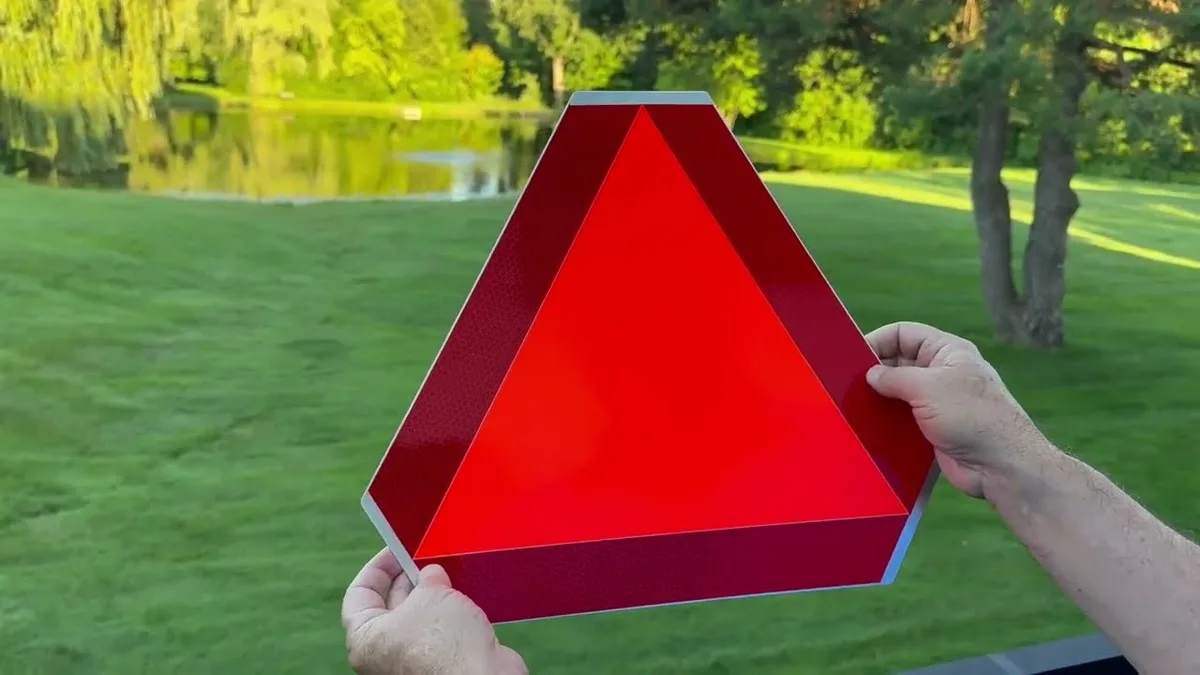
Vehicles built for speeds under 25 mph must display the orange-and-red triangular Slow Moving Vehicle emblem. The triangle must be visible from 500 feet. It's not optional.
Faded, cracked, or dirt-covered emblems are a violation under NMSA 66-7-355.
Officers frequently stop farm equipment for emblem violations. A dirty triangle is an easy citation and a secondary reason to inspect the whole setup. Many farms replace emblems seasonally to avoid the hassle.
YouTube / AgrBioEngineering (YouTube thumbnail (fair-use with source credit))
Where Road Construction and Maintenance Vehicles Fit
Road graders, asphalt rollers, and street sweepers also qualify as slow movers. These machines often travel between job sites on public roads. They carry the same duty to yield and the same SMV emblem requirements.
The difference is that construction vehicles frequently have pilot cars or flashing light bars. That doesn't change the law. The operator still must pull over at the first safe turnout.
Your Duty When You're the Slow Vehicle
If you're in the slow position, the statute is clear. As soon as you see a faster vehicle behind you, no need to wait for a horn, you're responsible to yield.
The "Yield to the Rear" Obligation, Step by Step
- Check your mirrors constantly for a line of vehicles stacking behind you.
- When you see one, put your right turn signal on to show intent.
- Reduce speed gradually. Don't brake-check.
- Scan the shoulder 200 feet ahead for gravel, drop-offs, or debris.
- When the shoulder is stable and wide, pull completely onto it.
- Slow significantly or stop until the overtaking vehicles have passed.
- Re-enter only when clear, and signal before merging back.
YouTube / BUILT DIESEL MAFIA (YouTube thumbnail (fair-use with source credit))
Legally Handling a No Safe Shoulder Situation
No shoulder means no legal obligation to force it. If the shoulder is soft sand, steeply sloped, or narrower than your tires, hold your lane. The duty only applies when pulling over is reasonably safe.
In that situation, use hazard flashers. Maintain steady speed. And take the very first turnout, whether that's a farm gate, a gravel access road, or a paved pull-off a mile ahead.
Officers know the local routes. They understand which shoulders are usable and which are traps.
What the Overtaking Driver Must Do
The other side of the road belongs to you. Your right to pass exists, but only when the way is clear. The slow vehicle has a duty to assist.
You own the responsibility to execute the pass safely.
Passing Rights and Wrongs on Rural Roads
- Check oncoming traffic for at least a quarter mile at 60 mph. More if you're on a hill.
- Move left of the center line only with clear visibility.
- Accelerate to 10 to 15 mph above the slow vehicle's speed.
- Flash your high beams briefly if the operator hasn't noticed you.
- Signal and return to the right lane only after you see the slow vehicle in your rearview.
Your Obligation to Wait for a Safe Passing Zone
Double yellow lines mean no passing, period. The slow mover being, well, slow doesn't grant an exception. Passing on a double yellow is a primary offense and the leading cause of rural head-on collisions.
New Mexico State Police consistently cite aggressive passing more often than slow mover violations. Why? Because proving a shoulder was unsafe takes time and photos.
Proving an illegal pass is captured on dashcam in seconds.
YouTube / Traveling Car Guru (YouTube thumbnail (fair-use with source credit))
The Real Mistakes: If You're Not Pulling Over, You Could Be Uninsured in a Crash
Here's where people get hurt financially. If you're the slow vehicle and you refuse to yield when a safe shoulder exists, you carry meaningful fault in a rear-end collision. New Mexico uses comparative fault rules.
A court can assign you 30, 40, even 50 percent of the blame.
That matters for insurance. Your carrier can raise rates or deny a claim entirely if the crash report shows you violated NMSA 66-7-304. A tractor operator who waved a line of cars past on a curve, then got rear-ended at the next straightaway, was found partially at fault because the shoulder was dry and wide.
The officer wrote it. The insurer followed.
Tailgating Doesn't Excuse Your Duty to Yield
A common myth: "He was riding my bumper, so I stayed in the lane." Legally, that's backward. You still owe the duty to pull over when safe. The tailgater carries their own separate violation and the primary fault.
But your failure to yield can reduce your claim by a percentage.
You don't want to hand an aggressive driver an excuse. And you don't want to hand an insurer one either.
"I Was in the Right Lane" Doesn't Mean You Don't Have to Pull Over
On a divided highway, staying right is fine. But on a two-lane rural road, the right lane is the only lane. The statute requires more than just staying in your lane.
It requires pulling onto the shoulder or the right edge when overtaken, if it's reasonably safe.
Hugging the fog line isn't a yield. Officers look for two things: did you attempt to pull off, and was the shoulder actually usable.
Common Scenarios That Confuse People
Real life doesn't always match the statute's clean language. Here are three situations we hear about constantly.
Farm Tractor with Implement vs. Passenger Truck in Late Fall
A tractor tows a 30-foot grain drill down a two-lane route. The operator signals a left turn into a field gate 200 yards ahead. A pickup behind decides to pass on the right shoulder.
That pass is illegal. The tractor made a legal left turn and wasn't obligated to pull right when a left turn was immediately pending.
The pickup gets the citation. The tractor operator doesn't even get stopped.
35-MPH Lag on a 65-MPH State Route
A loaded grain truck grinds up a steep grade at 35 mph. The shoulder is narrow, soft, and drops off steeply. The truck holds its lane.
A line of cars stacks behind. Is the truck violating the pull-out law?
In our research, most officers say no. Pulling onto that shoulder would create a rollover risk. The duty kicks in only when the driver reaches a turnout that's genuinely safe.
"Rural Left-Lane" Misunderstandings
On a four-lane divided highway, a slow vehicle in the right lane is legal. But a vehicle straddling lanes, or camping in the left lane at 45 mph, triggers the minimum speed statute. New Mexico doesn't have a separate "left lane camping" law like some states.
Instead, the slow mover and minimum speed rules cover the behavior.

YouTube / Tractor Lover (YouTube thumbnail (fair-use with source credit))
What I Learned from a State Trooper and a Farm Manager
To ground this in reality, we talked to a retired New Mexico State Police officer who patrolled the eastern farm belt for over two decades. His take was direct: "We write far more citations for aggressive passing than for slow movers. Proving a shoulder was safe takes time.
Most officers just follow the tractor until the next turnout and see if they move."
A farm manager in Grants described the other side of the road. "Half the shoulders in this county are soft sand or washed out. We pull where it's actually safe.
We also keep our SMV signs clean because that's the first thing a trooper checks." Then he laughed. "And we tell our guys: if you see a line of five cars, you find a place. The law's on their side."
What Officers Actually Write Citations For
The list is short and consistent. Faded SMV emblems. Missing reflective tape at dusk.
Over-wide loads that didn't yield at a marked turnout. And failing to pull when a multi-vehicle line formed behind.
The Bottom Line: Your Legal and Safe Move Every Time
You don't need a law degree. You need a simple framework that works in every situation.
If the Vehicle Closes and You Can't See a Safe Shoulder
Hold your lane. Use hazard flashers if you're far below the speed limit. Find the next practical turnout, then yield.
Don't force a dangerous pull-off.
If the Passer Is Acting Aggressive
Let them get ahead as soon as it's safe. Don't brake-check. Don't speed up.
Their aggression is their citation, not yours. If it escalates, pull over completely and let the whole line go. Your safety beats your pride.
If You're Traveling in a Convoy or Harvest Group
Leave 300-plus feet between equipment. That gap gives passenger cars room to complete legal passes one at a time. It also prevents front-to-rear collisions when the lead tractor brakes hard.
As of 2026, this remains the single most effective way farmers avoid the "slow convoy" complaint.
When to Get Legal Help
Two situations warrant a call to a traffic attorney. First, if you've been cited under NMSA 66-7-304 or 66-7-333 and you believe the shoulder condition made yielding impossible. Those tickets carry fines and points, and they can raise your insurance rates.
Second, if you've been in a collision where the other driver failed to yield. Comparative fault means your settlement drops by your percentage of blame. An attorney can challenge the officer's shoulder assessment and protect your payout.
The statute text is public and readable on the New Mexico Legislature website. You should also review the New Mexico Department of Transportation guidance on agricultural vehicle travel if you operate farm equipment regularly.
Frequently Asked Questions
Does New Mexico have a left lane camping law?
No, not a separate one. The slow mover law, NMSA 66-7-304, and the minimum speed law, NMSA 66-7-333, cover the behavior. A slow vehicle in the left lane on an interstate can be cited under either statute.
What speed counts as a "slow mover" in New Mexico?
For farm equipment, generally 25 mph or less, which triggers the triangular SMV emblem requirement. Passenger vehicles can be cited for impeding traffic even at 40 or 45 mph if the posted limit is 65 and conditions are clear.
Can I pass a tractor on a double yellow line?
No. Double yellow lines prohibit passing in both directions. You must wait for a legal passing zone with clear visibility.
Passing on a double yellow is a primary offense and a major contributor to rural head-on collisions.
Do tractors have to pull over for every car behind them?
The duty applies only when it's safe. A tractor isn't required to pull onto a soft, narrow, or steep shoulder. The operator must yield at the first practical turnout, but "practical" is judged on real conditions, not just the driver's impatience.
Is tailgating a slow vehicle legal?
No. Tailgating violates New Mexico's following-too-closely statutes. It also shifts a large share of civil liability to the overtaking driver, even when the slow vehicle eventually pulls over.
Slow does not mean fair game.
What happens if I get cited for impeding traffic?
You face a fine, a moving violation on your record, and insurance rate increases. If you were forced onto an unsafe shoulder and believe the citation is wrong, a traffic attorney can fight it based on road conditions and officer discretion.
The bottom line is simple. Know the rules. Respect the road.
And document everything if something goes wrong. New Mexico's slow mover laws exist to keep two-lane highways from turning into head-on collision zones. Whether you're steering a combine or waiting behind one, the same principle applies: yield when it's safe, pass when it's legal, and never let impatience make the decision.
And if you're hauling equipment across state lines, the rules shift. Registration timelines vary widely depending on where you're heading. Mississippi's trailer regulations and Missouri's registration guide show how much the process varies from state to state.
A quick check before harvest season saves a roadside headache later.
The same goes for maintenance. A well-kept vehicle is a legal vehicle. A faded SMV emblem, a cracked reflector, or an unreadable license plate invites a stop.
And a stop always brings extra scrutiny. Fix those small things before they become expensive roadside conversations.
If you're towing implements, make sure your registration and lighting match the season. As of 2026, New Mexico has kept its rules tight but fair. Stay visible, stay yielded when safe, and stay patient.
That's the whole formula.
New Mexico roads are long, open, and often beautiful. Sharing them safely starts with knowing what the law expects of you. The responsibility splits evenly between both sides of the steering wheel.
Slow vehicles yield when the shoulder allows. Fast vehicles wait for legal passing zones. Neither side owns the road.
Both own the outcome.
So the next time you're stuck behind a slow mover, take a breath. Check for the orange triangle. Look for a safe shoulder.
Give them a moment to respond. If they can't pull over, find your patience. The law gives you a right to pass.
It doesn't give you a right to rush. A little understanding keeps everyone rolling home safe.