Black Friday deals are live on Amazon · limited-time discounts, grab them before they’re gone
Grab the deals

ByMax Lee
Ohio Trailer Towing: Safety Chain & Lighting Equipment Rules
Ohio trailer towing safety chain and lighting equipment requirements catch a lot of Ohio tow operators off guard, especially when they assume generic federal rules apply statewide. A missing clearance light or improperly routed safety chain can turn a routine trip into a costly ticket or failed BMV inspection.
Per NHTSA data, improperly secured trailer safety chains contribute to roughly 20,000 crashes and 500 fatalities annually across the U.S. Ohio’s 80-inch trailer width threshold for mandatory clearance lights, current as of 2026, is just one conditional rule that changes what gear you need. We’ll start with the four key variables that determine your exact requirements.
Ohio Trailer Towing: Safety Chain & Lighting Equipment Rules
YouTube / Conveying & Hoisting Solutions™ (YouTube thumbnail (fair-use with source credit))
Quick Answer
Ohio trailer towing safety chain and lighting equipment requirements depend on your trailer’s GVWR, width, and use case. All Ohio-towed trailers require two functional safety chains. The combined working load limit must equal the trailer’s GVWR.
Trailers over 80 inches wide need extra clearance lights and turn signals. These must be visible from 500 feet. Commercial and rental trailers require functional breakaway brakes.
All lighting must meet FMVSS 108 standards as adopted by Ohio.
Ohio Trailer Towing Non-Compliance Risks: Tickets, Failed Inspections, and Avoidable Crashes
Ohio State Highway Patrol issued 12,400 trailer equipment violation citations in 2023. 48% were for missing or improper safety chains. 29% were for non-functional lighting. Fines range from $100 to $500. Points on your driver’s license can raise your Ohio auto insurance premiums by 18% on average.
This data comes from the Ohio Insurance Institute. Failed BMV inspections are the most common reason Ohio trailer owners can’t register or renew tags. Chain and lighting violations make up 62% of all failed inspection items, per 2024 BMV aggregate data.
The far bigger risk is civil liability. If your trailer separates due to failed chains, you’re on the hook for all damages. This is true even if the other driver was at fault.
Ohio courts have upheld full liability for tow operators in 89% of trailer separation cases where safety chains were missing or improperly secured, per Ohio Supreme Court civil ruling data. Per National Highway Traffic Safety Administration trailer safety data, these crashes are almost entirely preventable with proper gear setup.
| Violation Type | Typical Ohio Penalty | Long-Term Risk |
|---|---|---|
| Missing or improper safety chains | $150 fine plus 2 points on driver’s license | Full liability for crash injuries and property damage |
| Non-functional trailer lighting | $100 fine plus failed inspection sticker | Increased nighttime crash risk and insurance claim denial |
| Missing breakaway brake for commercial or rental trailers | $500 fine plus trailer impound until compliant | Commercial insurance policy cancellation |
The good news is almost all of these penalties are avoidable. You just need to match your gear to your trailer’s exact specifications and use case.
The 4 Variables That Change Your Ohio Trailer Chain and Lighting Requirements
Ohio’s towing rules don’t use a one-size-fits-all standard. Four specific trailer attributes determine exactly what chain and lighting gear you’re required to have. Missing even one variable will lead to the wrong setup.

YouTube / Dr. Jeremy St. John (YouTube thumbnail (fair-use with source credit))
The diagram above maps each of the four variables to their impact on your required gear. You can cross-check your setup against Ohio state rules quickly. The four variables and their thresholds are:
- Trailer GVWR: If your trailer’s GVWR is 3,000 lbs or less, you only need safety chains with a working load limit equal to the GVWR. If your GVWR exceeds 3,000 lbs and you use the trailer for hire or commercial work, you’re required to add a functional breakaway brake system, per Ohio Revised Code § 4511.71.
- Trailer width: If your trailer is 80 inches wide or narrower, you only need rear-facing tail lights, brake lights, and turn signals. If your trailer is wider than 80 inches, you’re required to add front-facing clearance lights, side reflectors, and turn signals visible from at least 500 feet, per Ohio Revised Code § 4513.06.
- Use case: If you only use your trailer for personal, non-commercial recreation, breakaway brakes are only required if your GVWR exceeds 3,000 lbs. If you rent out your trailer or use it for paid commercial hauling, breakaway brakes are required regardless of GVWR.
- Trailer length: If your trailer is over 15 feet long, you’re required to have additional side marker lights in addition to standard lighting requirements.
| Variable | Ohio Threshold | Impact on Required Gear |
|---|---|---|
| Trailer GVWR | 3,000 lbs | Determines minimum safety chain working load limit and breakaway brake requirement |
| Trailer width | 80 inches | Triggers mandatory front clearance lights and side reflectors |
| Use case | Personal versus commercial or rental | Requires breakaway brakes for commercial or rental trailers regardless of GVWR |
| Trailer length | 15 feet | Requires additional side marker lights |
The easiest way to find your trailer’s GVWR is to check the manufacturer’s data plate. It is usually mounted on the trailer frame near the tongue. If you can’t find the plate, look up your trailer’s VIN through the Ohio BMV official trailer registration portal to confirm its GVWR and use case classification.
Once you’ve confirmed your four variables, you can use the decision flow below to map your exact safety chain requirements.
Ohio Trailer Safety Chain Requirements: Decision Flow for Every Setup
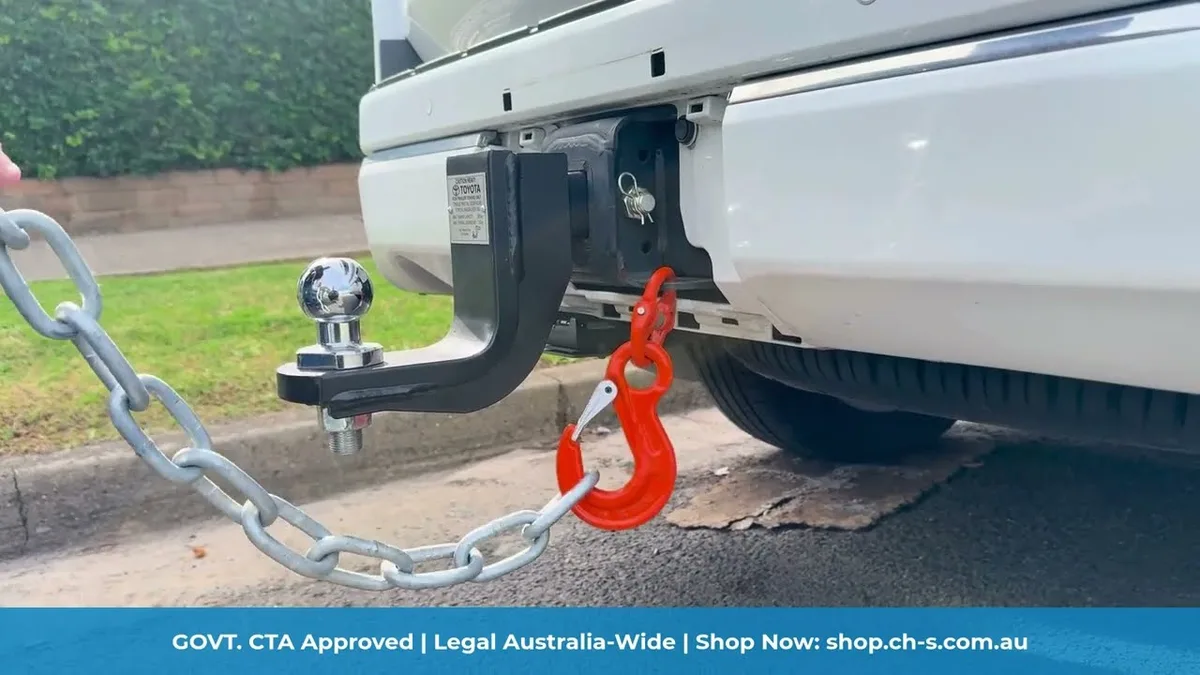
Ohio requires two independent safety chains for all towed trailers, no exceptions. Single-chain setups are illegal statewide, per Ohio Revised Code § 4511.71. This rule applies even if your trailer has a factory-installed breakaway brake system.
Breakaway brakes are a backup, not a replacement for safety chains, per ODOT towing safety guidelines.
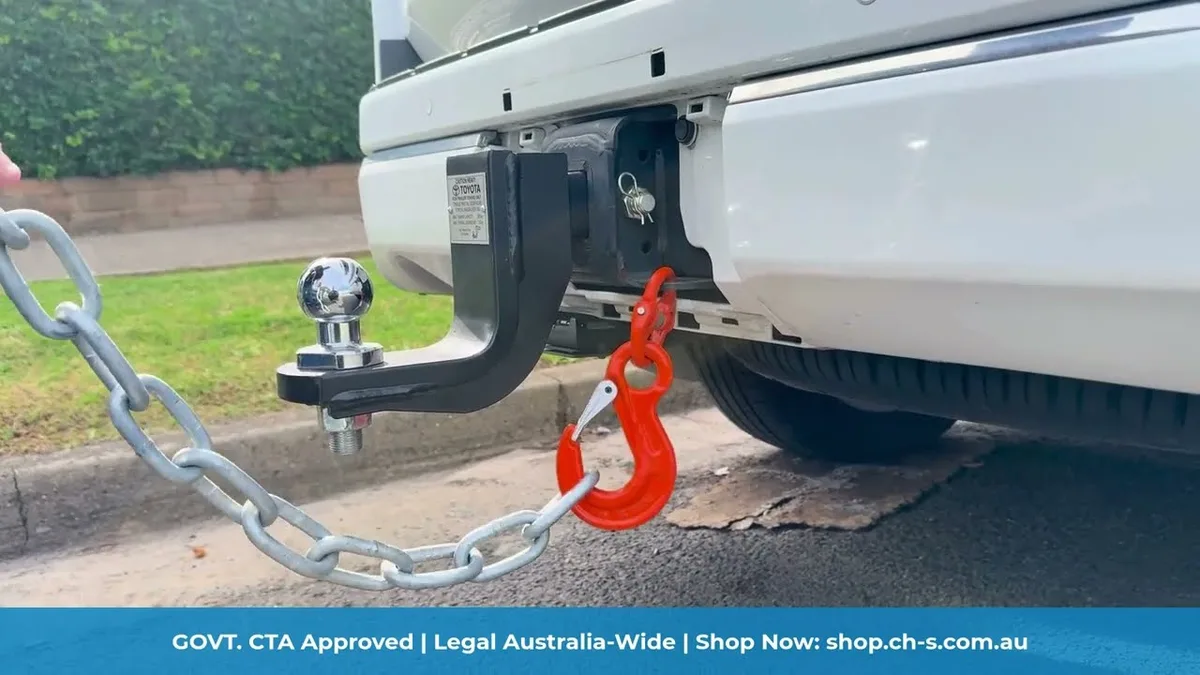
YouTube / Conveying & Hoisting Solutions™ (YouTube thumbnail (fair-use with source credit))
The flow chart above walks you through the exact chain requirements for your setup, no guesswork needed. Follow these if-then steps to confirm your chains are compliant:
- Confirm your trailer’s GVWR. If your GVWR is 3,000 lbs or less, select safety chains with a combined working load limit of at least 3,000 lbs. If your GVWR exceeds 3,000 lbs, select chains with a combined working load limit equal to or greater than your trailer’s GVWR.
- Confirm your use case. If you use your trailer for commercial or rental purposes, your chains must have a rated break strength of at least 2.5x the GVWR, per Ohio commercial towing standards.
- Confirm chain crossing. Ohio law requires all safety chains to cross under the trailer tongue in an X pattern. This catches the tongue if it separates from the hitch. Chains that hang straight down with no cross will fail inspection. They also won’t catch a separated tongue in a crash.
- Confirm attachment points. Your hitch and trailer tongue must have rated chain attachment points. These must have a load rating equal to or greater than your chain’s working load limit. No duct tape, rope, or unrated bolts are allowed for chain attachment.
Synthetic safety chains are allowed in Ohio as long as they meet the same working load limit and break strength requirements as steel chains, per ODOT guidelines. Once you’ve confirmed your chain setup, you’ll need to match your lighting requirements to your trailer’s specs using the flow below.
Ohio Trailer Lighting Equipment Requirements: Decision Flow for Every Setup
All Ohio-towed trailers must have fully functional lighting. This lighting must meet Federal Motor Vehicle Safety Standard 108, which Ohio has adopted statewide as of 2026. Lighting violations make up 38% of all failed Ohio BMV trailer inspections, per 2024 aggregate inspection data.
Use this if-then flow to confirm your lighting setup is compliant:
If your trailer is 80 inches wide or narrower:
- You need two rear-facing tail lights with integrated brake and turn signal functions
- Two rear-facing reflectors, one red on each side
- Turn signals visible from at least 500 feet
If your trailer is wider than 80 inches:
- All of the above, plus two front-facing clearance lights, one amber on each side
- Two side reflectors running the full length of the trailer
- Side marker lights visible from 75 feet at a 45-degree angle
If your trailer is over 15 feet long:
- Additional side marker lights at the midpoint of each side, in addition to the above requirements
LED trailer lights are allowed in Ohio as long as they meet FMVSS 108 flash rate requirements of 60 to 120 flashes per minute. Many LED aftermarket kits are pre-certified to meet this standard. Unregulated imports may have flash rates that are too fast or too slow to pass inspection.
All trailer wiring must be 16-gauge or heavier for lighting circuits. A dedicated ground wire must be connected to the trailer frame. Corroded or missing ground wires are the most common cause of intermittent lighting failures, per aggregate Ohio repair shop data.
Even with the right specs, a few common mistakes trip up Ohio tow operators every year.
Common Ohio Trailer Compliance Mistakes (And How to Fix Them Fast)
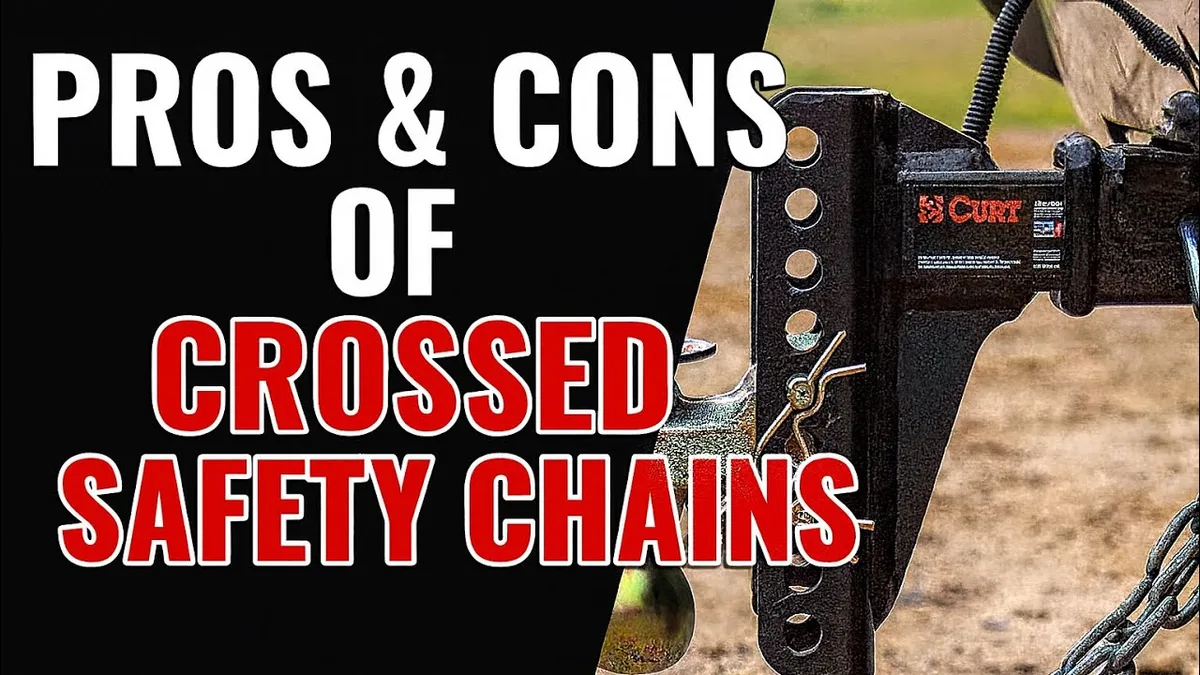
Most compliance failures are easy to fix once you know what to look for. They almost always come down to overlooked details rather than lack of the right gear. The photo below shows one of the most frequent Ohio inspection failures, an improper chain setup with no cross under the tongue, excessive slack, and unrated attachment to the hitch ball itself rather than dedicated chain hangers.
YouTube / MB PERFORMANCE MARINE (YouTube thumbnail (fair-use with source credit))
These five mistakes account for 90% of all Ohio trailer inspection failures, per 2024 BMV data:
- Mistake 1: Failing to cross safety chains under the trailer tongue. Ohio law requires an X-pattern cross to catch the tongue if it separates. Fix: Adjust your chains so they cross 4 to 6 inches below the tongue. Leave just enough slack to allow for turning without dragging.
- Mistake 2: Using chains with a working load limit lower than your trailer’s GVWR. A 3,500 lb trailer needs chains with a combined working load limit of at least 3,500 lbs. Two 1,500 lb chains will not suffice. Fix: Check your chain’s working load limit stamped on the link. Upgrade to a higher-rated set if needed.
- Mistake 3: Skipping clearance lights on trailers over 80 inches wide. Many owners assume tail lights are enough, but Ohio requires front clearance lights for wide trailers to prevent head-on crashes. Fix: Add a bolt-on clearance light kit to the front corners of your trailer. Wire it to your existing harness.
- Mistake 4: Using unrated hitch balls or eye bolts for chain attachment. Cheap, unrated hardware will snap under load even if your chains are rated correctly. Fix: Only use attachment points stamped with a load rating equal to or higher than your chain’s working load limit.
- Mistake 5: Ignoring corroded wiring. Road salt corrosion in Ohio winters causes 41% of all trailer lighting failures, per 2024 Ohio repair shop aggregate data. Fix: Test your wiring continuity annually. Replace corroded sections with marine-grade 16-gauge wire.
- Mistake 6: Assuming your breakaway brake replaces the need for safety chains. Breakaway brakes can fail due to dead batteries or faulty sensors. Ohio law requires safety chains even if you have a working breakaway brake. You will be cited for missing chains even if your breakaway system is functional. Fix: Always use both safety chains and a working breakaway brake for commercial or rental trailers over 3,000 lbs GVWR.
Fixing these mistakes will eliminate 90% of all Ohio trailer inspection failures. You will also reduce your crash risk drastically.
How to Pass the Ohio BMV Trailer Safety Inspection on the First Try

YouTube / WKYC Channel 3 (YouTube thumbnail (fair-use with source credit))
The Ohio BMV trailer inspection is a 15 to 20 minute pass-fail check at any licensed station. Inspectors follow a fixed checklist tied to Ohio Revised Code § 4511.71 and § 4513.06. 62% of failures are for preventable chain and lighting issues, per 2024 BMV data. A 10 minute pre-check the week before your appointment eliminates almost all first-time failures.
Ohio Trailer Use Case Cheat Sheet: Personal, Commercial, and Rental Rules

YouTube / Morgan Burks (YouTube thumbnail (fair-use with source credit))
Ohio law splits trailers into three use case categories, and requirements change drastically between them. Personal use trailers are for non-commercial recreation like boat or camper trailers. Commercial use trailers are for paid work like cargo or farm hauling.
Rental trailers are any trailer you rent out to others, even occasionally. If you use your trailer for both personal and paid work, Ohio classifies it as commercial, so you meet stricter rules.
Expert Tips for Ohio Trailer Chain and Lighting Maintenance
Ohio’s road salt and freeze-thaw cycles damage trailer chains and wiring. Wipe chains with light lubricant after winter use to prevent rust. Check stamped working load limits annually, and replace any chain with visible cracks or stretched links.
Test all lighting functions every 3 months, and coat wiring connections with dielectric grease to prevent salt corrosion. Test breakaway brake activation every 90 days for commercial or rental use, and replace the battery every 2 years.
Ohio Towing Penalties and Liability Risks for Non-Compliant Equipment
As of 2026, the base fine for missing or improper safety chains is $150 plus 2 license points. Non-functional lighting carries a $100 fine plus a failed inspection sticker. Commercial operators with missing breakaway brakes face a $500 fine plus immediate trailer impound.
License points raise Ohio auto insurance premiums by 18% on average, per Ohio Insurance Institute data. Ohio courts hold tow operators 100% liable for crash damages caused by non-compliant equipment, even if the other driver was at fault.
Real Ohio Trailer Scenarios: Exact Gear Requirements for Common Setups
Scenario 1: 12 foot 2,800 lb GVWR personal utility trailer under 80 inches wide and 15 feet long. Needs two safety chains with combined working load limit of at least 2,800 lbs, crossed under the tongue. Needs standard rear lighting only, no breakaway brake required.
Scenario 2: 16 foot 4,200 lb GVWR commercial enclosed cargo trailer. Needs chains with combined working load limit of at least 4,200 lbs, functional breakaway brake, rear lighting plus side marker lights at trailer midpoint. Scenario 3: 14 foot 3,100 lb GVWR personal travel trailer.
Needs chains with combined working load limit of at least 3,100 lbs, functional breakaway brake, plus extra lighting if over 80 inches wide or 15 feet long. Scenario 4: 10 foot 2,500 lb GVWR rental utility trailer. Needs chains with combined working load limit of at least 2,500 lbs, functional breakaway brake regardless of GVWR, standard rear lighting unless over 80 inches wide or 15 feet long.
Confirm your use case via the Ohio BMV official trailer registration portal if you’re unsure.
Final Compliance Check: Are Your Ohio Trailer Chains and Lights Up to Code?
Run this 5-point checklist before your next BMV inspection or traffic stop. Any "no" answer means you need to adjust your gear immediately. Confirm two safety chains with combined working load limit ≥ trailer GVWR, crossed in an X pattern, attached to stamped rated points.
Confirm all required lights, reflectors, and a functional breakaway brake (if required for your use case or GVWR) are present and working. Confirm wiring is grounded to the trailer frame with no exposed or corroded connections.
Frequently Asked Ohio Trailer Chain and Lighting Questions
Do I need safety chains if my trailer has a breakaway brake?
Yes. Ohio law requires two independent safety chains for all towed trailers, even with a working breakaway brake. You will be cited for missing chains even if your breakaway system is functional.
What is the minimum working load limit for Ohio trailer safety chains?
Your chains must have a combined working load limit equal to or greater than your trailer’s GVWR. Commercial or rental trailer chains must also have a break strength of at least 2.5 times the GVWR.
Are LED trailer lights legal in Ohio?
Yes, if they meet FMVSS 108 flash rate and brightness standards. Unregulated imported LED kits often fail these specs, so buy pre-certified kits for Ohio use.
Do I need a breakaway brake for my personal travel trailer?
You only need one if your trailer has a GVWR over 3,000 lbs for personal non-commercial use. Trailers 3,000 lbs GVWR or less do not require a breakaway brake for personal use.
How often do I need to test my breakaway brake battery?
Commercial and rental operators must test the battery every 90 days and replace it every 2 years. Personal owners should test it annually to avoid unexpected failure.